
Indo-Pacific Alliance Building Intensifies Amid China Pushback
The appearance of U.S. Department of Defense (DoW) visual information does not imply or constitute DoW endorsement.
Intelligence Summary
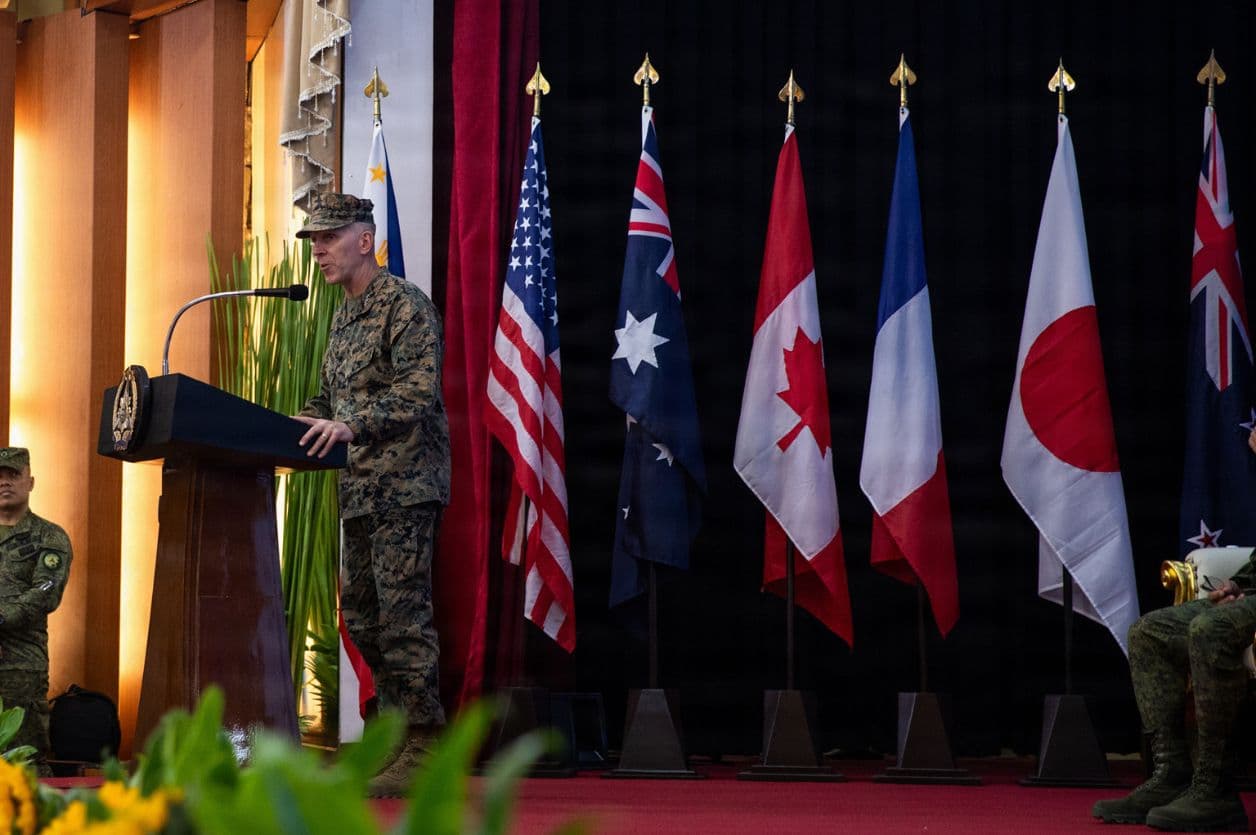
The United States and the Philippines began the Balikatan Exercise on April 20, 2026, described as the largest iteration of the annual drill. The exercise was scheduled to run from April 20 to May 8, 2026. The drill involved more than 17,000 troops. Japan participated with about 1,400 personnel, marking the first time Balikatan included a significant Japanese contingent. The opening ceremony took place at Camp General Emilio Aguinaldo in Manila on April 20, 2026, and included service members from the United States and the Philippines alongside personnel from Australia, Japan, Canada, France, and New Zealand.
Planned activities included live-fire drills in the northern Philippines facing Taiwan and in Palawan, an island province facing the disputed South China Sea. The timing of the exercise coincided with a fragile U.S.–Iran ceasefire described as due to expire on Wednesday unless extended, while the United States had committed more than 60,000 troops to the Middle East. Despite that Middle East force posture, U.S. strategy continued to emphasize alliance-building in Asia-Pacific, including a new security deal with Indonesia.
China’s Foreign Ministry condemned the Balikatan drills and framed them as harmful to regional stability and trust. Chinese Foreign Ministry spokesperson Guo Jiakun stated that the Asia-Pacific needed peace and tranquility and warned against division and confrontation linked to external forces. Guo also stated that military and security cooperation should not be conducted at the expense of mutual understanding and trust, should not target a third party, and could backfire for countries tying their security to others.
On April 21, 2026, Japan approved a major overhaul of defense export rules that lifted long-standing restrictions on exporting lethal weapons. Japan’s cabinet under Prime Minister Sanae Takaichi lifted the ban, and Takaichi stated that transfers of all defense equipment would in principle become possible under the amendment. Takaichi stated that recipients would be limited to countries that commit to use equipment in accordance with the UN Charter. Takaichi also stated that no single country could protect its peace and security alone, and that partner countries supporting each other through defense equipment were necessary.
The revised Japanese guidelines removed earlier category-based limits that had largely confined exports to rescue, transport, surveillance, warning, and minesweeping equipment. The new system allowed all defense equipment to be approved, subject to government screening and controls on transfers to third countries. Japanese newspapers indicated the change would encompass fighter jets, missiles, and warships, including platforms Japan had agreed to build for Australia. Japan’s Chunichi newspaper stated at least 17 countries would be eligible to buy Japanese weapons under the changes, with the list potentially expandable through additional bilateral agreements.
Japan’s policy shift followed a reported $7 billion Australia–Japan deal under which Mitsubishi Heavy Industries would build the first three of 11 warships for the Australian navy. The policy change was criticized by China, with Guo Jiakun stating China would remain highly vigilant and oppose what he called reckless militarization. Separately, reports indicated Prime Minister Takaichi sent a ritual offering to Tokyo’s Yasukuni Shrine during its spring festival, a site associated with sensitivities in China and South Korea due to enshrined convicted war criminals.
Why it Matters
These developments collectively signal a tightening military alignment structure in the Indo-Pacific that increases deterrence signaling while also raising escalation risk. The Balikatan exercise scale, its live-fire components, and its geography matter because they operationalize alliance commitments in areas directly adjacent to the region’s most sensitive flashpoints. Live-fire activity in the northern Philippines facing Taiwan and in Palawan facing the South China Sea demonstrates a practical focus on contested approaches, maritime access, and rapid reinforcement. The inclusion of multiple partner militaries at the opening ceremony further normalizes a coalition operating model, even when the core exercise remains U.S.–Philippines led.
Japan’s participation with a sizable contingent for the first time is strategically significant because it reduces the political and operational distance between Japan’s Self-Defense Forces and Southeast Asian contingency planning. This is not only symbolic. It creates habits of cooperation, shared procedures, and a more interoperable posture that can be leveraged in crises. China’s emphasis on eroded trust highlights that Beijing interprets these activities as more than routine training. The warning that such cooperation could backfire indicates an intent to shape regional perceptions and potentially deter smaller states from deepening defense ties with external powers.
Japan’s decision to lift long-standing restrictions on lethal weapons exports is a structural shift that can reshape regional defense supply chains. The move expands Japan’s ability to provide high-end capabilities, not just non-lethal support. The stated limitation to recipients committed to UN Charter use is important politically, but it still enables a broader set of transfers than before. The introduction of screening and third-country transfer controls suggests Tokyo is attempting to balance expansion with risk management, but the net effect is a larger Japanese role as an arms supplier.
The reported Australia warship deal and the explicit linkage to platforms such as fighter jets, missiles, and warships indicate that Japan’s export policy is being aligned with concrete industrial outcomes. This matters for deterrence because it can increase partner capacity and complicate adversary planning. It also matters for resilience because it can diversify procurement options for states that might otherwise rely heavily on U.S. or European suppliers. At the same time, it can intensify regional arms competition, especially if additional eligible countries pursue Japanese systems.
The U.S. ability to proceed with major Indo-Pacific exercises while maintaining a large Middle East troop commitment underscores a strategic message about global force management and prioritization. Even without additional details, the juxtaposition suggests Washington is signaling that Middle East demands will not fully displace Indo-Pacific alliance-building. That message can reassure partners, but it can also reinforce Chinese perceptions of encirclement or containment, increasing the likelihood of counter-moves such as more assertive military presence, coercive diplomacy, or intensified gray-zone activity.
Finally, the Yasukuni Shrine-related reporting matters because historical memory issues can become accelerants in security competition. Symbolic acts can harden public opinion and narrow diplomatic flexibility, especially in periods of heightened military activity. When combined with expanded exercises and arms export liberalization, such symbolism can be interpreted as part of a broader trajectory, making crisis de-escalation harder even when leaders seek it.
Stay Informed. Stay Ahead.