
Transitions and Strategic Realignments across South Asia, Europe, and Africa
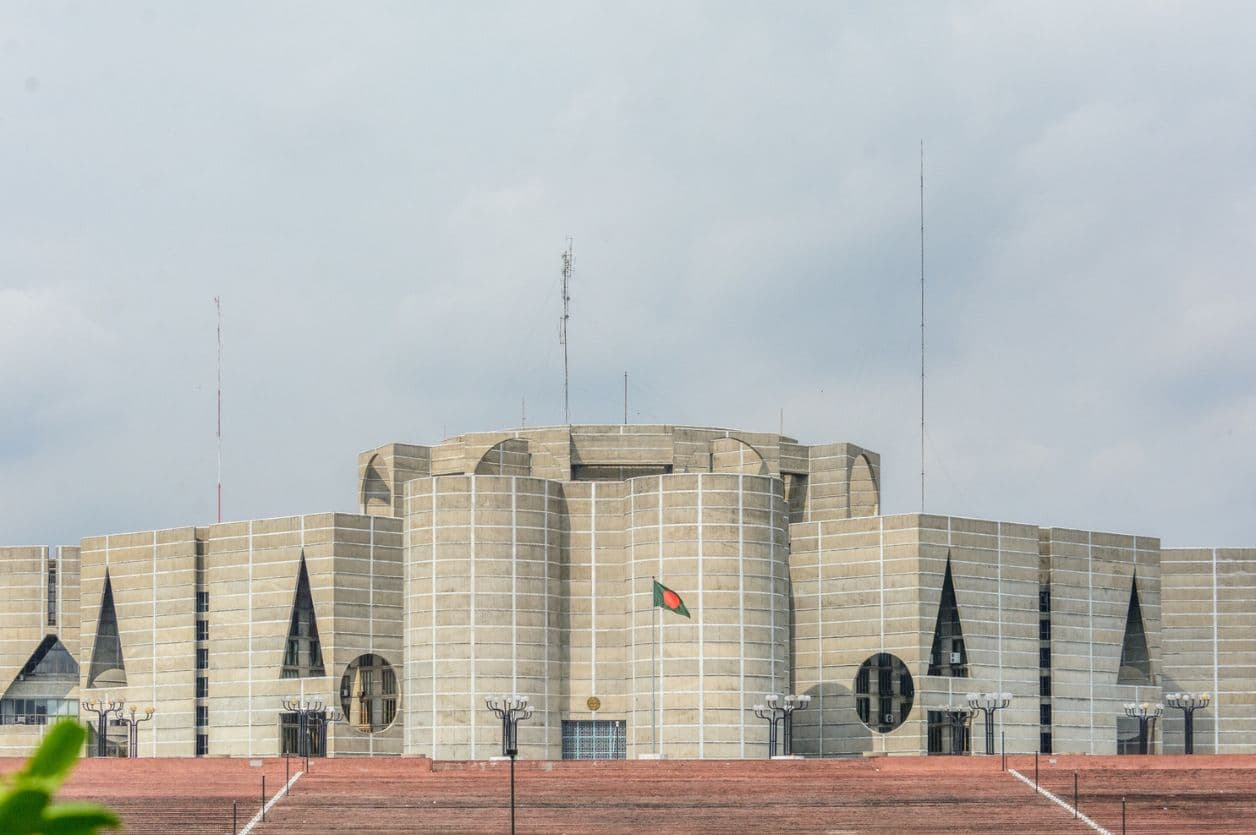
Parliament House of Bangladesh. Photo credit: iStockPhoto.com/Kabir Uddin
Intelligence Summary
Bangladesh completed a major political transition in mid-February 2026, marking the end of the interim administration led by Nobel laureate Muhammad Yunus and the beginning of a new government under Prime Minister Tarique Rahman. Yunus formally resigned on February 16, 2026, after overseeing the country’s first general election since the 2024 student-led uprising that toppled Sheikh Hasina’s government. The Bangladesh Nationalist Party (BNP), led by Rahman, secured a decisive victory in the February 12 election, winning at least 212 of 300 parliamentary seats, while Jamaat-e-Islami captured 77 seats to become the main opposition. The Awami League, Hasina’s long-dominant party, was barred from participating.
The new parliament and a Constitution Reform Commission were sworn in on February 17, 2026, formalizing the transfer of power. The election was accompanied by a national referendum approving the “July Charter,” a sweeping package of democratic reforms that included term limits for prime ministers, the creation of an upper house of parliament, expanded presidential powers, and greater judicial independence. The reforms, a central element of Yunus’s transitional agenda, must still be ratified by the new parliament. European Union observers described the election as credible and competently managed.
Rahman, aged 60 and heir to one of Bangladesh’s most influential political families, pledged to unify the country and consolidate democratic institutions after years of authoritarian rule. His government inherits a complex regional environment shaped by strained relations with India and renewed engagement with Pakistan. Since Hasina’s flight to India following the 2024 uprising, bilateral ties with New Delhi have deteriorated sharply, with suspended visa services, halted cross-border transport links, and reduced air connectivity. Indian Prime Minister Narendra Modi extended a cautious message of congratulations to Rahman, expressing hope for a democratic and inclusive partnership.
Analysts noted that India’s relationship with the BNP has historically been uneasy, citing the 2001–2006 BNP-Jamaat coalition period, which saw mutual mistrust, arms smuggling incidents, and stalled economic cooperation. During Hasina’s 15-year rule, India benefited from close security cooperation and alignment against insurgent groups, but her exile in Delhi and the BNP’s return to power have complicated this dynamic. Rahman has signaled a more independent foreign policy, declaring that Bangladesh will prioritize national interests over alignment with either India or Pakistan.
Dhaka has already moved to normalize relations with Islamabad, resuming direct flights between Dhaka and Karachi after 14 years and hosting the first Pakistani foreign ministerial visit in over a decade. Trade between the two countries rose by 27 percent in 2024–2025, and military exchanges have resumed. However, India remains Bangladesh’s largest trading partner in South Asia, and both sides continue to conduct joint military exercises and naval patrols.
In Europe, Hungary entered a critical pre-election phase as opposition leader Peter Magyar launched his campaign to unseat Prime Minister Viktor Orban after 16 years in power. Magyar, a former Fidesz insider who now leads the center-right Tisza party, announced his platform in Budapest on February 16, 2026, pledging to combat corruption, restore democratic institutions, and reorient Hungary toward Western Europe. Tisza, which won about 30 percent of the vote in the 2024 European Parliament elections, currently leads most national polls ahead of the April 12 general election.
Magyar has criticized Orban’s economic management, alleged corruption, and close ties with Russia, while promising to maintain border security and oppose accelerated Ukrainian accession to the European Union. He met several European leaders at the Munich Security Conference, emphasizing Hungary’s place within Europe and the need to regain access to suspended EU funds by strengthening judicial independence. Orban, meanwhile, has vowed to continue his campaign against what he calls foreign influence and “pseudo-civil organizations,” signaling a continuation of his nationalist agenda.
Separately, the United States expanded its military footprint in West Africa, with 100 of 200 planned troops arriving in Nigeria on February 16, 2026, to train local forces. The deployment follows a U.S. missile strike on December 25, 2025, targeting ISIS-linked militants in Sokoto State, though some missiles reportedly fell short and damaged civilian property. The Trump administration justified the mission as part of efforts to protect Christian communities, while Nigerian officials emphasized that violence affects both Muslim and Christian populations.
Why it Matters
The political transitions in Bangladesh and Hungary, alongside the U.S. military expansion in Nigeria, illustrate how domestic developments can reshape regional alignments and influence great power competition. Bangladesh’s democratic restoration under Tarique Rahman represents a major shift in South Asian geopolitics. The BNP’s return to power ends a 15-year period of Indian-aligned governance under Sheikh Hasina and introduces a leadership that seeks strategic autonomy. This recalibration could alter India’s security calculus along its 4,096-kilometer border with Bangladesh, particularly regarding counterinsurgency cooperation and cross-border intelligence sharing.
Rahman’s early outreach to Pakistan and emphasis on sovereignty signal a potential diversification of Dhaka’s foreign partnerships. Renewed Pakistan-Bangladesh engagement, including resumed flights and military exchanges, may reintroduce Islamabad as a regional actor in South Asia’s strategic balance. For India, this development raises concerns about losing influence in a neighboring state that has historically served as a buffer against Chinese and Pakistani encroachment. The BNP’s pragmatic approach, however, suggests Dhaka will seek to balance relations rather than pivot decisively away from India.
The July Charter reforms, if implemented, could strengthen Bangladesh’s institutional resilience and reduce the risk of future authoritarian consolidation. Yet the exclusion of the Awami League from the election and Hasina’s continued exile in India may sustain internal polarization. India’s management of Hasina’s presence on its soil will test its diplomatic agility, as overt support for her could be perceived in Dhaka as interference. The BNP’s large parliamentary majority provides an opportunity to stabilize governance, but the durability of reforms will depend on whether Rahman can maintain unity within his coalition and manage opposition from Islamist and nationalist factions.
In Europe, Hungary’s approaching election has implications for the European Union’s internal cohesion and its stance toward Russia. Peter Magyar’s challenge to Viktor Orban represents the most credible threat to Hungary’s illiberal trajectory in over a decade. A Magyar victory could realign Budapest with Brussels, potentially unlocking billions in frozen EU funds and reducing one of Moscow’s key political footholds within the EU. His campaign’s emphasis on transparency and judicial independence aligns with EU priorities, while his retention of border controls and skepticism toward rapid Ukrainian accession reflect a pragmatic balancing act designed to appeal to conservative voters.
Conversely, if Orban retains power, Hungary’s semi-detached position within the EU and NATO could persist, complicating collective decision-making on sanctions, defense integration, and support for Ukraine. The outcome will therefore influence the EU’s ability to present a unified front in its strategic competition with Russia and China.
The U.S. troop deployment to Nigeria underscores Washington’s growing focus on counterterrorism and influence projection in Africa. The mission expands U.S. Africa Command’s operational reach in the Gulf of Guinea, a region critical for maritime security and energy transport. However, the unconfirmed civilian damage from the December 2025 missile strike highlights the risks of escalation and potential backlash against perceived U.S. unilateralism. The framing of the intervention around religious protection narratives may also complicate relations with Nigeria’s multi-faith population and regional partners wary of sectarian framing.
Together, these developments reveal a global pattern of domestic political shifts intersecting with strategic competition. Bangladesh’s transition affects South Asian alignments, Hungary’s election could reshape EU cohesion, and U.S. actions in Nigeria demonstrate the persistence of military instruments in U.S. foreign policy. Each case underscores how internal political dynamics can reverberate across regional security architectures, influencing alliances, deterrence postures, and the balance of power among major states.
Key Actors
- Bangladesh
- India
- Pakistan
- Hungary
- European Union
- Nigeria
Stay Informed. Stay Ahead.