EU and Australia Forge Trade and Defense Partnership
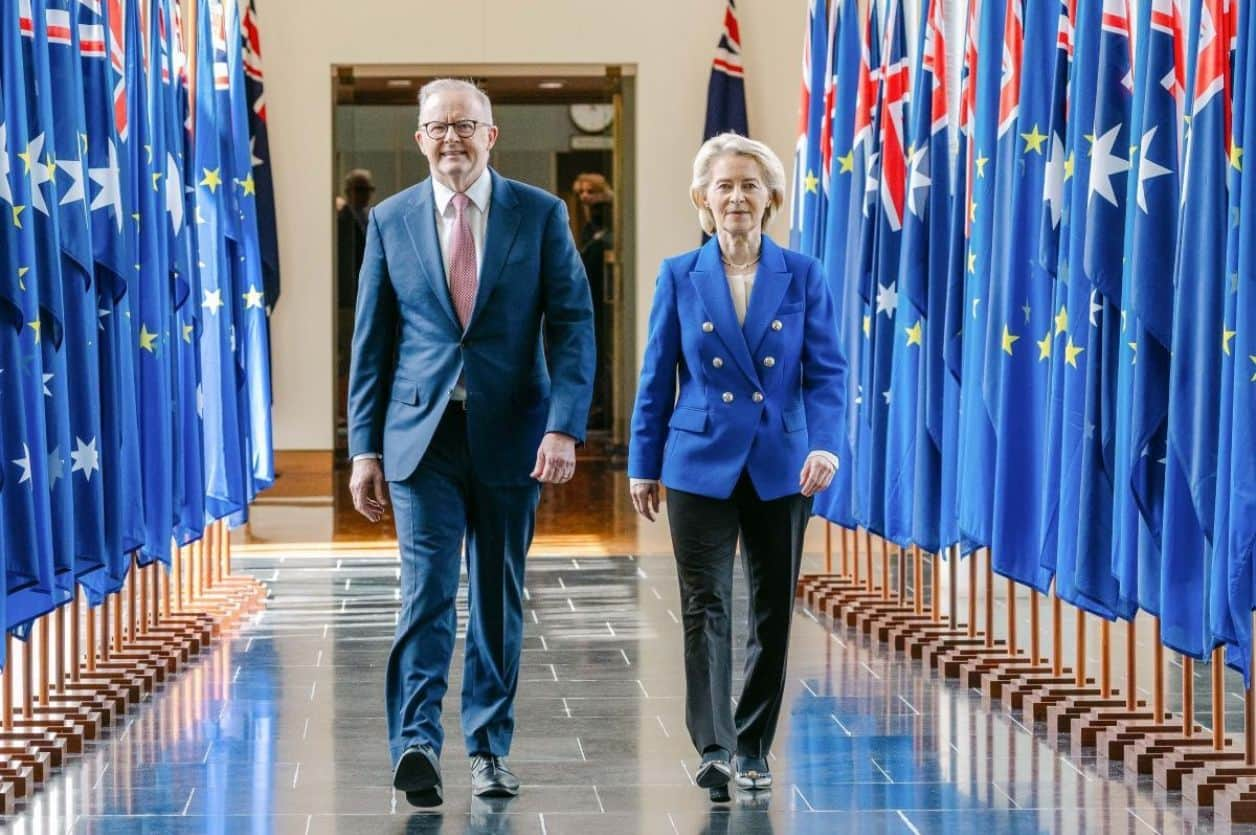
© European Union, 2026. Photo: Christophe Licoppe / European Commission Audiovisual Service.
Intelligence Summary
On March 24, 2026, the European Union and Australia concluded an eight-year negotiation process by signing a comprehensive free trade and defense partnership agreement in Canberra. The accord, valued at approximately 10 billion Australian dollars (7 billion US dollars), removes nearly all tariffs on goods traded between the two partners and establishes new frameworks for cooperation in defense, critical minerals, and research. European Commission President Ursula von der Leyen and Australian Prime Minister Anthony Albanese described the deal as a strategic milestone designed to strengthen collective resilience amid global instability and shifting power dynamics.
The trade component eliminates over 99 percent of tariffs on European exports to Australia, reducing duties by roughly 1 billion euros annually for European companies. Australian tariffs on European wine, fruit, vegetables, and chocolates will drop to zero immediately, while tariffs on cheese will be phased out over three years. European car manufacturers will benefit from Australia raising the luxury car tax threshold for electric vehicles, exempting about three-quarters of imported EVs from the tax. The agreement also opens the European market to Australian agricultural exports, including wine, seafood, and grains, with an estimated 37 million Australian dollars in annual savings for Australian wine producers.
The most contentious issue during negotiations involved agricultural quotas and the use of protected European product names. The final deal allows Australia to export 30,600 tons of beef to the EU under two tariff rate quotas, with 55 percent entering duty-free and 45 percent at a reduced 7.5 percent duty, phased in over five years. The EU will also permit 25,000 tons of Australian sheep and goat meat over seven years. Australian producers can continue using names such as parmesan and feta under grandfathering provisions, while the use of prosecco will be phased out for exports over a ten-year period.
Beyond trade, the agreement establishes a new defense and security partnership encompassing cooperation in counterterrorism, maritime security, space, and defense industry collaboration. The two sides also agreed to begin negotiations for Australia to join the EU’s Horizon Europe research and innovation program. The deal includes commitments to collaborate on critical minerals such as lithium and tungsten, aimed at securing supply chains and reducing dependence on China.
The EU’s decision to finalize this agreement reflects a broader strategic effort to diversify trade relationships and reduce exposure to both US tariff volatility and Chinese market dominance. The European Union is Australia’s third-largest two-way trading partner and its second-largest source of foreign investment, making the partnership economically significant for both sides.
In parallel, China has launched a sweeping trade initiative with Africa, eliminating tariffs on imports from 53 African countries effective May 1, 2026. This policy, announced by President Xi Jinping, is part of a broader strategy to strengthen China’s economic influence across the Global South and to position Beijing as a leading advocate of open markets in contrast to the protectionist policies of the United States. The initiative builds on the 2025 Changsha Declaration, which committed China to expand zero-tariff treatment to all African nations maintaining diplomatic relations with Beijing.
China’s approach combines unilateral tariff liberalization with framework agreements that cover trade, investment, digital economy, and technical assistance. By early 2026, China had signed framework agreements with 31 African countries and concluded early harvest arrangements with the Republic of the Congo and Kenya, granting duty-free access for selected goods. The policy aims to redirect African export flows toward China, deepen economic integration, and promote the yuan as a trade currency.
Together, these developments illustrate a global realignment in trade and alliance structures. The EU-Australia partnership strengthens Western economic and defense cooperation, while China’s Africa initiative expands its influence in the developing world. Both moves occur amid heightened geopolitical competition, energy insecurity, and the reconfiguration of global supply chains.
Why it Matters
The EU-Australia trade and defense partnership represents a significant recalibration of Western economic and strategic alignments in response to the erosion of traditional transatlantic cohesion and the intensifying rivalry with China. By removing nearly all tariffs and establishing frameworks for defense and critical minerals cooperation, the agreement strengthens the economic and security interdependence between two like-minded democracies. This partnership provides both actors with greater autonomy from the United States, whose tariff policies and shifting foreign priorities have introduced uncertainty into global trade governance.
Strategically, the inclusion of defense and critical minerals cooperation elevates the deal beyond a conventional trade agreement. The focus on lithium and tungsten directly addresses vulnerabilities in supply chains essential for defense technologies, electric vehicles, and renewable energy systems. This reflects a broader Western effort to secure access to strategic resources amid disruptions caused by the Middle East conflict and the global energy crisis. The defense partnership also signals a convergence of European and Australian security interests in the Indo-Pacific, where both actors face challenges from China’s expanding influence.
The EU’s diversification strategy mirrors a global trend toward regionalized trade blocs and selective decoupling from major powers. For Australia, the agreement mitigates the risks of overdependence on China, which remains its largest trading partner but also a source of political friction. For the EU, it offers a pathway to strengthen ties with a stable, resource-rich democracy while reducing exposure to US tariff volatility and Chinese market leverage. The inclusion of Horizon Europe cooperation further integrates Australia into European innovation networks, reinforcing long-term technological and scientific collaboration.
China’s simultaneous expansion of tariff-free access for African countries demonstrates a parallel but competing model of global economic integration. By offering zero-tariff treatment to 53 African nations, Beijing positions itself as a champion of the Global South and an alternative to Western-led trade systems. The framework agreements and early harvest arrangements allow China to shape trade norms and embed African economies within its own regulatory and financial systems. This approach enhances China’s geopolitical influence while promoting the yuan and securing access to African raw materials.
The juxtaposition of these two developments underscores the fragmentation of the global trade order into competing spheres of influence. The EU-Australia partnership consolidates a Western-aligned bloc emphasizing transparency, sustainability, and mutual defense, while China’s Africa initiative builds a Global South-oriented network emphasizing flexibility and asymmetrical reciprocity. Both strategies aim to secure supply chains, expand markets, and project influence through economic interdependence rather than direct confrontation.
In the context of ongoing energy insecurity and geopolitical instability, these trade realignments carry significant implications for global governance. They suggest a shift toward multipolar trade architectures where regional partnerships and resource security drive policy decisions. The EU-Australia deal strengthens Western resilience and strategic autonomy, while China’s Africa policy deepens its foothold in emerging markets. Together, they mark a decisive step in the reconfiguration of global economic power and the emergence of new patterns of alliance formation that blend trade, security, and technological cooperation.
Stay Informed. Stay Ahead.