EU Sanctions Israeli Settlers and Hamas Leaders
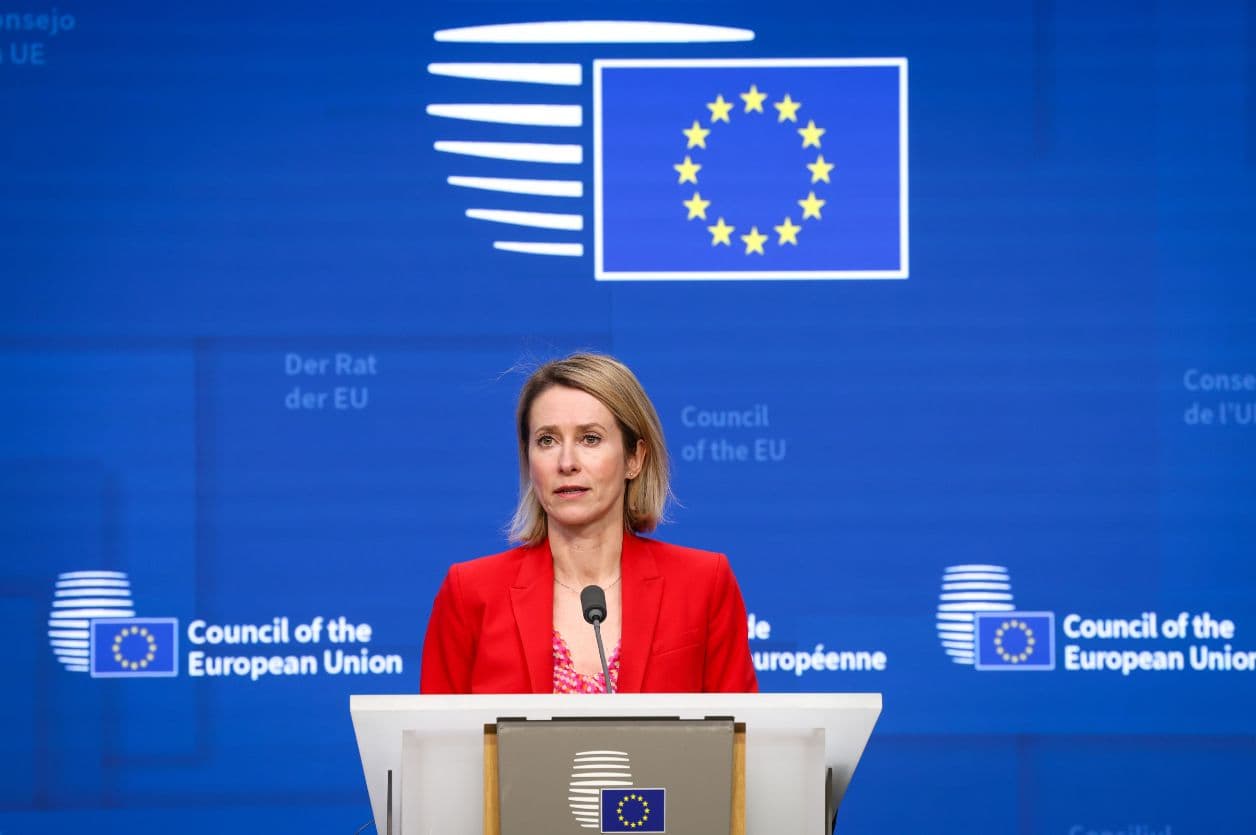
Council press conference in Brussels on May 11, 2026. European Union, licensed under CC BY 4.0.
Intelligence Summary
On May 11, 2026, the European Union’s 27 foreign ministers reached a unanimous decision to impose new sanctions on Israeli settlers and organizations involved in violence against Palestinians in the occupied West Bank, as well as on senior Hamas leaders. The decision followed months of internal EU deadlock, which was broken after Hungary’s new Prime Minister Peter Magyar lifted the veto previously maintained by former Prime Minister Viktor Orban, a close ally of Israel.
The sanctions package targets three individual settlers and four settler organizations accused of supporting or financing violent settlement expansion. Although the EU has not yet disclosed the full list, reports indicate that the organizations include Nachala, Regavim, HaShomer Yosh, and Amana, all of which have been linked to unauthorized outposts and settler violence. Individuals reportedly include Daniella Weiss, a prominent settler leader already sanctioned by the United Kingdom, and Meir Deutsch and Avichai Suissa, executives of Regavim and HaShomer Yosh respectively. The EU’s foreign policy chief Kaja Kallas stated that extremism and violence must carry consequences, while French Foreign Minister Jean-Noël Barrot emphasized that the sanctions target the main organizations responsible for violent colonization of the West Bank.
The EU also sanctioned Hamas leaders for their role in the October 7, 2023 attacks on southern Israel, which killed approximately 1,200 people and resulted in the abduction of 240 hostages. Barrot described the move as a necessary step to hold accountable those responsible for what he called the worst antisemitic massacre in modern European memory. The sanctions include asset freezes and travel bans, and mark the first time the EU has simultaneously targeted both Israeli and Palestinian actors in the same decision.
Israel’s government condemned the EU’s decision. Foreign Minister Gideon Sa’ar called the measures arbitrary and politically motivated, asserting that Israel would continue to defend the right of Jews to settle in what it considers its historical homeland. National Security Minister Itamar Ben Gvir accused the EU of antisemitism and vowed that settlement expansion would continue. The EU’s decision also reignited debate within the bloc over whether to ban imports from Israeli settlements, a proposal supported by several member states but not yet adopted.
In parallel, the EU and the United Kingdom jointly announced new sanctions on May 11, 2026, targeting Russian officials and institutions accused of deporting and indoctrinating Ukrainian children. The EU sanctioned 23 individuals and entities, while the UK imposed measures on 85 people and organizations, roughly one-third of which were linked to the deportation program. The EU described the deportations of nearly 20,500 Ukrainian children as grave breaches of international law. The sanctions targeted the Russian Centre for Military and Patriotic Training and Education of Youth, known as the “warrior centre,” and Yulia Sergeevna Velichko, the Moscow-installed youth minister in the Luhansk region.
The United States also expanded its sanctions regime on May 11, 2026, announcing measures against three individuals and nine companies for facilitating Iranian oil shipments to China. The targeted entities included four firms in Hong Kong, four in the United Arab Emirates, and one in Oman. The U.S. Treasury stated that these companies acted as front organizations for Iran’s Islamic Revolutionary Guard Corps (IRGC), which used them to sell oil and move funds through shell companies. Treasury Secretary Scott Bessent said the sanctions aimed to deprive Iran of revenue for its weapons and nuclear programs. The State Department also offered a $15 million reward for information disrupting IRGC financial networks.
India’s energy policy was also affected by sanctions enforcement. In late April 2026, India declined to accept a liquefied natural gas (LNG) shipment from Russia’s U.S.-sanctioned Portovaya plant, leaving the tanker stranded near Singapore. The decision was conveyed to Russian Deputy Energy Minister Pavel Sorokin during his April 30 meeting with Indian Petroleum Minister Hardeep Singh Puri. India’s refusal underscored its effort to balance energy security with compliance risks amid U.S. sanctions. While India continues to import Russian crude under temporary waivers, it has avoided sanctioned LNG cargoes, which are harder to disguise than oil shipments.
Why it Matters
The coordinated expansion of sanctions across multiple theaters, Israel-Palestine, Russia-Ukraine, and Iran-China, illustrates the consolidation of economic coercion as a central instrument of Western strategic policy. The EU’s decision to sanction Israeli settlers and Hamas leaders represents a significant shift in its Middle East posture, signaling a willingness to apply punitive measures to both state-aligned and non-state actors. This dual approach reflects growing European frustration with escalating violence in the West Bank and Gaza, as well as a desire to reassert the EU’s normative authority on international law and human rights.
The sanctions on Israeli settlers are particularly consequential because they challenge Israel’s long-standing immunity from European punitive measures. By targeting organizations such as Regavim and Nachala, the EU is directly addressing the infrastructure of settlement expansion rather than isolated individuals. This could strain EU-Israel relations, especially as Israel’s current government includes pro-settler factions that view such measures as attacks on national sovereignty. The move also exposes divisions within the EU, as some member states, notably Italy and Sweden, have called for broader trade restrictions, while others remain cautious about jeopardizing diplomatic and security cooperation with Israel.
The simultaneous targeting of Hamas leaders underscores the EU’s attempt to maintain balance and avoid accusations of bias. However, the inclusion of both sides in the same sanctions package may complicate diplomatic engagement, as it equates state-linked and non-state actors under a single punitive framework. This could limit the EU’s ability to act as a mediator in future peace efforts, particularly if Israel and Hamas both reject European involvement.
The sanctions on Russian officials for the deportation of Ukrainian children reinforce the EU and UK’s commitment to accountability under international law. By coordinating with Canada and the United States, the measures demonstrate a unified Western front. The inclusion of institutions involved in alleged indoctrination and military training highlights the growing intersection between human rights enforcement and hybrid warfare deterrence.
The U.S. sanctions on Iranian oil shipments to China reveal the integration of economic pressure into broader strategic competition with Tehran and Beijing. By targeting Hong Kong and UAE-based intermediaries, Washington is extending its enforcement reach into global financial hubs, aiming to disrupt the IRGC’s revenue streams. The timing of the announcement, days before President Trump’s planned meeting with Xi Jinping, suggests that sanctions are being used as leverage in U.S.-China negotiations over Iran and energy security.
India’s refusal to accept sanctioned Russian LNG underscores the secondary effects of Western sanctions on non-aligned states. New Delhi’s decision reflects a pragmatic approach to avoid secondary sanctions while maintaining access to Russian crude under temporary waivers. This balancing act highlights the growing complexity of global energy trade, where compliance risks increasingly shape procurement decisions. The incident also demonstrates how sanctions enforcement can indirectly influence maritime logistics, as the stranded LNG tanker near Singapore exemplifies the operational disruptions caused by overlapping sanction regimes.
Collectively, these developments illustrate how sanctions have evolved from isolated punitive tools into a coordinated system of economic statecraft. They now serve not only to punish perceived violations of international law but also to shape global alignments, constrain adversaries’ access to resources, and reinforce Western influence over financial and energy networks. The convergence of sanctions across multiple conflicts—Israel-Palestine, Ukraine, and Iran—marks a new phase in the weaponization of economic interdependence as a strategic deterrent.
Stay Informed. Stay Ahead.