
Limited Gaza Access Returns Amid Escalation in Lebanon and Syria
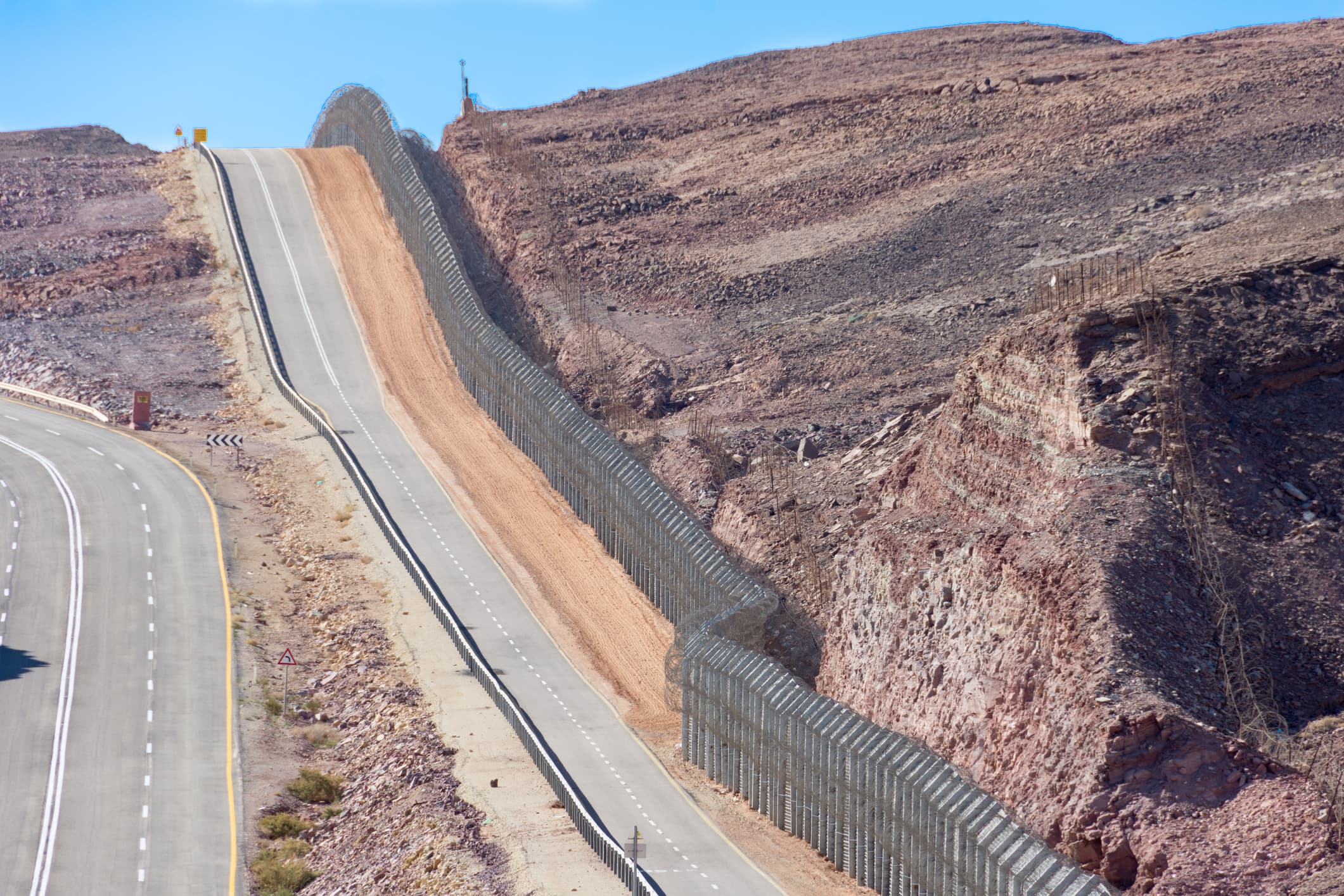
Border security infrastructure along the Israel–Egypt border. Photo credit: iStockPhoto.com/dnaveh
Intelligence Summary
Israel reopened the Rafah border crossing with Egypt on February 2, 2026, marking the first limited movement of people in nearly two years. The crossing, seized by Israeli forces in May 2024, had been closed until the return of the body of Israeli police officer Master Sgt. Ran Gvili, abducted during the October 7, 2023 Hamas attack that killed about 1,200 people. The reopening was part of the first phase of U.S. President Donald Trump’s ceasefire plan between Israel and Hamas, which began in October 2025. On the first day, only five Palestinian patients and seven companions were allowed to leave Gaza for medical treatment, while 12 Palestinians re-entered the territory after months abroad. Israeli authorities said 50 patients per day would be permitted to exit, but Palestinian officials blamed delays on Israeli security checks. The crossing is now operated by the European Union Border Assistance Mission with Palestinian staff, while Israel conducts remote security screening. The World Health Organization reported that about 20,000 Palestinians are awaiting medical evacuation, and Egypt has prepared 150 hospitals and 300 ambulances to receive them. EU foreign policy chief Kaja Kallas and UK Foreign Secretary Yvette Cooper welcomed the reopening as a positive step but urged further easing of restrictions.
In Lebanon, Israeli airstrikes continued despite a ceasefire signed with Hezbollah in November 2024. On February 2, 2026, Israeli strikes killed one person and wounded eight in southern Lebanon, targeting towns including Ain Qana, Kfar Tibnit, Ansarieh, and Qlayieh. The Israel Defense Forces (IDF) claimed the attacks targeted Hezbollah weapons depots and killed a senior commander, Ali al-Hadi Mustafa al-Haqqani, though no independent verification was provided. The Lebanese Health Ministry confirmed civilian casualties, and local authorities reported extensive damage to infrastructure. The Lebanese government has documented over 2,000 Israeli violations of the ceasefire in the last quarter of 2025, with more than 330 people killed since the truce began, including at least 127 civilians. The International Organization for Migration estimated that 64,000 Lebanese remain displaced, unable to return to destroyed villages near the border. Human Rights Watch reported that Israeli forces have attacked reconstruction equipment, hindering rebuilding efforts.
UN peacekeeping operations in southern Lebanon were disrupted when Israeli aircraft dropped unidentified chemicals near the Blue Line on February 1, 2026. The IDF described the substance as non-toxic but warned UNIFIL personnel to take cover, forcing a nine-hour suspension of operations. Lebanon’s Environment Ministry condemned the incident as environmental destruction, while UNIFIL labeled it a violation of UN Security Council Resolution 1701. Samples were collected for analysis, and peacekeepers expressed concern about long-term effects on farmland and civilian health. Reports indicated that the IDF’s Northern Command has been using civilian aircraft to spray herbicides along the borders with Syria and Lebanon to clear vegetation, a tactic previously used around Gaza. Syrian state media confirmed similar flights over al-Qunitra on January 25, 27, and 30, and Syria’s UN representative raised the issue at the Security Council.
In Syria, the national army entered the northeastern city of Hasakah on February 2, 2026, under a U.S.-backed ceasefire agreement with the Kurdish-led Syrian Democratic Forces (SDF). The deal, announced on January 30, 2026, provides for the integration of SDF brigades into the Syrian army and the merger of SDF-controlled civilian institutions with state structures. Syrian forces took control of state buildings in Hasakah’s security zone, while Kurdish police retained local security duties pending full integration. The agreement also covers the cities of Qamishli and Kobane, where Interior Ministry forces began deploying. Turkish President Recep Tayyip Erdogan warned that any attempt to undermine the deal would be met with force. The United States hailed the agreement as a milestone toward national reconciliation after 14 years of conflict.
Meanwhile, U.S. and Israeli naval forces conducted joint drills in the Red Sea on February 1, 2026, involving the USS Delbert D. Black and the Israeli corvette INS Eilat. The exercise was part of a broader U.S. military buildup in the region amid threats of a potential strike on Iran. A U.S. carrier strike group led by the USS Abraham Lincoln has been deployed, and additional air defenses are being positioned across the Middle East. The drills followed a meeting between top U.S. and Israeli generals in Washington, D.C., underscoring close coordination between the two militaries.
Why it Matters
The reopening of the Rafah crossing, though limited, represents a fragile step in implementing the U.S.-brokered ceasefire between Israel and Hamas. The crossing’s operation under EU supervision and Israeli remote control reflects a hybrid governance model balancing humanitarian access with Israeli security imperatives. However, the extremely low number of daily crossings and continued restrictions on goods underscore the persistence of Gaza’s isolation. The humanitarian dimension, with 20,000 patients awaiting evacuation, highlights the intersection of military control and civilian suffering, reinforcing the perception of Gaza as a pressure point in regional diplomacy. The involvement of the EU and WHO indicates a multilateral attempt to stabilize the situation, but the limited scope of movement suggests that Israel retains decisive leverage over Gaza’s external access.
In Lebanon, the continuation of Israeli strikes despite the 2024 ceasefire demonstrates the fragility of deterrence along the northern front. The targeting of alleged Hezbollah assets without verification and the killing of civilians indicate a pattern of unilateral enforcement by Israel, undermining the credibility of the truce. The displacement of 64,000 Lebanese and the destruction of reconstruction equipment suggest that Israel’s strategy extends beyond immediate military objectives to long-term territorial and psychological control. The Lebanese state’s weakness and Hezbollah’s constrained capacity to respond militarily create a volatile equilibrium that could collapse if either side miscalculates. The repeated violations of UN Resolution 1701 and the harassment of UNIFIL peacekeepers erode international mechanisms designed to contain escalation.
The chemical-spraying incidents along the Lebanon and Syria borders add an environmental and legal dimension to the conflict. The use of herbicides by the IDF’s Northern Command, even if described as non-toxic, raises questions about compliance with international environmental and humanitarian law. The disruption of UNIFIL operations and Syria’s formal complaint to the UN Security Council indicate that these actions are not isolated tactical measures but part of a broader Israeli effort to reshape the security landscape along its northern borders. The establishment of permanent posts in southern Lebanon and al-Qunitra suggests a de facto extension of Israeli control zones, potentially setting precedents for future territorial normalization.
In Syria, the integration of the SDF into the national army under a U.S.-backed framework marks a significant shift in the country’s post-war power structure. The deal consolidates President Ahmed al-Sharaa’s authority while reducing Kurdish autonomy, aligning with U.S. objectives to stabilize the region without direct military involvement. Türkiye’s warning underscores the delicate balance between counterterrorism cooperation and Ankara’s opposition to Kurdish self-rule. The agreement’s success or failure will influence the broader regional alignment, particularly regarding U.S.-Turkish relations and Iran’s influence in eastern Syria.
The U.S.-Israel naval drills in the Red Sea highlight the strategic convergence between the two allies amid rising tensions with Iran. The deployment of the USS Abraham Lincoln carrier group and additional air defenses signals U.S. readiness for potential escalation, while the exercises serve as a deterrent message to Tehran. The coordination between U.S. and Israeli forces demonstrates operational integration that extends beyond symbolic partnership, reinforcing deterrence but also increasing the risk of miscalculation in a region already strained by multiple flashpoints.
Collectively, these developments illustrate a Middle East in which ceasefires coexist with ongoing militarization, and humanitarian measures are tightly interwoven with strategic competition. The overlapping crises in Gaza, Lebanon, and Syria reveal a pattern of managed instability, where great powers and regional actors pursue limited tactical gains while avoiding full-scale war. The interplay of U.S. diplomacy, Israeli military assertiveness, and regional realignments underscores the enduring volatility of the region’s security architecture.
Key Actors
- Israel
- Hamas
- Hezbollah
- Lebanon
- Syria
- United States
- European Union
Stay Informed. Stay Ahead.