Maritime Escalation in Gulf Pushes Global Energy System Toward Crisis
Intelligence Summary
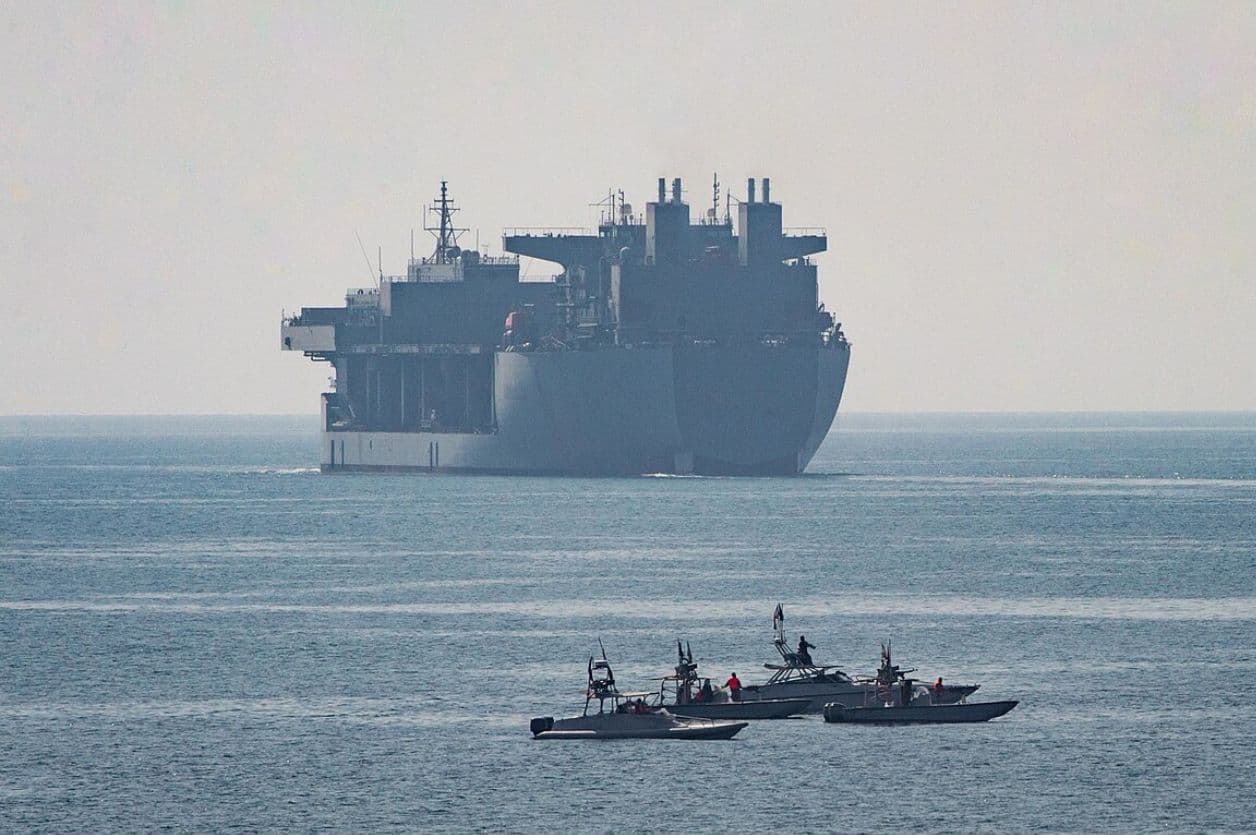
The escalation of the U.S.-Israel war on Iran and the subsequent near-closure of the Strait of Hormuz have triggered a severe global energy and food security crisis. The Strait, which normally carries about one-fifth of the world’s oil and liquefied natural gas (LNG) supplies, has been largely shut since late February 2026, when Iran restricted maritime traffic following attacks from the United States and Israel that killed Supreme Leader Ayatollah Ali Khamenei. The United States then imposed a naval blockade on Iranian ports, with President Donald Trump announcing that the U.S. Navy would interdict vessels paying tolls to Iran. Central Command later clarified that the blockade would apply only to ships entering or exiting Iranian ports, but the announcement alone caused oil prices to surge above $100 per barrel.
The disruption has stranded approximately 3,200 vessels west of the Strait, according to maritime intelligence firm Windward. Analysts warned that the blockade could push oil prices above $150 per barrel if Iran-aligned groups such as the Houthis retaliate by closing the Bab al-Mandeb Strait, another critical chokepoint connecting the Red Sea to the Indian Ocean. The energy shock has cascaded through global supply chains, raising costs for chemicals, fertilizers, and plastics. Cameron Johnson of Tidalwave Solutions projected that raw material prices would rise within weeks if the blockade persisted beyond early May, while Deborah Elms of the Hinrich Foundation warned that packaging shortages and fertilizer disruptions could affect food production later in 2026 and into 2027.
The Food and Agriculture Organization (FAO) has warned that a prolonged disruption could lead to a global food catastrophe. FAO Chief Economist Maximo Torero and Agrifood Economics Director David Laborde stated that 20 to 45 percent of key agricultural inputs transit through the Strait of Hormuz, including nearly half of the world’s traded urea fertilizer. Fertilizer plants in the Gulf have already reduced output due to gas shortages, and the FAO cautioned that poorer countries would be most affected as planting calendars slip and input costs rise. The organization emphasized that while current food stocks have prevented immediate price spikes, the clock is ticking for resuming maritime traffic.
The fertilizer shortage has been compounded by the simultaneous loss of LNG exports from the Gulf, which supply one-fifth of global LNG and are essential for fertilizer production. Plants from Qatar to Bangladesh have shut down, and analysts warn that the world is “a step removed from the worst-case scenario.” Governments are attempting to mitigate the crisis through subsidies and stockpiling. India, for example, has large reserves of rice and wheat and previously raised fertilizer subsidies by 233 percent during the 2022 supply shock. China, the world’s largest fertilizer producer, has restricted exports to preserve domestic supply, a move that benefits local producers but harms global markets.
Oil market dynamics have become increasingly distorted. The physical market for immediate oil delivery has diverged sharply from futures contracts, with Dated Brent spot prices reaching $144 per barrel—about $35 higher than futures—reflecting acute scarcity of physical supply. Only 17 vessels transited the Strait on April 11, compared with 130 daily before the war, resulting in an estimated shortfall of 8 million barrels per day. Analysts attribute the divergence to traders betting on a future resolution, while the physical market reflects the immediate deficit.
Despite U.S. efforts to ease domestic energy costs, such as a 60-day waiver of the Jones Act to allow foreign-flagged vessels to transport goods between U.S. ports, prices have continued to rise. Brent crude futures climbed to nearly $99 per barrel, and U.S. gasoline prices reached $4.12 per gallon, up from $3.63 a month earlier. The Containerized Freight Index rose more than 10 percent in a month as 34,000 ships diverted from the Strait, while major shipping firms suspended routes through the Gulf.
The crisis has also accelerated shifts toward energy independence. In the United States, households are increasingly adopting solar panels and battery storage to offset rising costs and frequent power outages. The U.S. Energy Information Administration reported that electricity interruptions doubled in 2024 compared with the previous decade, prompting more than 5 million households to install rooftop solar systems.
Analysts have warned that the global economy could lose up to 4 percent of its activity if the Strait remains closed, equivalent to the contraction during the 2008–2009 Great Recession. The loss of 12 percent of global oil supply and 3 percent of natural gas has already removed about 4.5 percent of total world energy, with disproportionate effects on import-dependent economies such as Taiwan, which relies on LNG for 42 percent of its electricity. The same analysis noted that helium shortages, a byproduct of natural gas extraction, are disrupting semiconductor production, further amplifying the economic impact.
Why it Matters
The Hormuz crisis underscores the fragility of global energy and food systems and the strategic vulnerability of chokepoints in great power competition. The blockade has transformed a regional conflict into a systemic global shock, demonstrating how military escalation in one maritime corridor can reverberate through every sector of the world economy. The Strait of Hormuz, carrying roughly one-fifth of global oil and LNG, functions as a single point of failure for the energy-dependent global order. The U.S. decision to impose a naval blockade, even if limited to Iranian ports, has effectively weaponized maritime access, signaling a shift toward coercive economic warfare through physical interdiction rather than sanctions alone.
The FAO’s warnings highlight how energy insecurity translates directly into food insecurity. Fertilizer production depends on natural gas, and disruptions in LNG exports from the Gulf have already forced plant shutdowns from Qatar to Bangladesh. The resulting fertilizer shortage threatens to reduce yields in the next planting season, particularly in developing countries that lack subsidies or reserves. This dynamic mirrors the cascading effects of the 2022 Ukraine war on grain and fertilizer markets but on a larger scale, as both energy and agricultural inputs are now constrained simultaneously.
The divergence between spot and futures oil prices reveals a structural breakdown in market expectations. Traders’ belief that the crisis will be temporary contrasts with the physical scarcity of oil, suggesting that financial markets are underestimating the duration and severity of the disruption. This misalignment could delay policy responses and exacerbate volatility. The 8 million-barrel-per-day shortfall estimated by Kpler represents one of the largest supply shocks in modern history, and the longer it persists, the more likely it is to trigger a global recession.
The crisis also exposes the limits of national mitigation strategies. The U.S. Jones Act waiver and domestic energy subsidies have had negligible effects on prices, while European and Asian economies remain heavily exposed to imported energy. The rise of homegrown solar adoption in the United States illustrates a micro-level adaptation to macro-level instability, but such measures cannot offset systemic shortages in global supply chains.
From a strategic perspective, the blockade and mine-clearing operations in the Strait have militarized global trade routes. The U.S. Navy’s mine countermeasure operations, combined with Iranian Revolutionary Guard Corps efforts to control navigation routes, have turned the Strait into a contested battlespace. This environment increases the risk of miscalculation and further escalation, particularly if Iran-aligned groups retaliate in other maritime chokepoints such as Bab al-Mandeb or the Suez Canal.
Economically, analysts quantified the potential contraction of global output at roughly 4 percent, comparable to the Great Recession. The correlation between energy availability and economic activity underscores that even a 4–5 percent loss in energy supply can produce a proportional decline in GDP. The cascading effects—rising costs for plastics, semiconductors, and food—illustrate how energy scarcity permeates every industrial process. The helium shortage affecting semiconductor production adds a technological dimension to the crisis, threatening supply chains critical to defense and digital infrastructure.
Strategically, the crisis accelerates the global energy transition but under duress. European and Asian states are likely to intensify diversification away from Gulf energy, while the United States may double down on domestic production and renewables. However, the immediate effect is destabilizing: higher inflation, reduced growth, and heightened geopolitical competition over alternative supply routes and resources. The Hormuz blockade represents not only a military confrontation but a structural stress test for the globalized economy, revealing the interdependence of energy, food, and security systems.
Stay Informed. Stay Ahead.