The Indo-Pacific's Security Transformation
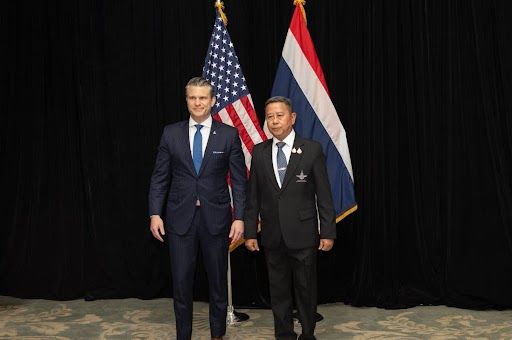
IISS Shangri-La Dialogue 2026. Photo credit: U.S. Department of War
Intelligence Summary
The 2026 Shangri-La Dialogue in Singapore underscored the accelerating militarization and strategic competition across the Indo-Pacific. Defense ministers and senior officials from Asia, Europe, and the United States described a deteriorating regional security environment marked by rising defense budgets, expanding alliances, and intensifying U.S.-China rivalry. Vietnamese President and Communist Party General Secretary To Lam opened the conference on May 29, 2026, emphasizing that competition among states must remain bounded by international law and that development and security are inseparable. Australian Deputy Prime Minister and Defense Minister Richard Marles echoed this linkage, warning that instability arises when prosperity and human development are undermined.
According to the Stockholm International Peace Research Institute, military spending in the Asia-Pacific rose by 8.1 percent in 2025 to $681 billion. U.S. Secretary of War Pete Hegseth argued that this level of spending was insufficient, announcing that the United States would soon allocate $1.5 trillion to defense and urging allies to strengthen their own capabilities. He praised South Korea, the Philippines, Australia, Singapore, Malaysia, Thailand, Vietnam, and India for expanding their defense investments, contrasting them with European allies he viewed as lagging.
The dialogue also revealed a shift in U.S.-China relations following a May 2026 meeting between Presidents Donald Trump and Xi Jinping, who agreed to pursue “constructive strategic stability.” Former Chinese Vice Foreign Minister Cui Tiankai described this as a new vision for bilateral ties, emphasizing that it should include halting U.S. arms sales to Taiwan. Hegseth confirmed that a $14 billion arms package for Taiwan, approved by Congress but paused by President Trump, remained under review.
Japan’s Defense Minister Shinjiro Koizumi used the forum to reject accusations of “new militarism,” asserting that Japan’s defense buildup is transparent and consistent with international law. He criticized China’s rapid military expansion and lack of transparency, while Chinese delegate Major General Meng Xiangqing accused Japan of failing to overcome its militarist past. Koizumi reaffirmed Japan’s commitment to dialogue but confirmed that Tokyo would continue strengthening its defense capabilities, including in artificial intelligence, unmanned systems, and space and cyber defense.
Parallel to these diplomatic exchanges, the United States and the Philippines conducted a joint patrol near Scarborough Shoal from May 26 to May 30, 2026. The U.S. Coast Guard cutter USS *Midgett* joined Philippine Navy and Coast Guard vessels within 35–40 nautical miles of the Chinese-controlled shoal. China’s military and coast guard simultaneously patrolled the area, highlighting the risk of confrontation. The patrol marked the first time the U.S. Coast Guard formally joined a bilateral patrol, expanding cooperation that began in 2023.
Regional defense cooperation deepened further as the Philippines and Vietnam upgraded their relationship to an “enhanced strategic partnership” during To Lam’s June 1, 2026 visit to Manila. Presidents Ferdinand Marcos Jr. and To Lam reaffirmed their commitment to freedom of navigation and peaceful dispute resolution under the United Nations Convention on the Law of the Sea and the 2016 arbitral ruling invalidating most of China’s South China Sea claims. The two nations renewed a 2010 defense cooperation memorandum and agreed to expand joint naval exercises and military education programs.
India also advanced its regional defense outreach. On May 31, 2026, Indian Defense Secretary Rajesh Kumar Singh confirmed at the Shangri-La Dialogue that India had signed a deal to supply Vietnam with the BrahMos supersonic cruise missile system, valued at approximately 60 billion rupees ($629 million). The missile, developed by an India-Russia joint venture, can travel at nearly three times the speed of sound and is designed for deployment from multiple platforms. Vietnam becomes the third Southeast Asian nation to acquire the system after the Philippines and Indonesia, both of which view it as a deterrent against Chinese maritime incursions.
India and Australia also reinforced their defense partnership during a June 1, 2026 meeting in New Delhi. Defense Ministers Rajnath Singh and Richard Marles agreed to finalize a Joint Maritime Security Collaboration Roadmap and a new Memorandum of Understanding on defense articles and services. They emphasized cooperation in undersea surveillance, maritime domain awareness, and advanced technologies, while reaffirming support for freedom of navigation and the Quad’s Indo-Pacific Maritime Surveillance Collaboration initiative.
Vietnam’s approach at the Shangri-La Dialogue reflected a deliberate strategy to shape regional security discourse through nontraditional security themes such as climate resilience, AI governance, and undersea infrastructure protection. To Lam framed regional instability as a crisis of international order, development, and strategic trust, calling for preventive diplomacy and cooperative frameworks that avoid forcing smaller states to choose between major powers.
Meanwhile, the U.S. Department of Commerce issued new guidance on May 31, 2026, tightening export controls on advanced AI chips to Chinese companies, including subsidiaries operating abroad. The Bureau of Industry and Security clarified that all China- or Macau-headquartered entities require export licenses for advanced computing items, closing loopholes that had allowed indirect acquisitions through overseas affiliates.
Why it Matters
The developments across the Indo-Pacific illustrate a decisive phase in the region’s transformation into the central arena of competition. The Shangri-La Dialogue served as a barometer and catalyst for this shift, revealing how regional states are rearming, diversifying partnerships, and redefining strategic autonomy in response to the U.S.-China rivalry. The 8.1 percent rise in regional defense spending and the U.S. commitment to a $1.5 trillion defense budget signal a sustained arms buildup that risks entrenching a security dilemma.
The U.S.-Philippine patrol near Scarborough Shoal demonstrates Washington’s operational commitment to Manila under the Mutual Defense Treaty, but it also heightens the risk of direct confrontation with China in contested waters. The patrol’s proximity to Chinese-controlled territory underscores the potential for miscalculation, especially as both sides conduct simultaneous operations.
Vietnam’s dual-track diplomacy—deepening defense cooperation with the Philippines and India while promoting nontraditional security frameworks—illustrates how middle powers are maneuvering to preserve agency amid intensifying polarization. The BrahMos missile deal with India represents a significant qualitative leap in Vietnam’s deterrent capabilities, potentially altering the regional balance by introducing supersonic strike options into Southeast Asia. It also consolidates India’s emergence as a defense supplier to ASEAN states, reinforcing its “Act East” policy and expanding its influence beyond the Indian Ocean.
Japan’s assertive defense posture, coupled with its rejection of new militarism accusations, reflects Tokyo’s determination to normalize its military role and maintain transparency and adherence to international law. Its cooperation with South Korea and participation in multilateral exercises signal a convergence of U.S. allies around shared deterrence objectives. However, the rhetorical clash between Koizumi and Chinese representatives at the Shangri-La Dialogue highlights the persistence of historical grievances that complicate regional trust-building.
The India-Australia defense dialogue demonstrates the consolidation of a maritime security network that extends from the Indian Ocean to the Pacific. Their focus on undersea surveillance, maritime domain awareness, and advanced technologies aligns with broader Quad objectives and reflects growing concern over “grey zone” tactics, including unmarked maritime operations and cyber intrusions.
The U.S. export control tightening on AI chips adds a technological dimension to the strategic competition. By closing loopholes that allowed Chinese firms to access advanced processors through foreign subsidiaries, Washington is reinforcing its technological containment strategy. This move complements military deterrence efforts by constraining China’s access to dual-use technologies critical for AI-driven defense systems.
Collectively, these developments indicate a regional order in flux, where deterrence, alliance-building, and technological control are converging into a comprehensive strategy of competitive coexistence. The Indo-Pacific is no longer defined solely by maritime disputes but by a multidimensional contest encompassing defense industrial capacity, digital infrastructure, and normative influence. The interplay between hard security measures, such as missile sales and joint patrols, and soft balancing through diplomatic frameworks like Vietnam’s “strategic trust” concept suggests that regional actors are seeking stability without surrendering autonomy.
The risk, however, lies in the cumulative effect of these parallel militarization trends. As more states acquire advanced strike capabilities and expand defense cooperation, the threshold for escalation may lower, particularly in contested maritime zones. The simultaneous tightening of technology controls and expansion of defense networks could also deepen the bifurcation of the regional order into competing blocs. The 2026 Shangri-La Dialogue thus marks a pivotal moment where the Indo-Pacific’s security architecture is being redefined through both confrontation and coordination, setting the stage for a prolonged era of strategic competition.
Stay Informed. Stay Ahead.