Jimmy Lai Convicted Under Hong Kong National Security Law
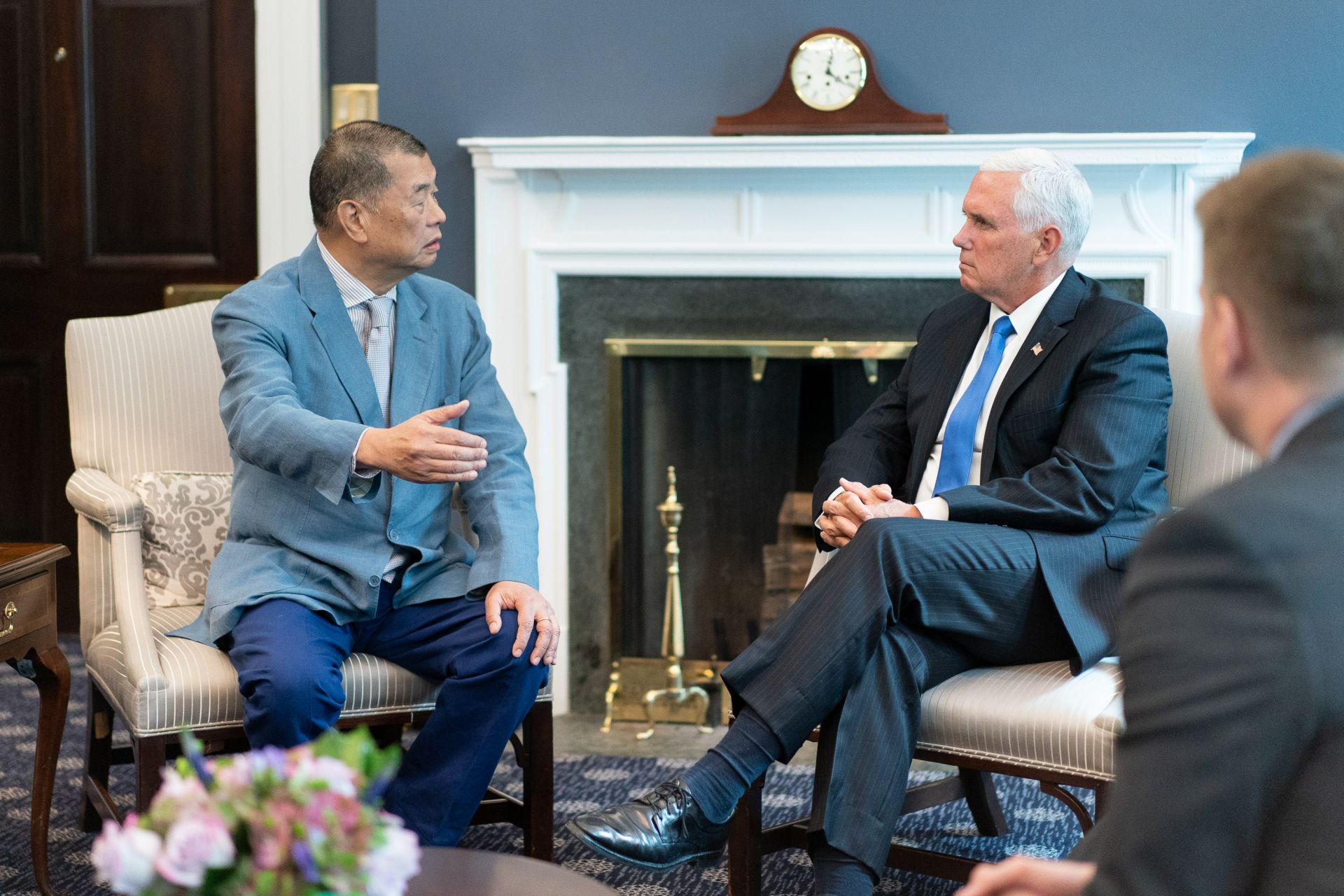
Photo credit: Office of U.S. Vice President
Intelligence Summary
Yesterday, December 15, 2025, Hong Kong’s High Court convicted 78-year-old pro-democracy activist and media tycoon Jimmy Lai on three charges under the Beijing-imposed National Security Law (NSL). The charges include: two counts of conspiring with foreign forces to endanger national security and one count of conspiracy to publish seditious material. The verdict followed a 156-day trial that began in December 2023 and was conducted without a jury before three government-approved judges, Esther Toh, Alex Lee, and Susana D’Almada Remedios. Lai, who pleaded not guilty, faces a potential life sentence, with a mitigation hearing scheduled for January 12, 2026.
The court’s 855-page judgment described Lai as the “mastermind” of a conspiracy to solicit foreign interference, calling attention to his meetings with former U.S. Vice President Mike Pence and former Secretary of State Mike Pompeo in 2019 as evidence of attempts to encourage sanctions or other hostile actions against China and Hong Kong. Judge Esther Toh emphasized that Lai had harbored resentment toward the People’s Republic of China for many years and had used his Apple Daily newspaper to promote anti-government sentiment. Prosecutors presented 161 Apple Daily articles, social media posts, and text messages as evidence of seditious intent.
Lai’s defense argued that his interactions with foreign officials were limited to sharing information about Hong Kong’s situation and did not constitute calls for sanctions. He testified for 52 days, maintaining that he never advocated for Hong Kong independence and that Apple Daily’s mission was to uphold the city’s core values including the rule of law, freedom of speech, and democracy. Despite these claims, the court concluded that Lai’s actions were designed to destabilize China and undermine national security.
The trial was widely viewed as a test of Hong Kong’s judicial independence and the “one country, two systems” framework established after the 1997 handover from Britain to China. The NSL, enacted in 2020 following the 2019 pro-democracy protests, granted authorities broader powers to prosecute acts deemed subversive or collusive with foreign forces. Since its implementation, many major opposition figures have been jailed or exiled, and Hong Kong’s last pro-democracy party was forced to disband in June 2025.
International reactions were overwhelmingly disapproving. The United Kingdom’s Foreign, Commonwealth & Development Office repeatedly condemned the persecution of Lai, characterizing it as politically motivated and reiterated calls for the repeal of the NSL. Germany’s Foreign Office described the ruling as very worrying, while Taiwan’s Mainland Affairs Council said it demonstrated the systematic erosion of Hong Kong’s freedoms. U.S. President Donald Trump and U.K. Prime Minister Keir Starmer both reaffirmed that securing Lai’s release was a diplomatic priority.
Human rights organizations, including Human Rights Watch, Reporters Without Borders, and the Committee to Protect Journalists, denounced the conviction as a politically driven attack. Analysts warn that Lai’s imprisonment will further reduce free expression in Hong Kong, where at least 14 media outlets have been shuttered since 2020.
Hong Kong Chief Executive John Lee defended the verdict, asserting that Lai’s actions harmed the country’s interests and the welfare of its citizens. The Chinese Foreign Ministry rejected Western criticism, accusing foreign governments of interfering in China’s internal affairs and defaming Hong Kong’s judicial system. Lai’s son, Sebastien Lai, urged the U.K. government to make his father’s release a precondition for closer relations with China.
Lai’s health has deteriorated during his five years in detention, with reports of heart problems, diabetes, and weight loss. Despite these conditions, Hong Kong authorities stated that his medical care was adequate. Lai remains in solitary confinement and has been denied bail throughout the proceedings.
Why it Matters
The conviction of Jimmy Lai highlights the continuous recalibration of Hong Kong’s legal and political landscape. The case demonstrates how the National Security Law has transformed Hong Kong’s judiciary and its resulting impacts on domestic political activity. The use of a non-jury trial, government-vetted judges, and the trial’s outcome may influence how foreign foreign governments assess the independence and reliability of Hong Kong’s judicial system, with potential implications for diplomatic and economic engagement.
Strategically, the verdict signals Beijing’s determination to eliminate remaining centers of dissent in Hong Kong and to deter foreign governments from supporting pro-democracy movements. By framing Lai’s interactions with U.S. officials as evidence of subversion, Chinese authorities have effectively criminalized international advocacy and redefined engagement with foreign actors as a security threat. This approach mirrors the broader trend in China’s domestic governance of prioritizing political loyalty.
The international response highlights the growing diplomatic friction between China and Western democracies. The United Kingdom’s condemnation carries particular weight given Lai’s British citizenship and the historical context of the 1997 handover. Calls from London and Washington for Lai’s release, coupled with Taiwan’s denunciation of the verdict, reinforce the perception of an ideological divide between democratic nations and nations with differing governance models. Beijing’s rejection of these criticisms as interference in internal affairs reflects its broader strategy of asserting sovereignty and resisting external pressure.
The case also has implications for global press freedom and journalist safety. Lai’s conviction, following the closure of Apple Daily and other independent outlets, signals a strategic dismantling of Hong Kong’s media landscape. The precedent set by this trial may embolden other governments to use national security laws to suppress dissent and criminalize journalism.
From a geopolitical perspective, the trial and verdict complicate China’s diplomatic relations with Western powers at a time of heightened strategic competition. It may influence trade negotiations, investment flows, and cooperation in multilateral forums. The case also provides a rallying point for human rights advocacy within the broader context of U.S.-China rivalry, where issues of governance, transparency, and rule of law are increasingly intertwined with economic and security policy.
Domestically, the trial and prosecution’s emphasis on Lai’s alleged coordination with foreign actors serves both as justification for the NSL. Many analysts view the verdict as a consolidation of China’s authority over Hong Kong, but simultaneously voice concern that it could potentially undermine international credibility and investor confidence in the nation.
Key Actors
- People’s Republic of China
- Hong Kong Special Administrative Region Government
- United Kingdom
- United States
- Taiwan
- Human Rights Watch, Reporters Without Borders, Committee to Protect Journalists
Stay Informed. Stay Ahead.