Leadership Crises Deepen in UK, South Africa, Philippines
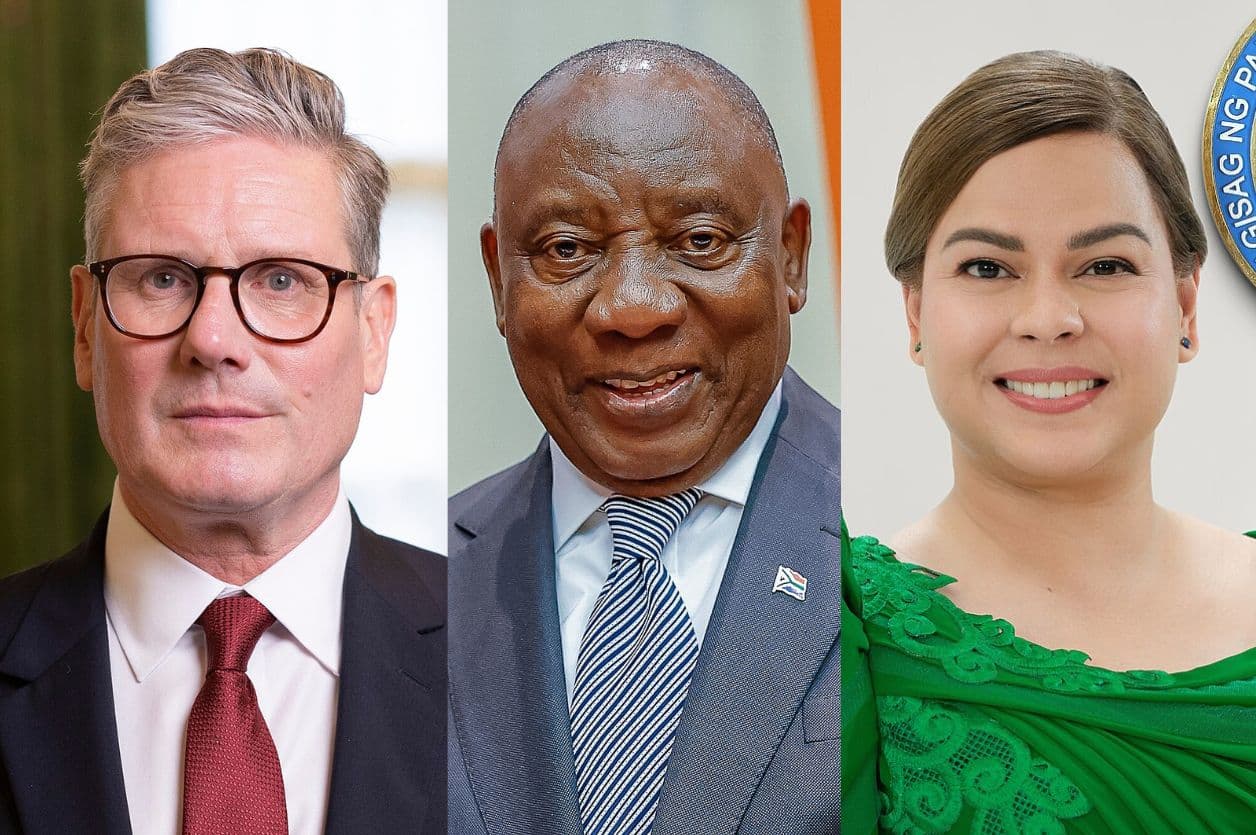
Cyril_Ramaphosa, Photo credit: Ricardo Stuckert
Sara Z. Duterte, Photo credit: Philippine Department of Foreign Affairs
Intelligence Summary
United Kingdom Prime Minister Keir Starmer faced intensified internal pressure to step down after Labour’s heavy losses in local elections across England, including the loss of more than 1,400 councillors, with many seats shifting to Reform UK and the Greens. He delivered a speech at Coin Street Community Centre in London on May 11, 2026, accepted responsibility for the results, and framed the outcome as a moment requiring renewed political effort rather than leadership change. Starmer argued that Labour’s major strategic choices remained correct, including avoiding being drawn into the U.S.-Israel war with Iran, and he highlighted claimed progress on National Health Service waiting lists, child poverty, and immigration. He also set out near-term policy priorities, including legislation to take ownership of British Steel, a pledge to rebuild the United Kingdom’s relationship with Europe, and a commitment to provide a guaranteed offer of job, training or work placement for every young person seeking work. Starmer warned against repeating the instability of frequent leadership changes and argued that another rapid turnover would damage national governance.
Calls for Starmer’s departure expanded within Labour’s parliamentary ranks, with more than 30 Labour MPs publicly urging resignation or a timetable for departure. Labour MP Catherine West stated she would begin collecting names of Labour MPs to demand a timetable for a new leadership election in September, and she indicated she would contact colleagues on May 11 if no alternative challenger emerged. Labour MP David Smith called for Starmer to set a clear timetable for departure, while Labour MP Paulette Hamilton argued the party risked losing power without a leadership change. Education Secretary Bridget Phillipson opposed a leadership contest and argued it would not resolve the party’s problems. Starmer appointed former Prime Minister Gordon Brown and former deputy Labour leader Baroness Harman to senior government roles on May 10, 2026, in a move presented as strengthening internal support. A leadership contest required endorsements from 81 Labour MPs, and potential challengers cited included Health Secretary Wes Streeting, former Deputy Prime Minister Angela Rayner, and Greater Manchester Mayor Andy Burnham.
In South Africa, Parliament moved to establish an impeachment committee to investigate President Cyril Ramaphosa over the Farmgate scandal after the Constitutional Court ruled that Parliament’s earlier decision to block an inquiry was inconsistent with the constitution. The committee was tasked to review evidence and decide whether to recommend formal proceedings, with deliberations expected to take several months, while no specific investigation timeframe was provided in Parliament’s statement. The scandal centered on a 2020 theft of foreign currency from Ramaphosa’s Phala Phala game farm, described as cash hidden in a sofa, with figures cited as $4 million and separately as $580,000, with Ramaphosa stating the funds were proceeds from buffalo sales. Ramaphosa stated on May 11, 2026 that he would not resign and would legally challenge an independent panel report that found preliminary evidence of misconduct, while arguing resignation would preempt a constitutional process. The case was advanced by opposition parties including the Economic Freedom Fighters and the African Transformation Movement, and impeachment would require a two-thirds majority in the 400-seat Parliament. Ramaphosa’s ANC, after losing its majority in 2024, remained positioned to help him survive a removal vote, including through its role in a 10-party Government of National Unity.
In the Philippines, the House of Representatives voted on May 11, 2026 to impeach Vice President Sara Duterte for a second time, sending the case to the Senate for trial where conviction would require a two-thirds vote and would disqualify her from public office. The House vote was 257 in favor out of 318 members, with 26 against and nine abstentions, while another count described 257 of 290 lawmakers in attendance voting in favor. Charges included alleged misuse of confidential funds, failure to disclose wealth, bribery, and issues linked to death threats against President Ferdinand Marcos Jr, First Lady Liza Araneta, and former House Speaker Martin Romualdez. The complaint referenced private bank transactions flagged by the anti-money laundering agency totaling more than $110 million. A prior impeachment motion passed in 2025 with 215 votes in a 313-member House but was voided by the Supreme Court on technical grounds. The Senate’s leadership changed shortly before the House vote, with Senator Alan Cayetano elected Senate president, while former Senate President Vicente Sotto linked his removal to the impeachment dynamics. Duterte, age 47, led early polls and held a 17-point lead in a March poll by WR Numero, and she had declared her intention to run for president in 2028 amid a political split with Marcos after their 2022 alliance. Duterte refused to appear in committee hearings, submitted a written response dismissing the case, and her counsel stated after the vote that accusers now carried the burden of substantiating claims under law.
Why it Matters
Simultaneous political shocks in the United Kingdom, South Africa, and the Philippines create alliance-management risk for Washington during a period of heightened global security stress. Each case involves a leader or senior executive figure under direct institutional challenge, and each challenge intersects with foreign policy credibility, defense posture, and the ability to sustain consistent commitments.
In the United Kingdom, leadership instability inside the governing party can narrow the government’s bandwidth for external crises and complicate long-cycle defense and industrial decisions. The domestic fight over the prime minister’s tenure is occurring alongside explicit positioning on the Iran war, with the government emphasizing that it avoided being pulled into the conflict. That stance matters because it signals constraints on operational support and coalition participation at a time when partners may seek visible alignment. The pledge to rebuild relations with Europe also becomes strategically consequential under leadership uncertainty. A government under internal siege may pursue quick diplomatic wins with European counterparts, but it may also become more risk-averse on contentious security files. The British Steel ownership plan adds another layer: industrial policy choices can affect defense supply chains and resilience, yet political fragility can delay implementation or invite reversal under a new leader.
In South Africa, the impeachment process introduces uncertainty into a pivotal regional actor whose political stability affects investment confidence, governance legitimacy, and the cohesion of a multi-party governing arrangement. The court-driven revival of impeachment proceedings reinforces the role of institutions, but it also forces coalition partners and party factions to choose between accountability narratives and continuity. The conflicting cash figures circulating in public discourse illustrate how contested facts can become political weapons, prolonging instability even if formal removal remains unlikely. For external partners, the key issue is predictability. A president fighting an impeachment probe may prioritize domestic survival, reshuffle alliances, or harden positions toward opponents, which can alter diplomatic signaling and reduce the state’s capacity to engage consistently on international priorities.
In the Philippines, the impeachment of the vice president is directly tied to Indo-Pacific alignment because it deepens the split between two major political camps that previously ran as a unified ticket. The case also interacts with international legal pressure on the Duterte family, and it raises the stakes for elite bargaining ahead of the next presidential cycle. Even if conviction is uncertain, the process can reshape incentives for senators who calculate national electoral consequences. That dynamic can produce abrupt shifts in coalition-building, legislative priorities, and security policy messaging. The Senate leadership change immediately before the impeachment vote underscores how institutional control is being contested in real time, which can affect whether the trial proceeds, how evidence is handled, and whether outcomes are viewed as legitimate.
Across all three countries, these crises can weaken deterrence signaling by creating ambiguity about who will be making decisions and for how long. Domestic turmoil can also complicate intelligence and security cooperation, not necessarily through formal policy change, but through slowed decision cycles, leadership turnover in key ministries, and heightened sensitivity to scandal narratives involving funds, corruption, or alleged threats.
Finally, these cases show how domestic accountability mechanisms can become strategic variables. Impeachment processes, leadership challenges, and court interventions are internal constitutional tools, but they can produce external effects by changing diplomatic posture, delaying defense procurement, and altering the credibility of commitments. For students of geopolitical analysis, the key lesson is that allied political stability is not background noise. It is a core input into forecasting alliance behavior under crisis conditions.
Stay Informed. Stay Ahead.