
Russia Escalates Winter Warfare on Ukraine’s Energy Grid
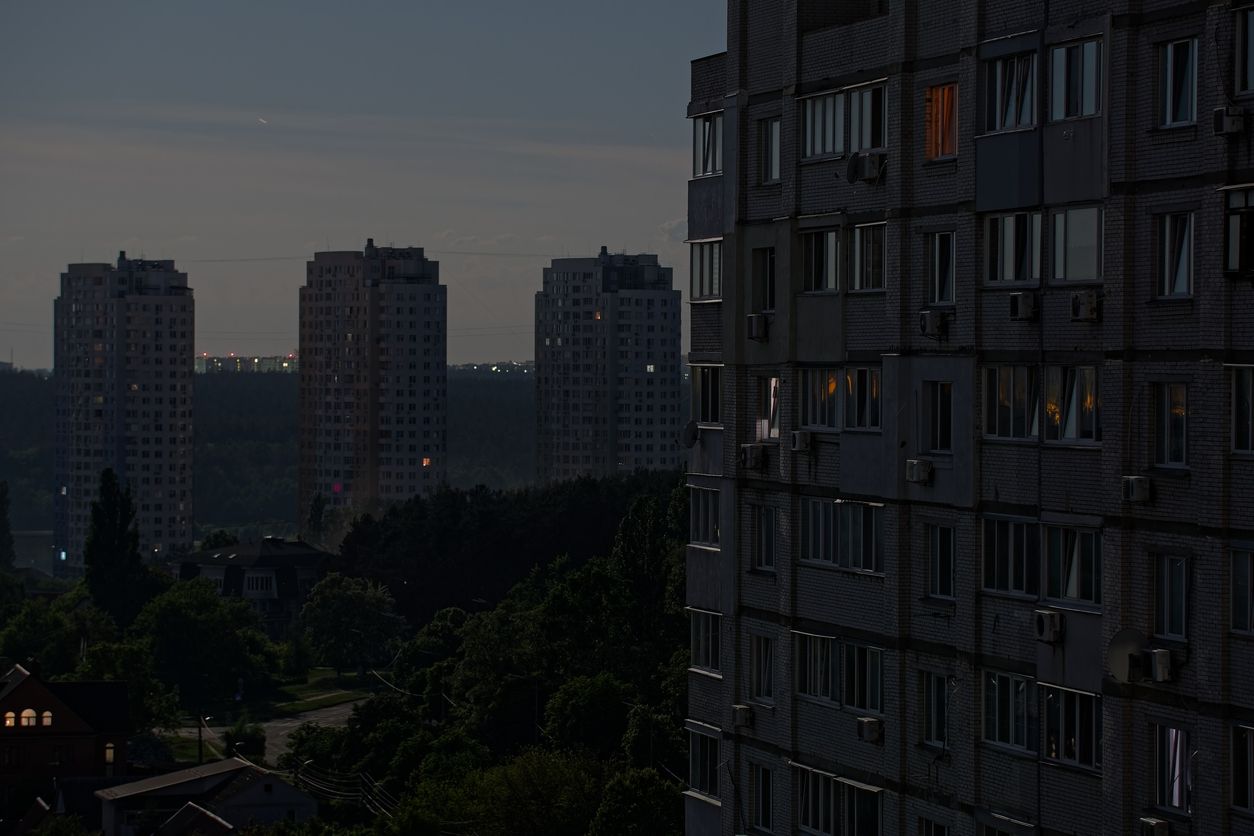
View of Kyiv, Ukraine blackout of electricity at sunset. Photo credit: iStockPhoto.com/Oleksii Maznychenko
Intelligence Summary
Between February 2 and 3, 2026, Russia launched its most extensive and destructive series of missile and drone strikes against Ukraine’s energy and transport infrastructure since the start of the year. Ukrainian President Volodymyr Zelenskyy reported that more than 70 ballistic and cruise missiles and approximately 450 drones were fired, with only 38 missiles intercepted by Ukrainian air defenses. The attacks coincided with subzero temperatures reaching minus 20 degrees Celsius, leaving over 1,000 residential buildings in Kyiv without heating and causing widespread blackouts across multiple regions.
According to Ukraine’s energy company DTEK, two of its power plants were hit in Odesa, while state-run facilities in Kyiv, Dnipro, and Kharkiv sustained severe damage. The strikes destroyed or disabled major thermal power plants and substations, including Kyiv’s TPP-4 and TPP-5, the Trypilska TPP, and the 750/330/35 kV “Kyivska” substation. In Dnipropetrovsk, the Prydniprovska TPP caught fire, while Kharkiv’s TPP-5 and Zmiivska TPP were rendered inoperable. In Vinnytsia, the Ladyzhynska TPP and the “Vinnytsia” substation were hit, and Odesa’s “Chornomorska” substation lost power, leaving about 50,000 subscribers without electricity.
Ukraine’s Energy Minister Denys Shmyhal described the campaign as an attempt at “winter genocide,” asserting that the strikes deliberately targeted civilian heating and power systems. Kyiv Mayor Vitali Klitschko confirmed that 1,170 apartment buildings lost heating, while Kharkiv authorities reported 125,000 consumers without heat. Emergency rolling blackouts were introduced nationwide, and “invincibility points” were opened to provide heat and electricity to civilians.
The Russian Ministry of Defense stated that the strikes were retaliation for Ukrainian attacks on Russian territory and were aimed at military-industrial facilities and supporting energy infrastructure. However, Ukrainian officials and Western observers claimed that many of the damaged sites were purely civilian, including residential buildings, schools, and hospitals.
Simultaneously, Russian forces intensified attacks on Ukraine’s transport network, particularly railway infrastructure in Dnipro and Zaporizhzhia, disrupting logistics and troop movements. Ukrainian President Zelenskyy said the Russian army was focusing on targeting logistics routes, while state rail operator Ukrzaliznytsia suspended several routes in the east due to high risk.
On the battlefield, Russian forces advanced in multiple directions, including Sumy, Kupyansk, Liman, Pokrovsk, and Zaporizhzhia, capturing Pridorozhnoye and parts of Lukashovka. Ukrainian losses were reported at approximately over 1,300 troops in 24 hours.
The escalation occurred just as a short “energy truce” brokered by U.S. President Donald Trump expired. The truce had been intended to pause strikes on energy facilities during extreme cold to facilitate peace talks scheduled in Abu Dhabi on February 4–5. Zelenskyy stated that Russia used the pause to stockpile missiles and prepare for renewed attacks.
Diplomatic efforts continued despite the violence. Trump’s special envoy, Steve Witkoff, was scheduled to attend the Abu Dhabi talks alongside Russian and Ukrainian delegations. NATO Secretary-General Mark Rutte visited Kyiv on February 3, addressing parliament and warning that peace would require difficult decisions. Rutte confirmed that NATO’s PURL weapons program was supplying about 90 percent of Ukraine’s air defense missiles.
Meanwhile, Germany arrested five individuals accused of exporting goods to Russian defense companies in violation of EU sanctions, allegedly facilitating 16,000 shipments worth at least €30 million to 24 Russian defense firms. The arrests underscored ongoing efforts to enforce sanctions amid Russia’s continued access to Western technology.
Ukraine also secured cooperation from SpaceX to restrict Russian use of Starlink satellite systems after reports that Russian drones were exploiting the network for targeting and communications. Ukrainian Defense Minister Mykhailo Fedorov announced that unauthorized terminals would be deactivated to prevent Russian exploitation of the system.
Why it Matters
The February 2026 escalation demonstrates a Russian strategy to weaponize winter conditions and energy dependency as instruments of coercion. By striking power plants, substations, and heating infrastructure during subzero temperatures, Moscow sought to degrade civilian morale, pressure Kyiv into concessions, and test Western resolve. The attacks’ timing, immediately after the expiration of a U.S.-brokered truce, suggests that Russia used the pause to regroup and coordinate a synchronized campaign combining ballistic, cruise, and drone strikes.
The scale of the assault, involving over 500 aerial weapons, highlights Russia’s continued capacity to sustain high-intensity operations despite sanctions and battlefield attrition. The use of mixed missile types and swarm drone tactics indicates evolving Russian targeting doctrine designed to overwhelm Ukrainian air defenses. The limited interception rate, with only 38 missiles downed, underscores Ukraine’s dependence on Western-supplied systems such as Patriot and NASAMS and the urgent need for replenishment.
The attacks on transport routes in Dnipro and Zaporizhzhia reveal a complementary objective: to disrupt Ukraine’s logistics and troop mobility ahead of potential Russian offensives in the east and south. The simultaneous ground advances in Sumy, Pokrovsk, and Zaporizhzhia suggest that Russia is exploiting infrastructure paralysis to gain tactical momentum.
Diplomatically, the strikes undermine the credibility of ongoing peace efforts. The Abu Dhabi talks, attended by U.S. envoy Steve Witkoff, were overshadowed by the renewed bombardment, signaling Moscow’s intent to negotiate from a position of strength. NATO Secretary-General Mark Rutte’s visit to Kyiv, coinciding with the attacks, reinforced Western solidarity but also highlighted the alliance’s dilemma: balancing support for Ukraine with the risk of escalation. His acknowledgment that NATO supplies 90 percent of Ukraine’s air defense missiles underscores the alliance’s deep operational involvement short of direct intervention.
The German arrests for sanctions violations expose persistent vulnerabilities in the enforcement of export controls. The network’s ability to deliver 16,000 shipments to Russian defense firms despite EU embargoes illustrates the challenge of closing loopholes in dual-use goods trade. Such cases demonstrate how Russia sustains its military-industrial base through covert procurement networks, complicating Western efforts to constrain its warfighting capacity.
Ukraine’s move to restrict Russian access to Starlink technology represents a new front in the cyber and electronic warfare domain. By tightening control over satellite communications, Kyiv aims to deny Russia a critical advantage in drone coordination and battlefield intelligence. This step also reflects the increasing militarization of commercial technology platforms in modern warfare.
Strategically, the renewed strikes deepen Europe’s energy insecurity. The destruction of Ukrainian power infrastructure not only threatens humanitarian stability but also affects regional electricity flows, as Ukraine has become an emergency supplier to parts of Eastern Europe. The attacks reinforce the interdependence between military operations and energy geopolitics, linking battlefield developments to broader European energy resilience.
Overall, the February escalation marks a transition from attritional warfare to systemic infrastructure warfare, where energy, logistics, and information systems are targeted to erode national functionality. It underscores the fusion of kinetic, cyber, and economic instruments in Russia’s campaign.
Key Actors
- Russia
- Ukraine
- United States
- NATO
- European Union (Germany)
- SpaceX (commercial actor in communications domain)
Stay Informed. Stay Ahead.