Trump Tariff Strategy Reworked After Supreme Court Ruling
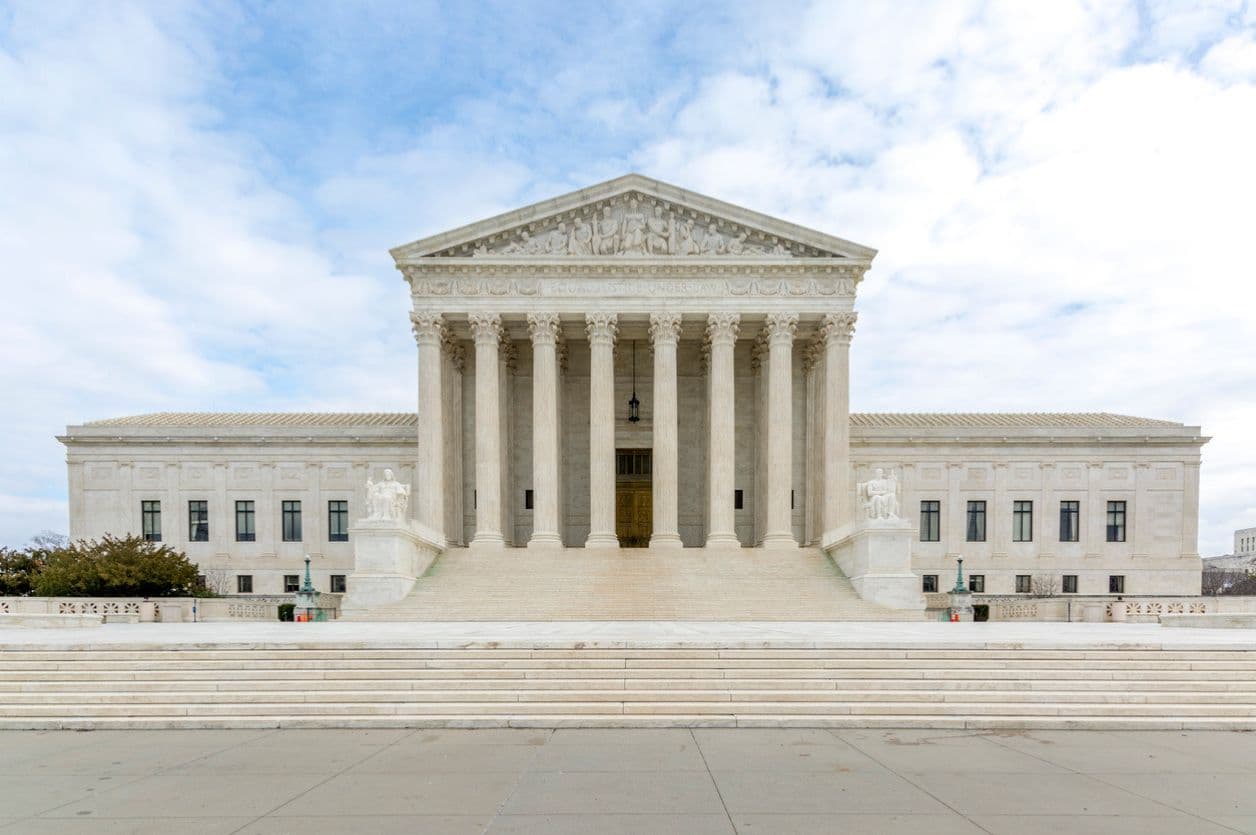
U.S. Supreme Court, Photo credit: iStockPhoto.com/BrianPirwin
Intelligence Summary
A US Supreme Court decision issued on Friday, February 20, 2026, ruled that President Donald Trump’s sweeping global tariffs imposed under the International Emergency Economic Powers Act (IEEPA) were unlawful, effectively voiding most of those measures and triggering immediate policy and market uncertainty. Following the ruling, Trump publicly escalated tariff threats, warning via Truth Social that countries that “play games” after the decision would face higher tariffs, and separately asserted he did not need congressional approval to impose tariffs.
In response to the court setback, Trump shifted to a different legal authority and announced a temporary global tariff under Section 122 of the 1974 Trade Act, first indicating a 10 percent rate and then raising it to 15 percent by Saturday, with reporting that the 15 percent level is the maximum allowed under that statute. The Section 122 mechanism was described as allowing the White House to impose tariffs for up to 150 days based on a presidential declaration without further investigation, after which the tariffs would expire unless Congress extends them.
US Customs and Border Protection (CBP) stated it would halt collection of tariffs imposed under IEEPA at 12:01 a.m. EST on Tuesday, February 24, 2026, and would deactivate all tariff codes associated with Trump’s prior IEEPA-related orders as of that time. CBP provided no reason for continuing to collect the IEEPA tariffs for more than three days after the Supreme Court ruling and did not provide information on possible refunds for importers. Reports tied the Supreme Court decision to potential refunds of more than $175 billion in US Treasury revenue generated by IEEPA tariffs, citing an estimate by Penn-Wharton Budget Model economists, and also cited an estimate that IEEPA-based tariffs had been generating more than $500 million per day in gross revenue. CBP also clarified that the IEEPA collection halt would not affect other tariffs imposed under Section 232 (national security) and Section 301 (unfair trade practices).
The tariff shift immediately affected US trade diplomacy with the European Union, where lawmakers again postponed approval steps for a transatlantic trade deal. The European Parliament’s trade committee postponed a vote that had been planned for Tuesday, February 24, 2026, on proposals to remove many EU import duties on US industrial goods and to continue zero duties for US lobsters initially agreed in 2020. The EU-US deal was struck in Turnberry, Scotland, in July 2025, by European Commission President Ursula von der Leyen and President Trump, The deal set a 15 percent maximum tariff on most EU imports into the US while Brussels agreed to remove many EU import duties on US goods, and required approval by the European Parliament and EU governments. European Commission spokesman Olof Gill said Brussels could not take further decisions until it had clarity from Washington on what was happening. Bernd Lange, chair of the European Parliament trade committee, said the new temporary US tariff could mean increased levies for some EU exports and that uncertainty remained about what would happen after the 150-day period. EU lawmakers are scheduled to reconvene on March 4 to assess whether the US clarified the situation and confirmed commitment to the 2025 deal.
German government spokesman Stefan Kornelius said Berlin was coordinating closely with European partners to determine what US tariffs to expect, while Chancellor Friedrich Merz was expected to travel to Washington that week to present a coordinated European position. Merz also raised the possibility of using the EU’s so-called trade bazooka as a final option to restrict access to the EU market. He expressed confidence a resolution could be found without using it.
China’s Commerce Ministry urged Washington to cancel unilateral tariffs, arguing they violate international trade rules and US domestic law after the Supreme Court ruling. Multiple reports described the prior escalation levels in the US-China tariff confrontation, stating US tariffs on Chinese goods at one point reached 145 percent and Chinese tariffs on US goods hit 125 percent, followed by a one-year pause reached in November that reduced tariffs to around 10 percent in some sectors. A comprehensive trade deal was reported as expected to be discussed during Trump’s state visit to Beijing in late March. US Trade Representative Jamieson Greer was reported as preparing alternative legal measures to reimpose permanent tariffs, including trade investigations into unfair trade practices targeting major partners, and as stating the US expects partners, including the UK, South Korea, and the EU, to stand by commitments made under tariff pressure.
Market reaction reflected the policy volatility, with gold rising 2 percent on Monday to a three-week high amid tariff uncertainty, and US equities falling in midday trading with the Nasdaq down 1.1 percent, the S&P 500 down 1 percent, and the Dow down 1.5 percent. Separate market reporting described S&P futures down 0.5 percent and Nasdaq 100 futures down 0.6 percent around 8:00 a.m. ET, alongside a defensive tone in premarket trading and continued investor focus on tariff uncertainty ahead of major US political and corporate events. A Washington Post-ABC News-Ipsos poll found 64 percent of Americans disapproved of Trump’s handling of tariffs.
Why it Matters
The immediate strategic significance of this episode is that US tariff policy is being forced into a rapid legal and administrative reconfiguration, and the resulting uncertainty is directly degrading US leverage in trade negotiations. The Supreme Court’s ruling removed the administration’s ability to rely on IEEPA for broad-based tariffs, and the pivot to Section 122 creates a built-in expiration clock of 150 days unless Congress extends it, which makes the tariff regime inherently time-limited and harder to use as a stable bargaining instrument. That time limit is already shaping behavior, as EU lawmakers explicitly linked their decision to postpone ratification steps to the inability to assess what tariff levels will apply after the temporary period ends.
For alliances, the EU response shows how tariff volatility can spill into broader political trust and institutional processes, even when a negotiated framework exists. The July 2025 Turnberry deal was designed to cap most EU exports to the US at 15 percent while reducing EU duties on US goods, but the new US 15 percent blanket tariff raised questions about whether it supersedes the deal and whether some products could face higher effective rates. The EU’s decision to reconvene on March 4 to reassess after seeking clarity from Washington indicates that the bloc is treating US tariff policy as insufficiently predictable to justify unilateral concessions such as removing EU import duties. Germany’s stated intent to coordinate a unified European position, combined with Merz’s reference to the EU’s market-access restriction tool as a last resort, signals that the dispute is moving beyond technical tariff schedules toward potential retaliatory or coercive trade instruments.
China’s call to scrap unilateral tariffs and reports that a comprehensive trade deal may be discussed during a late-March Beijing visit highlights how legal constraints inside the US can become negotiating leverage for rivals. Analysts have framed the Supreme Court ruling as strengthening China’s position by curtailing unilateral US authority, while noting the prior peak tariff levels of 145 percent and 125 percent. This underscores how quickly tariff disputes can escalate into systemic economic confrontation. At the same time, the US Trade Representative’s reported preparation of alternative legal pathways, including investigations into unfair trade practices, suggests the administration may shift from broad emergency tariffs to more targeted, process-driven tools that can still generate pressure but may take longer and be narrower in scope.
The operational and fiscal dimension matters because CBP’s halt to IEEPA tariff collections, combined with the lack of guidance on refunds, introduces a potentially large and politically sensitive financial overhang for importers and the US Treasury. The cited estimate that more than $175 billion in revenue could be subject to refunds, and that IEEPA tariffs were generating more than $500 million per day, indicates that the legal reversal is not only a trade policy issue but also a budget and cashflow issue with second-order effects on domestic politics and future tariff design. CBP’s clarification that Section 232 and Section 301 tariffs remain unaffected also implies that the administration retains other coercive trade instruments, which could shift the dispute into national security and unfair trade practice frameworks that often carry sharper geopolitical signaling.
Finally, the market response demonstrates that tariff policy volatility is functioning as a global risk factor alongside other geopolitical concerns, with safe-haven flows into gold and broad equity declines reported on February 23. The combination of policy whiplash, allied ratification freezes, and rival-state pressure to unwind tariffs points to a fragmentation dynamic where trade relationships become more contingent, more politicized, and more vulnerable to legal and electoral cycles.
Key Actors
- United States
- European Union
- Germany
- China
- India
- United Kingdom
- South Korea
Stay Informed. Stay Ahead.