Trump-Netanyahu Gaza Peace Plan Tests Middle East Diplomacy
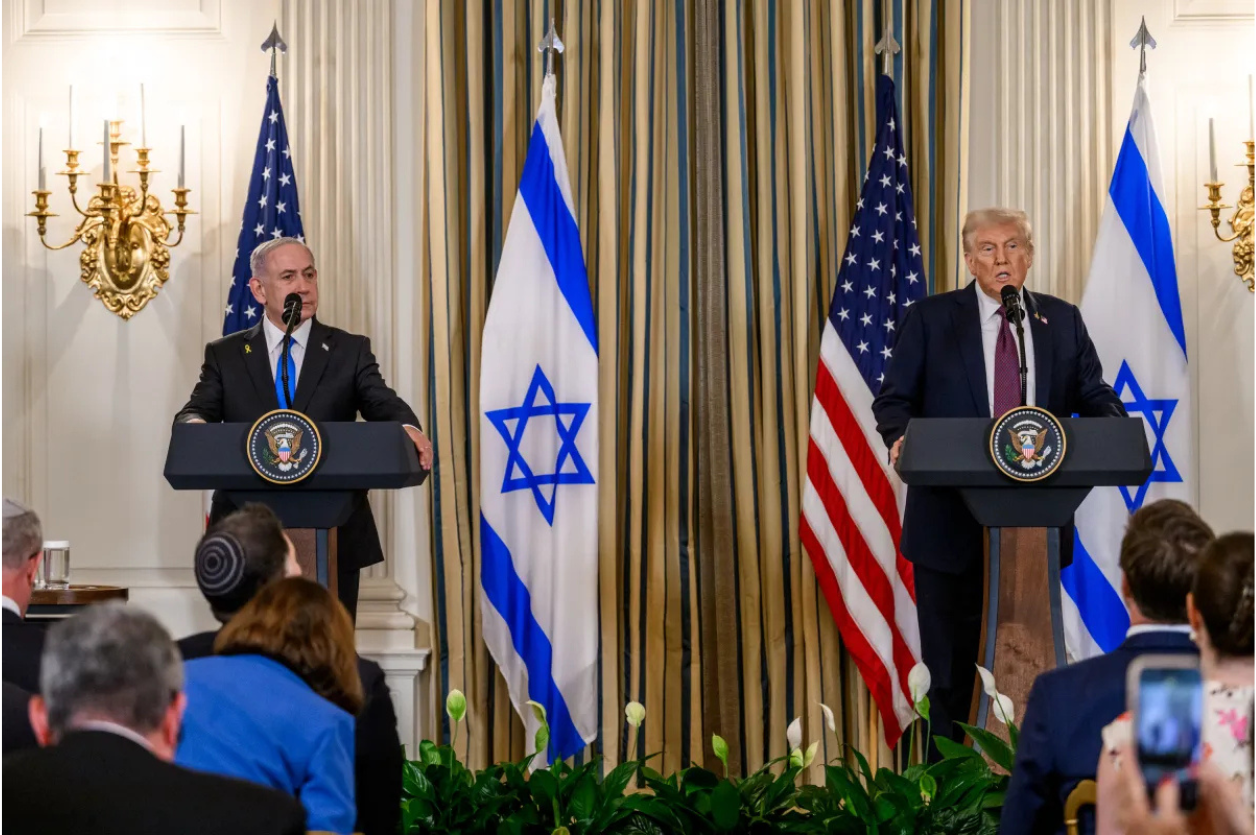
Photo credit: The United States White House
Intelligence Summary
On September 29, 2025, U.S. President Donald Trump and Israeli Prime Minister Benjamin Netanyahu jointly unveiled a 20-point ceasefire and governance plan for Gaza at the White House, marking Netanyahu’s fourth visit to Washington in 2025. The plan was presented as a comprehensive framework to end the war in Gaza, which has killed at least 66,055 Palestinians and wounded more than 168,000 since October 2023.
The proposal calls for an immediate ceasefire, with Israel halting military operations and withdrawing to agreed lines to prepare for a hostage release. Within 72 hours of Israel’s public acceptance of the agreement, all hostages, alive or deceased, would be returned. In exchange, Israel would release 250 prisoners serving life sentences and 1,700 Palestinians detained after October 7, 2023, including women and children. For each deceased Israeli hostage returned, Israel would release the remains of 15 Palestinians.
The plan stipulates that Hamas must disarm and relinquish governance of Gaza. Members who agree to peaceful coexistence and decommission weapons would be granted amnesty, while those wishing to leave Gaza would be given safe passage to receiving countries. Gaza would be governed by a temporary technocratic Palestinian committee, overseen by an international “Board of Peace” chaired by Trump and including former UK Prime Minister Tony Blair. This transitional authority would create the framework for the funding and redevelopment of Gaza until the Palestinian Authority (PA) completes its reform program and assumes control.
Security would be provided by a U.S.-backed International Stabilization Force (ISF), composed of Arab and international partners, with training support from Jordan and Egypt. The ISF would secure Gaza’s borders, prevent weapons smuggling, and train Palestinian police forces. Israel would progressively withdraw, but retain a security perimeter until Gaza is deemed secure from any “resurgent terror threat”.
The plan also includes a large-scale economic development initiative, with a special economic zone and international investment to rebuild Gaza’s infrastructure. Aid would be delivered through the UN, Red Crescent, and other neutral organizations, consistent with a January 2025 agreement, with a target of 600 trucks of aid per day.
Trump emphasized that Israel would not annex Gaza and that Palestinians would not be forced to leave, a shift from his earlier rhetoric advocating population removal. Instead, Gazans would be encouraged to remain and rebuild.
The plan was presented to Hamas by Qatari Prime Minister Sheikh Mohammed bin Abdulrahman Al Thani and Egypt’s intelligence chief. Hamas negotiators confirmed they were reviewing the proposal “in good faith”. Hamas officials reiterated that disarmament remains a red line if occupation continues, and Palestinian statehood is established on the 1967 borders.
The Palestinian Authority welcomed the plan and pledged to implement reforms. Arab and Islamic states including Saudi Arabia, UAE, Qatar, Egypt, Jordan, Turkey, Indonesia, and Pakistan issued a joint statement supporting Trump’s leadership and readiness to cooperate in implementation. European leaders including UK Prime Minister Keir Starmer, French President Emmanuel Macron, and Italian Prime Minister Giorgia Meloni also expressed support.
Despite Netanyahu’s public endorsement, he reiterated opposition to Palestinian statehood and insisted that Israel would maintain a military presence in Gaza. This contradicted the White House text, which stated Israel would not occupy or annex Gaza. Netanyahu also issued an apology to Qatar for a September 9 Israeli strike in Doha that killed a Qatari serviceman, an incident that had strained relations with a key mediator.
Unresolved issues remain. Analysts highlighted ambiguities regarding the formation of the transitional government, the mandate and composition of the ISF, the timeline for Israeli withdrawal, and the vague reference to Palestinian statehood. The plan treats Gaza as a separate entity, without addressing the West Bank or Israeli settlement expansion.
Why it Matters
The Trump-Netanyahu Gaza peace initiative marks a major attempt to reshape Middle East diplomacy, but its implications extend far beyond Gaza. Strategically, the plan positions the United States as the central arbiter of post-war governance, sidelining both Hamas and the Palestinian Authority in the short term. By placing Trump himself as chair of the “Board of Peace,” the U.S. consolidates direct control over Gaza’s political and economic reconstruction, effectively putting Gaza’s governance under international control led by Washington. This fits into a broader U.S. strategy of leveraging post-conflict stabilization to strengthen U.S. influence in the region.
The plan also shows how military threats and diplomacy are being used together. Netanyahu’s insistence that Israel will “finish the job” if Hamas rejects the deal, backed by Trump’s indication of U.S. support, signals that the proposal is presented more as an ultimatum than a negotiated deal. This approach may deter Hamas but risks entrenching the perception that the plan is a demand for surrender rather than a pathway to peace. The ambiguity surrounding Israel’s long-term military presence in Gaza casts further doubt on the proposal’s credibility, as Netanyahu’s statements directly contradict the White House text.
From a regional perspective, the plan has drawn rare consensus among Arab states, with Saudi Arabia, Qatar, Egypt, Jordan, and others publicly endorsing U.S. leadership. This shows a meeting of interests among Arab governments seeking to end the war and stabilize Gaza. However, the absence of Palestinian agency in shaping the plan risks eroding its legitimacy with the Palestinians, particularly given Hamas’s rejection of disarmament without statehood guarantees.
The economic side of the plan is equally significant. By proposing a special economic zone and large-scale international investment, the U.S. is attempting to tie security to economic incentives. This mirrors earlier U.S. strategies in Iraq and Afghanistan, where reconstruction was tied to political stabilization. However, without addressing core political issues such as Palestinian sovereignty, economic development alone is unlikely to deliver long-term stability.
The plan also has implications for geopolitical powers. By sidelining the UN and creating a U.S.-led governance structure, Washington is positioning itself as a central actor in Middle East conflict resolution, limiting the roles of Russia, China, and even the EU. This unilateral approach may reinforce U.S. influence among Arab allies but risks alienating other international actors who favor multilateral frameworks.
For Israel, the plan provides international backing for its war goals: dismantling Hamas’s military capacity, removing it from governance, and maintaining a security perimeter in Gaza. Netanyahu’s acceptance of the plan, despite internal coalition opposition, reflects both his reliance on U.S. support and the need to manage domestic politics. His apology to Qatar highlights the delicate balance Israel must manage between military operations and maintaining relations with key mediators.
For Hamas, the plan presents a stark choice: accept disarmament and exclusion from governance in exchange for amnesty and reconstruction, or face intensified Israeli military action. Given Hamas’s historical rejection of disarmament, the likelihood of acceptance remains low, increasing the chances of continued fighting.
Ultimately, the Trump-Netanyahu initiative lays bare the competing visions for Gaza’s future: U.S.-led international governance versus Palestinian self-determination. While the plan has garnered limited international support, its ambiguities, contradictions, and lack of Palestinian agency suggest that it may serve more as a diplomatic move to consolidate U.S. and Israeli positions than as a real path to lasting peace.
Key Actors
- United States
- Israel
- Hamas
- Palestinian Authority
- Qatar
- Egypt
- Saudi Arabia