Trump-Xi Talks Focus on Trade, Taiwan, and AI
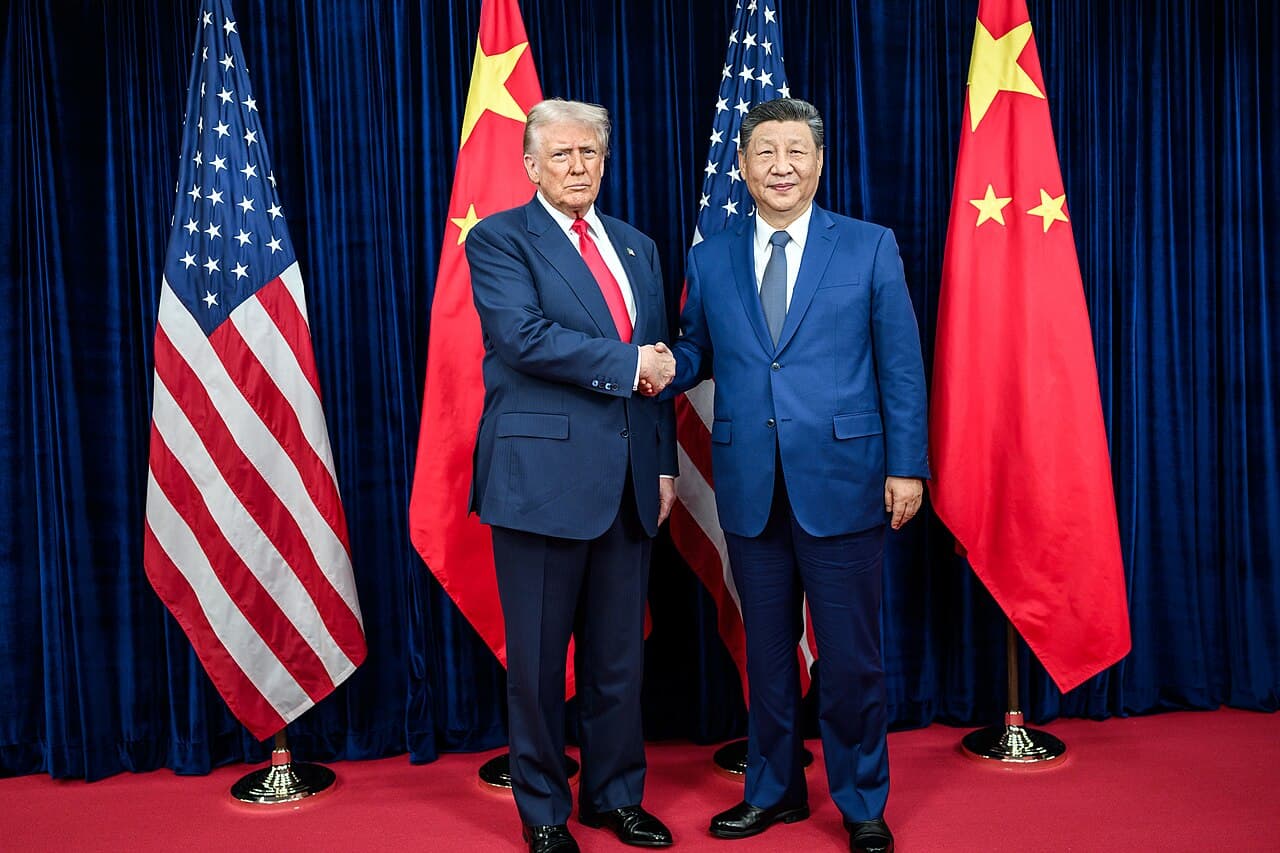
Gimhae International Airport terminal, Oct. 29, 2025, Busan, South Korea.
Photo credit: The White House, by Daniel Torok
Intelligence Summary
Chinese officials announced on May 11, 2026 that U.S. President Donald Trump will conduct an official visit to China from May 13 to May 15, 2026 at the invitation of Chinese President Xi Jinping. The trip is scheduled to include Trump’s arrival in Beijing on the evening of May 13, a welcome ceremony and bilateral meeting with Xi on May 14, a visit to the Temple of Heaven, and a state banquet. A second day of leader-level engagement is planned for May 15, including a bilateral tea and a working lunch. U.S. officials also indicated plans to host Xi for a reciprocal visit later in 2026.
The visit is framed as the first trip to China by a U.S. president in nearly nine years and is occurring amid heightened bilateral friction over tariffs, technology, and Taiwan. Beijing confirmed the May 13 to 15 dates shortly before the summit, after months of publicly noncommittal messaging that the two sides were in communication about Trump’s proposed visit. Preparatory engagement included a bipartisan U.S. congressional visit to Beijing that raised market access for U.S. firms, Boeing aircraft sales, tariff relief, and agricultural purchases as likely agenda items.
Parallel trade diplomacy was scheduled immediately before the summit. Both sides announced that Chinese Vice-Premier He Lifeng would travel to South Korea for trade talks with U.S. Treasury Secretary Scott Bessent on May 12 and May 13, described as a final round of negotiations before Trump’s arrival in Beijing. China’s Commerce Ministry stated that the talks would be guided by consensus reached at a prior Trump-Xi meeting in Busan, South Korea, and in previous phone calls, and would address economic and trade issues of mutual concern.
The summit occurs against the backdrop of a tariff confrontation that previously escalated above 100 percent on both sides before being paused after Trump and Xi met in South Korea in October 2025. Trump’s tariff approach included 2018 tariffs on $250 billion of Chinese imports and, after returning to office in 2025, additional measures including 20 percent tariffs linked to fentanyl accusations and a 34 percent levy announced on a so-called Liberation Day. The October 2025 meeting produced steps that included Beijing suspending export controls on rare earths and Washington dropping part of the tariffs tied to fentanyl-related ingredients, alongside a pause on planned reciprocal tariff increases.
Taiwan security issues were explicitly placed on the agenda. Trump stated at the White House that he will discuss U.S. arms sales to Taiwan with Xi during the Beijing meetings. Trump referenced a Taiwan weapons package announced in December valued at more than $11 billion and described as the largest in history. The same month, China conducted military drills simulating a blockade of Taiwanese ports.
The U.S. delegation is expected to include 17 senior executives spanning technology, finance, manufacturing, and agriculture, including Apple CEO Tim Cook, Tesla and SpaceX CEO Elon Musk, BlackRock CEO Larry Fink, Meta executive Dina Powell McCormick, Boeing CEO Kelly Ortberg, Visa CEO Ryan McInerney, Blackstone CEO Stephen Schwarzman, Cargill CEO Brian Sikes, Citi CEO Jane Fraser, Coherent CEO Jim Anderson, GE Aerospace CEO H. Lawrence Culp, Goldman Sachs CEO David Solomon, Illumina CEO Jacob Thaysen, and Mastercard president Michael Miebach. Nvidia CEO Jensen Huang is not listed, while Micron CEO Sanjay Mehrotra is included despite China’s 2023 restrictions on some Micron chips used in critical infrastructure.
Technology and AI governance issues were also positioned as salient, including concerns about cross-border diffusion of frontier AI capabilities through software channels such as API access, open-weight releases, synthetic datasets, and published research. U.S.-linked disclosures cited alleged large-scale extraction campaigns using fraudulent accounts involving Chinese laboratories DeepSeek, Moonshot AI, and MiniMax, alongside a White House Office of Science and Technology Policy memorandum accusing foreign entities principally based in China of industrial-scale campaigns against U.S. frontier systems. U.S. officials were also described as preparing a formal China-U.S. AI dialogue under the Trump administration, with the topic potentially on the Beijing agenda.
The Iran war and energy security pressures were identified as a major external factor shaping the summit’s timing and agenda. China’s oil position was described as buffered by domestic production, imports from Russia, and large reserves, while China was also characterized as Iran’s biggest oil buyer and reliant on Iran for cheap oil.
Why it Matters
This summit concentrates multiple coercive levers into a single leader-level bargaining space, increasing both the potential for stabilization and the risk of mis-signaling. The schedule itself matters because it creates two full days for iterative negotiation, not a single ceremonial encounter. That structure can enable trade-offs across files, but it also encourages linkage politics where concessions in one domain become implicit expectations in another.
Taiwan is the most escalation-sensitive issue on the agenda because it intersects directly with deterrence credibility and alliance confidence. The explicit intent to raise U.S. arms sales to Taiwan introduces a high-salience sovereignty dispute into a meeting already burdened by tariff and technology disputes. Even absent immediate policy change, leader-level language can shift perceived red lines. Regional actors calibrate their own defense planning and diplomatic hedging based on whether U.S. commitments appear steady, ambiguous, or transactional. The December arms package figure and the reference to blockade-simulation drills underscore that both sides are operating with recent, concrete signals of military preparedness and counter-preparedness.
Trade negotiations immediately preceding the summit indicate that economic stabilization is being treated as a prerequisite for political optics in Beijing. The sequencing suggests an attempt to reduce uncertainty before the leaders meet, which can prevent the summit from being consumed by technical disputes. At the same time, the history of tariffs rising above 100 percent demonstrates how quickly economic tools can become strategic weapons. The earlier pattern of reciprocal escalation, followed by partial pauses and selective relief, points to a cycle where both sides test pain thresholds and then seek face-saving off-ramps. That dynamic can harden into a durable feature of competition rather than a temporary crisis.
The presence of a large U.S. CEO delegation elevates the summit from statecraft into a combined political-economic campaign. This creates channels for commercial deals that can be presented as diplomatic wins, but it also embeds corporate interests into strategic bargaining. The inclusion of semiconductor-linked leadership alongside the absence of a central AI-chip figure highlights how export controls and market access are now inseparable from national security narratives. The Micron example illustrates how targeted restrictions can be used as signaling tools, shaping which firms gain or lose access and thereby influencing domestic political coalitions in both countries.
Technology competition is shifting from hardware chokepoints to software diffusion, which complicates enforcement and verification. Hardware controls can be licensed and interdicted, but software-based capability transfer through APIs, open weights, and distillation techniques is harder to police without broad surveillance or intrusive compliance regimes. Allegations of industrial-scale extraction campaigns and fraudulent account networks indicate that intelligence and cyber dimensions are becoming central to AI competition. This pushes the relationship toward a security dilemma in which defensive measures by one side are interpreted as offensive preparation by the other, especially when attribution is contested and verification is weak.
The Iran war’s spillover into this summit underscores how third-theater conflicts can reshape major power bargaining. Energy security pressures create incentives for both Washington and Beijing to seek de-escalation, but they also create leverage. If one side is perceived as more exposed to energy shocks or supply chain disruption, the other may attempt to extract concessions on unrelated issues. The result is a more interconnected strategic ledger where tariffs, rare earths, AI controls, and crisis diplomacy become mutually reinforcing tools.
Overall, the summit reflects a phase of selective bargaining rather than comprehensive reset. The combination of Taiwan deterrence signaling, tariff management, CEO-driven dealmaking, and AI governance disputes suggests a relationship increasingly organized around controlled competition, with periodic leader-level interventions to prevent spirals from becoming irreversible.
Stay Informed. Stay Ahead.