U.S.-China Tariff Cuts Extend Trade Truce
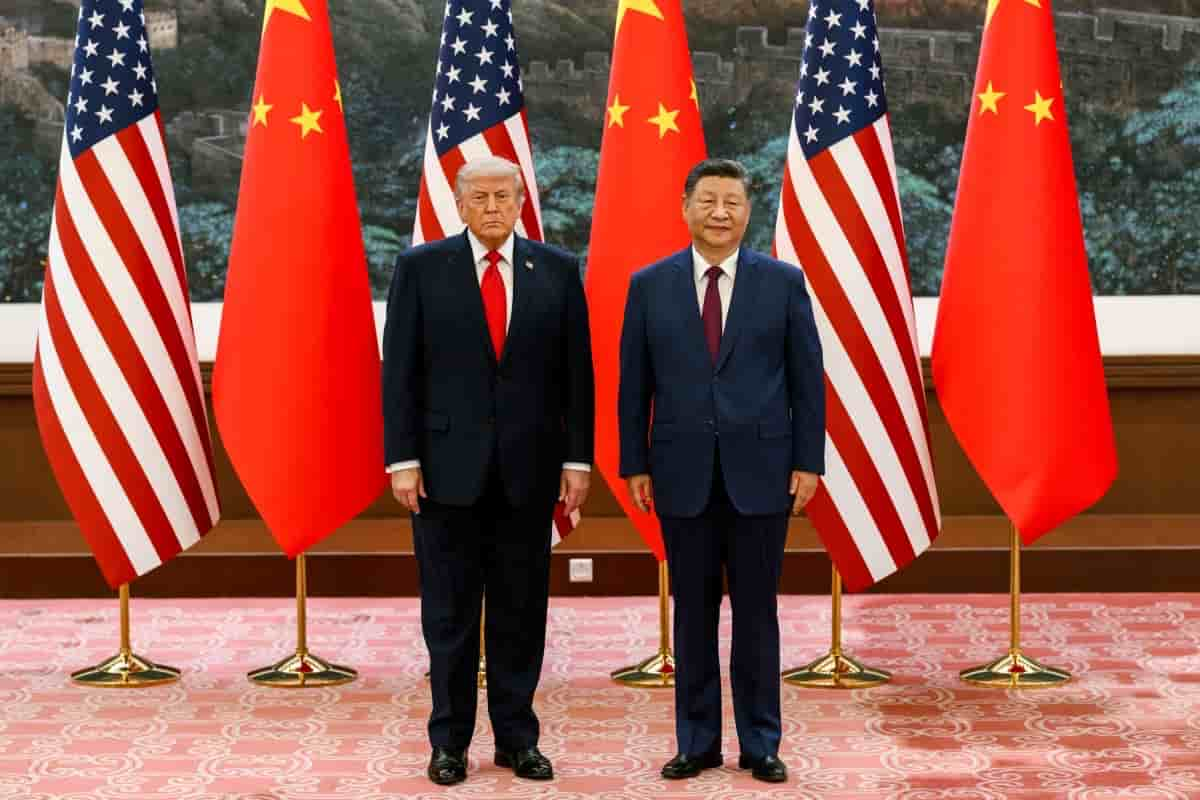
September 23, 2026. Photo credit: Official White House Photo
Intelligence Summary
The United States and China have released reciprocal product lists covering approximately $60 billion in bilateral trade for reduced tariff treatment, following the September 25 meeting between Presidents Donald Trump and Xi Jinping in Washington. The arrangement covers roughly $30 billion of imports in each direction. The United States identified 77 categories of Chinese goods, principally consumer products such as toys, tableware, fireworks, ornaments, microwave ovens, and other household items. China listed 1,619 U.S. products, including agricultural commodities, food products, coal, timber, medical equipment, and personal-care goods.
The announced treatment would reduce tariffs on more than 90 percent of listed products to most-favored-nation rates, according to China’s Commerce Ministry. In practical terms, this would remove country-specific tariffs from many covered items and return them to generally lower standard rates. However, implementation remains somewhat unclear. U.S. officials presented the lists as an agreement to provide more favorable treatment, while China’s Commerce Ministry described further discussions on a reciprocal tariff-reduction framework intended to reach consensus. Both governments indicated that the lists could be adjusted, likely no more than annually.
Agriculture is a significant but qualified component of China’s list. China included corn, wheat, sorghum, vegetable oils and meals, meat, dairy products, and other U.S. farm goods. Soybeans were excluded and remain subject to an additional 10 percent tariff. This is consequential because soybeans are a major U.S. agricultural export to China, and traders have said the existing tariff remains too high for private Chinese crushers to absorb. Chinese state firms Sinograin and COFCO have reportedly purchased more than 12 million metric tons of U.S. soybeans, while the White House has said Beijing committed to annual purchases of 25 million metric tons through 2028. China has not confirmed that purchase target.
The lists follow a two-month extension of the wider U.S.-China trade truce, moving its expiration from November to January. They also follow a sharp contraction in commerce after previous U.S. tariffs on Chinese goods reached as high as 145 percent. Two-way trade totaled $495 billion in 2025, a 25 percent decline from the prior year, according to the Office of the U.S. Trade Representative. The agreement does not cover strategically sensitive sectors, including semiconductors, electric vehicles, and batteries.

Why It Matters
The product lists represent a limited stabilization measure rather than a reset in U.S.-China economic relations. Their principal value is political and commercial. They create a defined area in which both governments can demonstrate reciprocal tariff relief while leaving their most sensitive economic disputes untouched. By concentrating on non-sensitive consumer, agricultural, energy, and manufactured goods, the arrangement reduces the risk that tariff relief will be interpreted as a concession on strategic technology or industrial competition.
The asymmetry in the trade relationship shapes the agreement’s effects. U.S. exports to China reached roughly $68 billion in the first seven months of 2026, while Chinese exports to the United States totaled about $270 billion in the first eight months. A $30 billion reduction list therefore covers a materially larger share of U.S. exports to China than of Chinese exports to the United States. This may give U.S. exporters, especially selected farmers and consumer brands, proportionally greater immediate market-access gains. Conversely, the U.S. list may modestly lower prices for selected consumer products and provide Chinese exporters with access to demand in a constrained market.
Soybeans illustrate the limits of the accommodation. Beijing’s inclusion of a broad set of U.S. agricultural goods provides relief in sectors that can support bilateral trade, but leaving soybeans under the additional 10 percent tariff preserves a major commercial constraint. The distinction allows progress in agricultural trade without resolving one of the most economically important and politically visible import categories. The gap between the White House’s stated soybean-purchase commitment and China’s lack of public confirmation also leaves the scale and durability of farm-sector recovery uncertain.
Near-term escalation risk appears lower while the broader truce remains in place and Trump and Xi are scheduled to meet again at the Asia-Pacific Economic Cooperation summit in November and the Group of 20 meeting in December. Yet the arrangement does not remove the principal sources of friction. The United States is investigating China, among other partners, under a Section 301 inquiry concerning excess industrial capacity, which could lead to additional tariffs. The key indicators will be whether the product lists are formally implemented, whether they are expanded beyond low-sensitivity goods, and whether the Section 301 process introduces measures that offset the present tariff relief.
Stay Informed. Stay Ahead.