China and the United States Seek Stability Through Trade and Security Dialogue
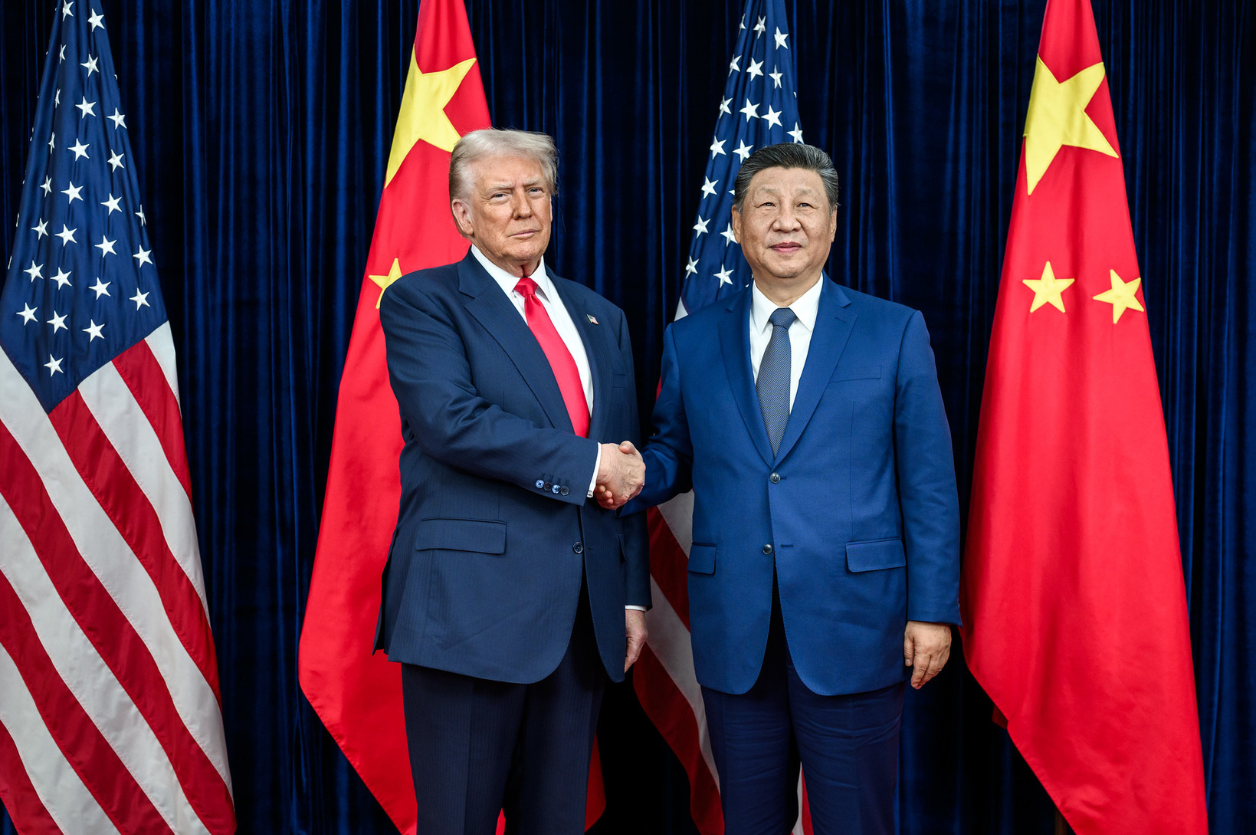
Photo credit: The White House
Intelligence Summary
On October 30 2025, U.S. President Donald Trump and Chinese President Xi Jinping met in Busan, South Korea, for what the White House framed as a “G2 summit,” signaling a shift in U.S.-China relations toward managed competition and selective cooperation. The meeting produced a temporary trade truce after months of tariff escalation. Trump agreed to halve the 20 percent fentanyl-related tariffs, while China committed to resume large-scale purchases of U.S. soybeans and will issue general export licences for rare earths. The White House fact sheet released on November 2 confirmed that Beijing would issue general export licenses for gallium, germanium, antimony and graphite, reversing restrictions imposed in October 2022 and April 2025.
U.S. Secretary of War Pete Hegseth also alleged that the Busan summit resulted in an agreement that direct military-to-military communication channels should be established between the U.S. and China to prevent escalation in future crises. Hegseth met Chinese Defense Minister Dong Jun in Malaysia shortly after the summit to discuss implementation. The concessions followed Trump’s earlier threats to impose 100 percent tariffs on Chinese imports.
China’s leverage in the negotiations stemmed from its dominance in rare earth production, accounting for 70 percent of global output and holding an estimated 44 million tonnes in reserves compared to the United States’ 1.9 million tonnes. The U.S. share of global rare earth production stands at 11 percent, giving Beijing significant influence over supply chains for advanced technologies.
Beijing also agreed to suspend investigations into U.S. semiconductor firms, including antitrust and anti-dumping probes, and to resume exports from Nexperia’s Chinese facilities, which supply critical legacy chips to Western automakers. The White House confirmed that China would postpone the implementation of new export controls on rare earths announced on October 9 for an additional year.
In Europe, China’s economic leverage has exposed structural vulnerabilities exemplified by two seemingly unrelated events. German industry remains deeply dependent on Chinese imports, with 25 percent of German companies sourcing semiconductors directly from China and approximately one million German jobs tied to exports to the Chinese market. Germany imported €156 billion in goods from China in 2024, while exporting €90 billion, making China its largest trading partner. The first event came in Volkswagen’s warning of potential production halts if rare earth exports were restricted. The second in the Netherlands’ decision to place Dutch-Chinese chipmaker Nexperia under state control in September 2025 triggered a diplomatic dispute with Beijing. These events are representative of the effects of geopolitics and China’s economic dominance on European industry.
China’s economic influence extends beyond Europe. In Indonesia, the $7.2 billion Jakarta-Bandung high-speed rail project, a flagship Belt and Road Initiative (BRI) investment, has become financially unsustainable. The project’s costs have risen 20 percent above initial estimates, and the operator, KCIC, faces mounting debt. Indonesia’s anti-corruption agency has launched an investigation into cost overruns, while the government seeks to renegotiate loan terms with the China Development Bank, including possible conversion of dollar-denominated debt into yuan.
China’s technological ambitions have also advanced. On November 3, 2025, Xpeng Aeroht began trial production of its modular flying car, the “Land Aircraft Carrier,” at a 120,000-square-meter facility in Guangzhou which has an annual production capacity of 10,000 detachable aircraft modules. The company has received 5,000 preorders, with mass production and delivery scheduled for 2026. The development underscores China’s push to lead in next-generation transport technologies amid global competition with U.S. firms such as Tesla.
China’s financial strategy continues to emphasize yuan internationalization. The currency now accounts for 30 percent of China’s $6.2 trillion trade in goods and 53 percent of all cross-border payments, which surpassed the dollar in China’s trade settlements for the first time in 2023. The yuan’s share of global reserves reached 2.4 percent in mid-2025. Beijing has signed currency swap agreements with over 50 countries and expanded its Cross-Border Interbank Payment System (CIPS) to more than 20 nations, offering an alternative to the dollar-dominated SWIFT network.
Regionally, China’s influence faces pushback. Vietnam has reclaimed 3,319 acres of land in the South China Sea since 2022, 71 percent of China’s total reclamation, constructing new harbors and an airstrip on Barque Canada Reef to enhance maritime logistics. However, China has refrained from direct interference, possibly due to respect for Vietnam’s military capabilities.
Why it Matters
The Busan “G2” summit signaled a temporary stabilization in U.S.-China relations but also affirms the reality of a potential bipolar world order. The mutual concessions on tariffs and rare earth exports reflect de-escalation rather than genuine reconciliation. China’s control over 70 percent of global rare earth production remains a strategic deterrent against Western economic coercion. By agreeing to issue export licenses and suspend semiconductor probes, Beijing demonstrated its ability to use supply chain leverage as a bargaining tool while preserving long-term dominance in critical minerals.
For the United States, the trade truce provides short-term relief for industries dependent on Chinese inputs but underscores enduring vulnerabilities in strategic materials. The future establishment of military-to-military communication channels suggests both sides recognize the risk of miscalculation in an environment of heightened military activity in the Indo-Pacific. However, the long standing history of the global competition for power will likely persist beneath the surface of cooperation.
Europe’s exposure to Chinese supply chains, particularly Germany’s dependence on Chinese semiconductors and rare earths, highlights fragility within the continent. The Nexperia dispute and Volkswagen’s warnings illustrate how Beijing can exploit economic interdependence to extract concessions. The EU’s limited capacity to diversify supply chains or attract alternative investment highlights the widening gap between U.S. and European industrial competitiveness.
In Southeast Asia, the Belt and Road Initiative’s financial strains in Indonesia reveal the limits of China’s infrastructure diplomacy. The Jakarta-Bandung rail project’s debt burden and corruption probes weaken Beijing’s narrative of win-win development and may deter future partners from accepting similar financing terms. Yet, China’s willingness to renegotiate loans in yuan suggests a broader strategy to expand the currency’s international role and reduce dollar exposure.
Technological competition remains central to China’s global strategy. The launch of Xpeng’s flying car production facility demonstrates Beijing’s ambition to dominate emerging industries. Despite domestic overcapacity and foreign tariffs, China’s ability to scale production rapidly reinforces its position as a global manufacturing hub.
The yuan’s growing role in trade and finance represents a deliberate effort to insulate China and its partners from Western sanctions. The expansion of CIPS and currency swap networks provides an alternative financial architecture that could erode the dollar’s dominance over time, particularly among BRICS and Global South nations. However, Beijing’s refusal to allow full convertibility limits the yuan’s potential as a global reserve currency, ensuring that its rise remains regionally concentrated rather than universal.
Vietnam’s accelerated land reclamation in the South China Sea illustrates how regional actors are recalibrating their strategies amid shifting power balances. Vietnam’s assertiveness reflects growing confidence in its maritime capabilities and tacit U.S. support, while China’s restraint indicates a preference for avoiding simultaneous confrontations.
Taken collectively, the developments reveal the complexities of competition, coercion, and adaptation in the current geopolitical landscape. Economic instruments currently serve as tools of strategic deterrence and coercive diplomacy. The temporary calm achieved in Busan may delay confrontation, but the underlying global contest for technological, financial, and geopolitical primacy remains unresolved.
Key Actors
- United States
- China
- Germany
- Indonesia
- Vietnam
- India