US Embassy Evacuation and Military Buildup Signal Escalating Iran Confrontation
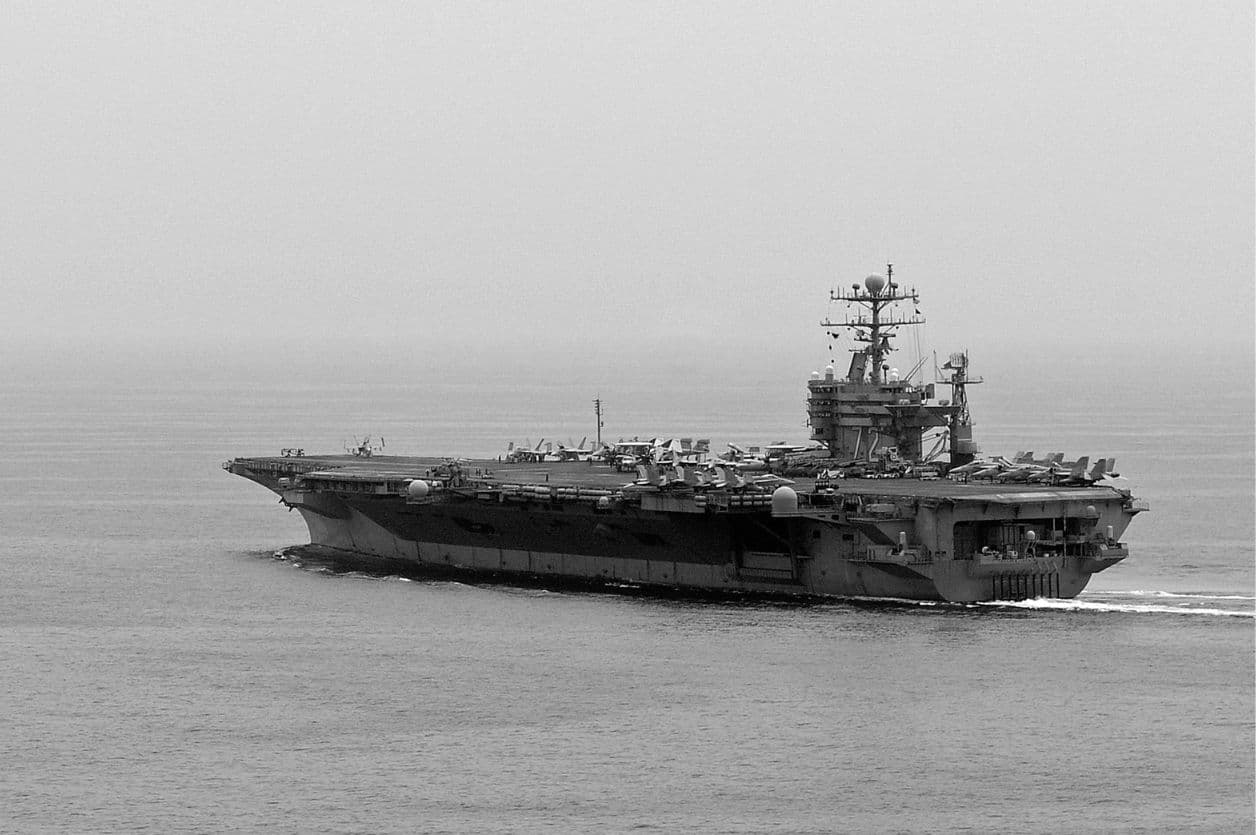
Photo Credit: Mass Communication Specialist Seaman Apprentice Joshua E. Walters/U.S. Navy 2012
USS Abraham Lincoln in Arabian Sea
Intelligence Summary
The United States has ordered the departure of non‑emergency personnel and eligible family members from its embassy in Beirut following a security review that cited escalating regional tensions and the possibility of armed conflict with Iran. Approximately fifty embassy staff were affected, with thirty‑two and their families departing Beirut on February 23. The State Department described the measure as temporary and precautionary, maintaining that the embassy would continue operations with essential staff.
The evacuation coincided with a major US military buildup across the Middle East, described as the largest since the 2003 invasion of Iraq. Satellite imagery confirmed the presence of the aircraft carrier USS Abraham Lincoln in the Arabian Sea, roughly 700 kilometers from Iran, supported by destroyers, combat ships, and fighter aircraft. The US also redeployed hundreds of troops from bases in Qatar and Bahrain, mirroring pre‑war movements seen before the June 2025 “12‑Day War” between Israel and Iran.
President Donald Trump publicly stated that he was considering a limited strike on Iran if negotiations failed, suggesting that a decision could come within ten days. Reports indicated that the administration was weighing a “targeted strike” on Iranian military or nuclear sites, potentially followed by a broader campaign aimed at regime change if Tehran did not comply with US demands for zero uranium enrichment. The proposed targets included the headquarters of the Islamic Revolutionary Guard Corps and ballistic missile facilities.
Within the administration, senior officials expressed divergent views. Chairman of the Joint Chiefs of Staff General Dan Caine reportedly warned that an attack on Iran could lead to a protracted conflict, heavy US casualties, and depletion of missile defense stockpiles already strained by the 2025 conflict. President Trump publicly rejected these warnings, asserting confidence in a swift victory if hostilities began. Vice President JD Vance and Secretary of State Marco Rubio were described as cautious but not opposed to military action, while Senator Lindsey Graham urged the president to disregard advisors advocating restraint.
Diplomatic efforts continued in parallel. Iranian Foreign Minister Abbas Araghchi and US envoy Steve Witkoff, joined by Jared Kushner, held indirect talks in Switzerland and Oman, with a third round scheduled in Geneva on February 26. Iran’s Foreign Ministry spokesman Esmaeil Baghaei stated that Tehran sought a diplomatic resolution but would treat any US strike as an act of aggression warranting self‑defense. President Masoud Pezeshkian described the negotiations as producing “encouraging signals” but emphasized readiness for all scenarios.
Iran’s leadership reiterated that US bases and assets in the region would be legitimate targets if attacked. Tehran also warned that it would not accept demands to halt uranium enrichment, asserting its sovereign right to civilian nuclear development. The US, meanwhile, continued to expand its regional military posture, deploying two aircraft carriers and reinforcing air defenses.
Regional dynamics further complicated the situation. Israel intensified airstrikes in Lebanon, killing at least twelve people in the Bekaa Valley and violating the 2024 ceasefire agreement. Lebanese officials reported over two thousand Israeli breaches of sovereignty in late 2025 and warned that continued attacks risked dragging Lebanon into a wider Iran‑US confrontation. Hezbollah, weakened by Israel’s 2024 campaign, signaled that it might intervene militarily if Iran were attacked. The Lebanese government, under President Joseph Aoun and Prime Minister Nawaf Salam, had agreed to a US‑backed plan to disarm Hezbollah, but the group maintained that its weapons were essential for national defense.
The cumulative effect of these developments was a region on high alert. Multiple governments, including Sweden, Poland, and Australia, advised citizens to leave Iran amid fears of imminent conflict. Both Washington and Tehran continued to signal openness to diplomacy, yet each simultaneously prepared for war, creating a volatile environment where miscalculation could trigger a large‑scale confrontation.
Why it Matters
The February 2026 escalation between the United States and Iran represents a convergence of military brinkmanship, alliance politics, and deterrence signaling that could reshape the Middle East’s strategic balance. The US evacuation from Beirut and the concurrent military buildup indicate that Washington is preparing for potential hostilities while attempting to maintain diplomatic leverage. The deployment of carrier strike groups and redeployment of forces from Gulf bases serve both as deterrence and as preparation for rapid escalation, demonstrating how military posturing can function as coercive diplomacy.
For Iran, the crisis underscores the dual strategy of resistance and negotiation. Tehran’s insistence on its right to uranium enrichment and its warnings of retaliation against US bases reflect a deterrence posture designed to raise the cost of any attack. By coupling diplomatic engagement with explicit threats of regional retaliation, Iran seeks to prevent unilateral US action while preserving domestic legitimacy amid internal unrest.
The internal divisions within the US administration reveal the tension between political imperatives and military risk assessment. General Caine’s caution about stockpile depletion and potential casualties contrasts sharply with the president’s confidence in a quick victory. This divergence highlights the recurring challenge of civil‑military coordination in crisis decision‑making. The involvement of political figures such as Rubio, Vance, and Graham also illustrates how domestic politics can shape foreign policy choices, particularly in an election‑sensitive environment.
Israel’s intensified operations in Lebanon add a destabilizing dimension. By escalating strikes against Hezbollah while the US contemplates action against Iran, Israel risks opening a northern front that could draw Lebanon and possibly Syria into a broader conflict. The Lebanese government’s inability to secure international guarantees against further Israeli incursions demonstrates the erosion of deterrence mechanisms established after the 2024 ceasefire. Hezbollah’s potential re‑entry into conflict would likely trigger Iranian support, creating a multi‑front war that could engulf the Levant.
Energy security and global trade routes are also at stake. A US‑Iran conflict would threaten shipping through the Strait of Hormuz, through which roughly one‑fifth of global oil supply passes. Although not explicitly mentioned in the sources, the scale of the US naval deployment and Iran’s history of targeting regional infrastructure imply that energy markets would face severe disruption if hostilities began. The presence of two US carrier groups and expanded air defenses underscores Washington’s intent to secure maritime chokepoints and protect allied energy flows.
Diplomatically, the crisis tests the resilience of multilateral mediation. Oman’s facilitation of indirect talks and Switzerland’s hosting of negotiations show that regional intermediaries remain active, but the credibility of diplomacy diminishes when both sides escalate militarily. The simultaneous pursuit of talks and threats reflects a pattern of coercive negotiation that risks misinterpretation.
From an intelligence perspective, the situation demonstrates the interplay between overt military signaling and covert preparation. The redeployment of troops, the evacuation of diplomatic personnel, and the selective release of satellite imagery all serve as indicators of operational readiness. Analysts must assess whether these actions are intended primarily for deterrence or as prelude to offensive operations.
Ultimately, the 2026 US‑Iran confrontation illustrates how competition, regional proxy dynamics, and domestic political pressures can converge to create a high‑risk environment. The absence of clear communication channels and the overlapping military operations in Lebanon, the Gulf, and the Arabian Sea increase the probability of miscalculation. For students of intelligence and geopolitics, this episode underscores the importance of integrating military, diplomatic, and informational indicators to anticipate escalation pathways and assess the credibility of deterrence postures.
Key Actors
- United States
- Iran
- Israel
- Lebanon
- Hezbollah
- Oman (mediator)
- Switzerland (host of negotiations)
Stay Informed. Stay Ahead.