U.S.–India Trade Agreement Links Tariff Relief to Energy Realignment
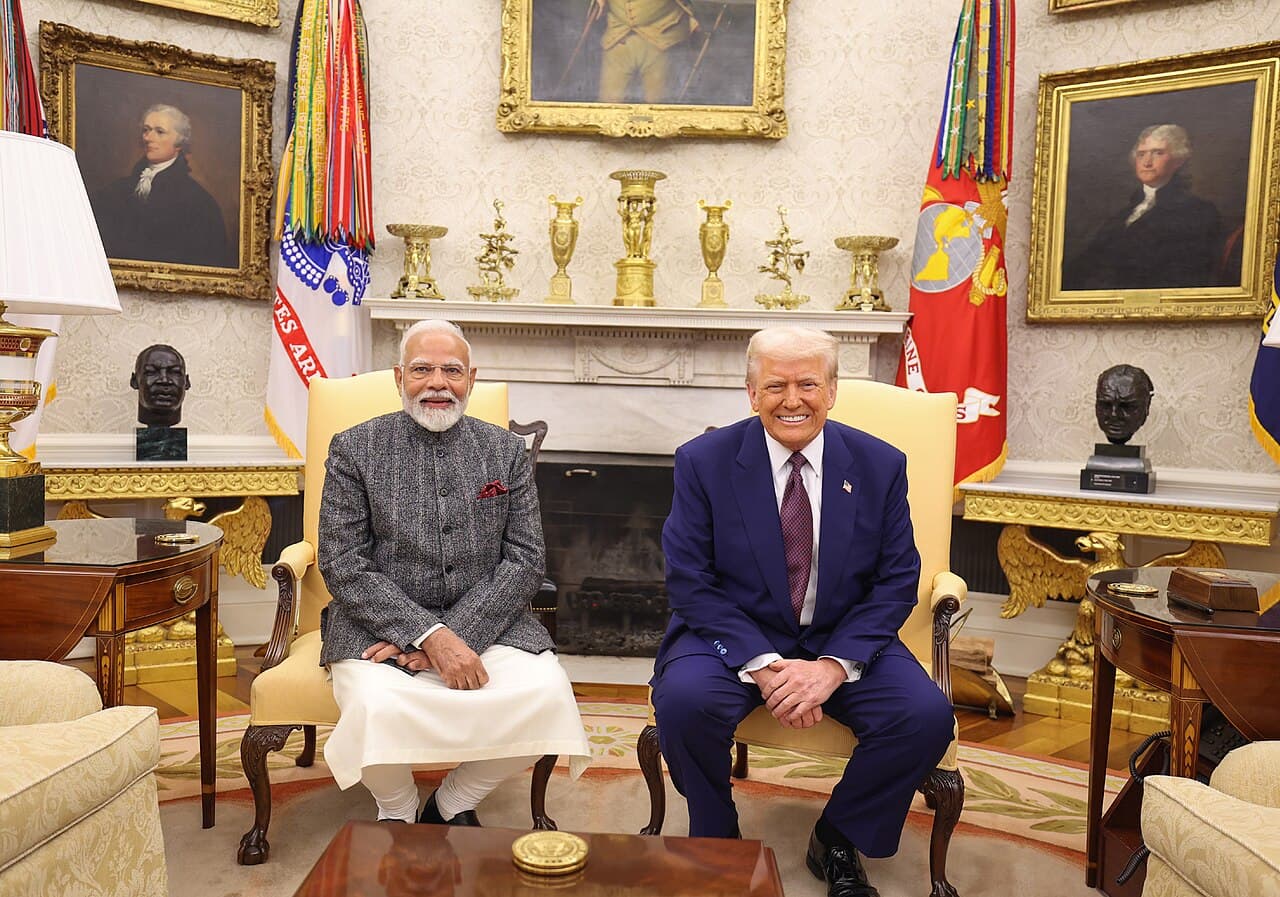
Prime Minister of India Narendra Modi and U.S. President Donald Trump at the White House, February 13, 2025.
Photo credit: GODL-India
Intelligence Summary
On February 2, 2026, United States President Donald Trump and Indian Prime Minister Narendra Modi announced a bilateral trade agreement that immediately reduced U.S. tariffs on Indian goods from 50 percent to 18 percent. The 50 percent rate had included a 25 percent penalty imposed in August 2025 over India’s continued purchases of Russian oil. The new agreement followed a phone call between the two leaders and was presented as a breakthrough after months of stalled negotiations.
According to Trump’s public statement, India agreed to halt its imports of Russian crude oil and to increase purchases of U.S. and potentially Venezuelan oil. He also stated that India would reduce its tariffs and non-tariff barriers on U.S. goods to zero and commit to buying more than $500 billion worth of American products, including energy, technology, agriculture, and coal. Modi confirmed the tariff reduction and expressed optimism about the partnership but did not explicitly confirm the oil purchase commitments.
The White House confirmed that the punitive 25 percent duty linked to Russian oil purchases would be rescinded as part of the deal. The agreement came less than a week after India signed a landmark free trade agreement with the European Union, which had been under negotiation for nearly two decades. Analysts described the U.S.-India deal as a strategic response to the EU-India pact, which aimed to reduce both sides’ dependence on the U.S. economy.
Indian officials framed the deal as a major step toward strengthening the “Make in India” initiative and deepening strategic cooperation with Washington. External Affairs Minister Subrahmanyam Jaishankar, who was in Washington for a ministerial meeting on critical minerals supply chains, said the agreement would spur growth, create jobs, and promote innovation in both economies. Union Home Minister Amit Shah and Minister Ashwini Vaishnaw also hailed the deal as historic, emphasizing its potential to enhance technology collaboration and peace-oriented development.
Domestically, the announcement triggered a sharp rally in Indian financial markets. On February 3, 2026, the BSE Sensex surged by over 4,200 points, or 5.14 percent, to 85,871.73, while the Nifty 50 index rose nearly 5 percent to 26,341.20. Export-oriented sectors such as textiles, leather, and manufacturing saw gains of up to 20 percent, and the rupee appreciated by 119 paise to 90.30 against the U.S. dollar.
However, opposition figures in India criticized the agreement. Congress Party General Secretary Jairam Ramesh accused Modi of capitulating to U.S. pressure, arguing that Trump had dictated the terms of the deal from Washington.
In Moscow, Kremlin spokesman Dmitry Peskov stated that Russia had not received any official communication from India about halting oil purchases. Russian Deputy Prime Minister Aleksandr Novak said Moscow would continue to develop its energy relationship with India and that global demand would ensure continued sales. Moody’s warned that an immediate halt to Indian imports of Russian crude could disrupt global oil markets and harm India’s economic growth.
Data from analytics firm Kpler indicated that India’s imports of Russian crude had already declined from over 2 million barrels per day in mid-2025 to about 1.1 million barrels per day in January 2026, with further reductions expected. Iraq and Saudi Arabia were increasing their supply shares to India, signaling a gradual diversification of energy sources.
The trade deal coincided with India’s participation in a U.S.-led ministerial on critical minerals, aimed at reducing global dependence on China for strategic resources. The timing underscored a broader U.S.-India alignment on supply chain resilience and energy security.

Why it Matters
The U.S.-India trade deal represents a significant realignment in global economic and energy geopolitics. By linking tariff reductions to India’s energy sourcing decisions, Washington effectively used trade leverage to advance its sanctions regime against Russia. If fully implemented, India’s shift away from Russian oil would mark a major success for U.S. efforts to isolate Moscow economically, while simultaneously deepening India’s integration into Western energy and technology supply chains.
Strategically, the agreement strengthens the U.S.-India partnership as a counterweight to both China and Russia. The inclusion of commitments on critical minerals and technology cooperation aligns with Washington’s broader Indo-Pacific strategy, which seeks to secure supply chains and reduce dependency on adversarial states. Jaishankar’s participation in the critical minerals ministerial during the same week highlights how trade, energy, and strategic resource policy are being coordinated across multiple domains.
For India, the deal offers immediate economic relief and market confidence. The surge in stock indices and currency appreciation demonstrate investor optimism about renewed access to the U.S. market and reduced tariff burdens. However, the long-term implications are more complex. India’s energy security depends on affordable imports, and Russian crude has been a key factor in stabilizing domestic prices. A rapid reduction in Russian oil purchases could expose India to higher costs and supply volatility, especially if Venezuelan or U.S. supplies prove less competitive.
The Kremlin’s denial of any official notification from New Delhi suggests that India may be pursuing a phased or symbolic reduction rather than a full cessation of Russian imports. This ambiguity allows India to balance its strategic partnerships without overtly alienating Moscow, which remains a major defense and energy partner. The measured decline in Russian oil imports, as shown by Kpler data, supports the interpretation of a gradual diversification rather than an abrupt cutoff.
Politically, the deal underscores the asymmetry in U.S.-India relations. Trump’s unilateral announcement and the perception of Indian acquiescence have fueled domestic criticism that New Delhi conceded too much for tariff relief. Yet, from a strategic standpoint, the agreement may enhance India’s leverage in future negotiations with both Washington and Brussels. The nearly simultaneous conclusion of the EU-India free trade agreement suggests that New Delhi is hedging its bets by deepening ties with multiple Western partners.
For the United States, the deal serves multiple objectives: reinforcing sanctions enforcement, expanding energy exports, and demonstrating leadership in global trade realignment. By offering tariff relief in exchange for energy compliance, Washington has created a model for using economic incentives to achieve geopolitical goals. The inclusion of potential Venezuelan oil purchases also signals a pragmatic approach to stabilizing global energy prices while maintaining pressure on Russia.
In the broader context, the U.S.-India deal illustrates how trade policy is being weaponized as a tool of strategic alignment. It also highlights the growing interdependence between economic and security domains, where tariff structures, energy flows, and supply chain agreements collectively shape the balance of power. The outcome will depend on how consistently both sides implement their commitments and whether India can sustain its delicate balancing act between Western partnerships and its traditional ties with Russia.
Key Actors
- United States
- India
- Russia
- European Union
- Venezuela
Stay Informed. Stay Ahead.