
Missile Warfare and Energy Disruption Define Iran Conflict
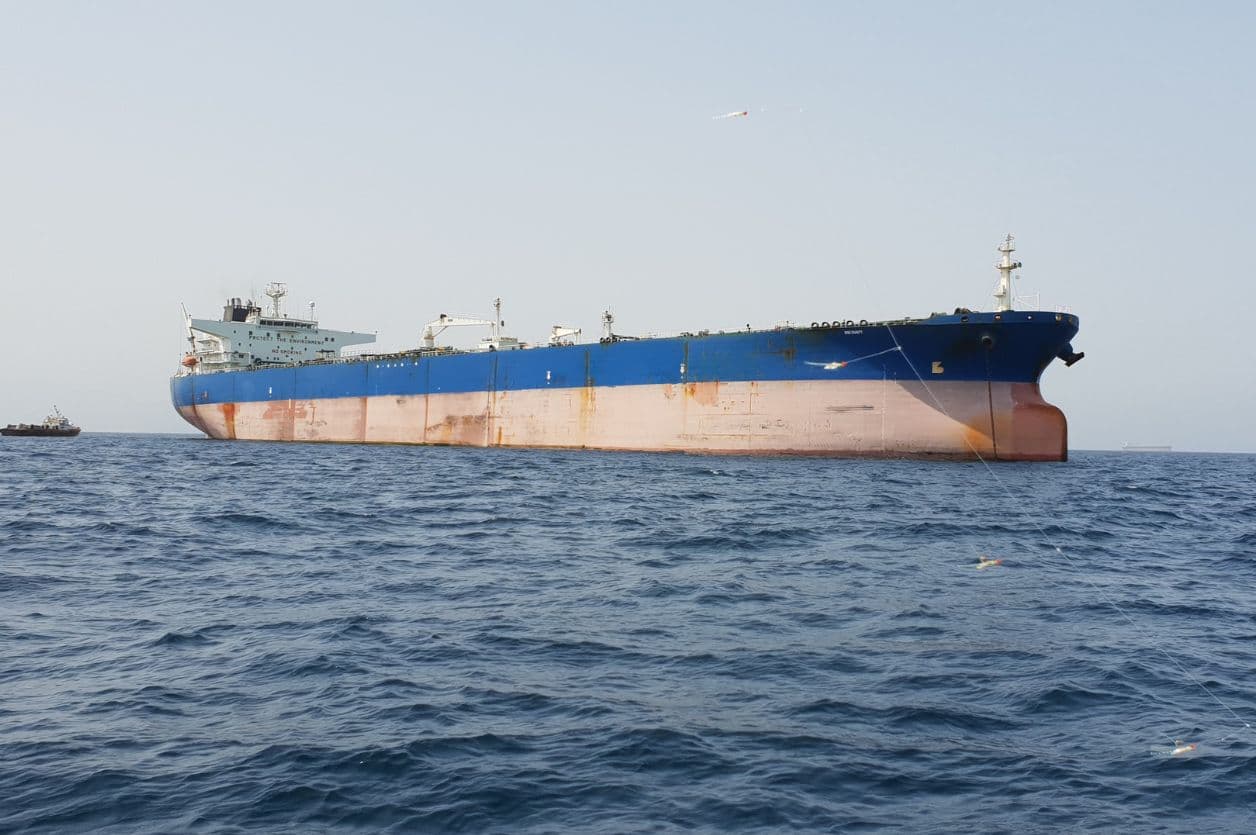
Oil tanker in Strait of Hormuz, Photo credit: iStockPhoto.com/World Traveler
Intelligence Summary
The joint United States–Israeli military campaign against Iran began on February 28, 2026, with large-scale air and missile strikes targeting Iranian military infrastructure, including air defense systems, missile launchers, and naval assets. The initial operation killed Iran’s Supreme Leader, Ayatollah Ali Khamenei, and several senior commanders, marking a decapitation strike intended to collapse the Iranian regime. However, the strategy failed to produce the expected rapid surrender. Iran’s new leader, Mojtaba Khamenei, was swiftly appointed, and the country continued to launch missiles and drones at Israeli and U.S. targets.
By the second week of the war, Tehran was experiencing some of the most intense bombardments of the conflict. U.S. President Donald Trump claimed that over 5,000 targets had been struck, destroying Iran’s navy, air force, and up to 90 percent of its missile launchers. Iranian officials reported more than 1,255 deaths and 10,000 injuries, including 40 killed in a single attack on residential buildings in eastern Tehran. The Iranian Foreign Ministry accused the U.S. of seeking to partition the country and seize its oil resources, while Foreign Minister Abbas Araghchi vowed to continue fighting.
Iran retaliated with missile and drone attacks across the region. Israeli cities such as Haifa and Tel Aviv were hit, killing at least 11 people. Iran’s Islamic Revolutionary Guard Corps (IRGC) claimed responsibility for a drone strike on an Israeli oil refinery in Haifa. In Lebanon, Hezbollah launched rockets at Israel following Khamenei’s death, prompting Israeli offensives that killed more than 486 people and displaced nearly 700,000.
Iranian missiles and drones also struck U.S. bases and allies across the Gulf. Kuwait, Bahrain, Saudi Arabia, and the United Arab Emirates reported intercepting multiple projectiles, with Bahrain confirming one civilian death and eight injuries. The UAE’s defense ministry reported intercepting hundreds of missiles and over 1,300 drones, while Saudi Arabia’s defense forces destroyed drones over Riyadh and al-Kharj. Kuwait’s Ali Al-Salem Air Base and Bahrain’s U.S. Navy 5th Fleet headquarters were damaged.
The conflict also extended beyond the Middle East. NATO air defenses allegedly intercepted an Iranian ballistic missile over Türkiye, marking the first such incident in alliance airspace. A U.S. submarine sank the unarmed Iranian warship IRIS Dena off Sri Lanka, killing more than 80 sailors. Iran also targeted U.S. bases in Iraq and Syria, while Jordan and Qatar intercepted missiles aimed at U.S. installations.
Infrastructure attacks became a defining feature of the war. On March 7, U.S. and Israeli forces struck Iranian oil depots in Tehran and Karaj, hitting 30 large tanks and causing environmental damage. Iran retaliated by striking refineries in Haifa and oil facilities in Kuwait and Bahrain, forcing Bahrain’s state oil company to declare force majeure. The bombardment of Iranian oil facilities drove global crude prices above $110 per barrel before dropping to $90 after Trump threatened further escalation if Iran blocked the Strait of Hormuz.
Diplomatic efforts emerged alongside military escalation. Russian President Vladimir Putin offered mediation proposals to end the war, which the Kremlin said remained “on the table.” Putin and Trump discussed the conflict by phone, with Trump urging Russia to end its war in Ukraine while acknowledging Moscow’s potential role in de-escalation. The Kremlin denied reports that Russia was providing Iran with targeting intelligence.
Domestically, Trump described the campaign as “Operation Epic Fury,” calling it a short-term excursion that would end “pretty quickly.” He claimed the U.S. had sunk 46 Iranian naval ships and eliminated most of Iran’s missile capacity. However, his administration’s messaging was inconsistent. On March 10, Trump alternated between declaring the war nearly complete and promising to intensify strikes if Iran continued threatening oil tankers. Defense Secretary Pete Hegseth confirmed that heavier ordnance, including 2,000-pound bombs, would be used in the next phase.
Public opinion diverged sharply. In Israel, over 80 percent of citizens supported the war, and the Tel Aviv Stock Exchange rallied despite missile attacks. In the U.S., rising fuel prices and economic concerns fueled domestic unease, with polls showing declining support for the war. European leaders, including German Chancellor Friedrich Merz and Spanish Prime Minister Pedro Sánchez, warned against mission creep and compared the campaign to the Iraq War.
Why it Matters
The U.S.–Israeli war with Iran represents a convergence of global competition, energy security crises, and regional instability on a scale unseen in decades. The conflict demonstrates how rapid escalation between asymmetric actors can transform a targeted military operation into a multidimensional geopolitical crisis. The initial decapitation strike on Iran’s leadership failed to achieve regime collapse, revealing the limits of precision warfare and the resilience of state structures under extreme pressure. This outcome underscores the analytical concept of “resilience as strategy,” where Iran’s capacity to sustain operations despite leadership loss shifts the conflict from a short-term campaign to a war of endurance.
The war’s regional expansion highlights the fragility of deterrence architectures across West Asia. Iran’s ability to strike U.S. and allied bases in Kuwait, Bahrain, and Saudi Arabia, and to reach as far as Türkiye and Sri Lanka, demonstrates the diffusion of missile technology and the erosion of traditional containment strategies. The alleged interception of Iranian missiles by NATO air defenses in Turkish airspace marks a critical threshold, drawing the alliance into direct defensive engagement and raising the risk of inadvertent escalation.
Energy security has become a central theater of conflict. The bombardment of Iranian oil infrastructure and retaliatory strikes on Gulf energy facilities have disrupted production and shipping through the Strait of Hormuz, a chokepoint for 20 percent of global oil supply. Even temporary disruptions have triggered price volatility, with crude prices oscillating between $90 and $120 per barrel. This volatility exposes the structural vulnerability of global markets to regional warfare and underscores how energy chokepoints can be leveraged as instruments of strategic coercion.
Diplomatically, the war has fractured international alignments. Russia’s mediation offers signal Moscow’s intent to assert influence in the Middle East amid Western distraction. The Kremlin’s denial of intelligence-sharing with Iran reflects its balancing act between strategic partnership and global image management. Meanwhile, European leaders’ warnings about mission creep reveal transatlantic divisions reminiscent of the Iraq War era, suggesting that U.S. unilateralism continues to strain alliance cohesion.
The conflict also illustrates the interplay between military technology and political signaling. The U.S. and Israel’s reliance on high-cost precision munitions and missile defense systems contrasts sharply with Iran’s use of inexpensive drones and ballistic missiles. This cost asymmetry favors Iran’s attrition strategy, forcing its adversaries to expend disproportionate resources on defense. The reported depletion of Israeli interceptor stockpiles and the U.S. use of increasingly heavy ordnance indicate a shift toward escalation rather than resolution.
Domestically, the war’s political repercussions are significant. In Israel, high public support and economic resilience have bolstered Prime Minister Benjamin Netanyahu’s wartime leadership. In contrast, U.S. domestic opinion has turned skeptical as fuel prices rise and economic indicators weaken. Trump’s inconsistent messaging, oscillating between imminent victory and open-ended escalation, reflects the tension between military ambition and political risk.
Strategically, the war underscores the enduring challenge of defining achievable end states in modern conflict. The U.S. and Israel’s stated goals, eliminating Iran’s military capacity and ensuring long-term security, lack clear metrics for success. As European leaders warned, such open-ended objectives risk entrenching the conflict into a self-perpetuating system of retaliation and deterrence. The historical parallels to Iraq and Afghanistan suggest that without a credible political settlement, military success may yield strategic failure.
Ultimately, the war’s significance lies in its transformation of the Middle East into a testing ground for 21st-century warfare, where energy markets, cyber operations, and information control are as decisive as missiles and bombs. The outcome will shape global perceptions of U.S. power projection, the durability of alliances, and the future of deterrence in an era of multipolar competition.
Key Actors
- United States
- Iran
- Israel
- Russia
- Saudi Arabia
- Bahrain
- United Arab Emirates
Stay Informed. Stay Ahead.