U.S. Seizure of Iranian Vessel Raises Ceasefire Tensions
The appearance of U.S. Department of Defense (DoW) visual information does not imply or constitute DoW endorsement.
Intelligence Summary
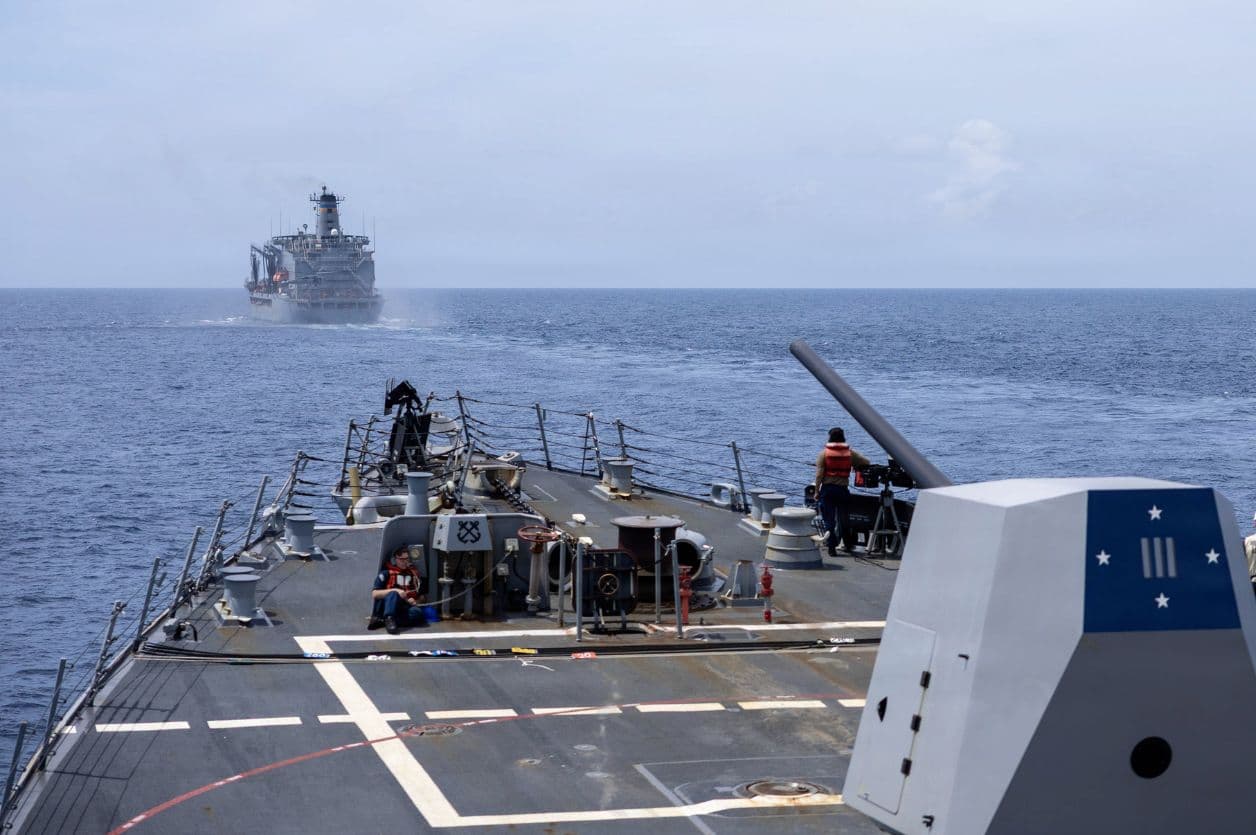
On April 19, 2026, U.S. forces seized the Iranian-flagged cargo ship M/V Touska near the Strait of Hormuz after it attempted to evade a U.S. naval blockade, with imagery showing the Arleigh Burke-class guided-missile destroyer USS Spruance conducting the interception in a location described as the north Arabian Sea. The seizure occurred during a fragile U.S.–Iran ceasefire that was described as nearing expiration within days, increasing uncertainty over whether the truce would hold through its end date.
U.S. Central Command stated the USS Spruance fired its 5-inch (127 mm) MK 45 gun into the Touska’s engine room to disable the vessel after repeated warnings over a six-hour period, followed by a boarding operation by U.S. Marines from the 31st Marine Expeditionary Unit. Video released by U.S. Central Command depicted troops arriving by helicopter from the USS Tripoli and boarding via ropes. The Touska was described as a 294-meter-long container ship, 32.25 meters wide, and Iranian-flagged, with its cargo not publicly confirmed at the time. The vessel and its owners were described as being under U.S. Treasury and Office of Foreign Assets Control sanctions for alleged sanctions-evasion support to Iran.
The U.S. blockade was described as having begun on April 13, 2026, with enforcement focused on barring Iranian ships and vessels traveling to or from Iranian ports from transiting the Strait of Hormuz. U.S. Central Command stated that since the blockade began, U.S. forces directed 27 vessels to turn around or return to an Iranian port. President Donald Trump stated the blockade would not be lifted until a deal with Tehran was reached, and he framed the blockade as inflicting severe economic pressure on Iran. Trump stated Iran was losing $500 million per day due to the blockade.
Iran’s joint military command, Khatam al-Anbiya, described the boarding as piracy and warned of retaliation for what it characterized as armed piracy by the U.S. military. Iran also characterized the seizure as a ceasefire violation, with Iranian officials linking continued U.S. actions to reluctance to proceed with diplomacy. Iranian Foreign Ministry spokesperson Esmaeil Baghaei stated Tehran had no plans to send negotiators to Islamabad shortly after the seizure, while also indicating distrust of Washington and citing perceived U.S. ceasefire violations. Iran’s parliament speaker and top negotiator Mohammad Bagher Qalibaf stated Tehran would not negotiate under threats and described U.S. positioning as an attempt to force surrender, while also stating Iran had been preparing new battlefield options over the prior two weeks.
Pakistan prepared to host a second round of negotiations in Islamabad, with tightened security measures including road closures and preparations at the Serena Hotel, which had hosted a prior round. U.S. participation was described as uncertain in timing, with Vice President JD Vance expected to lead the U.S. delegation alongside special envoy Steve Witkoff and adviser Jared Kushner, while travel timing was described as pending. Iran’s Foreign Minister Abbas Araqchi told Pakistani Foreign Minister Ishaq Dar that continued ceasefire violations were a major obstacle to diplomacy, while Iran weighed participation. Separate accounts cited unnamed Pakistani officials and an unnamed senior Iranian official indicating Tehran was positively reviewing participation, despite public statements of no plans.
Maritime disruption intensified as Iran maintained its own restrictions on Hormuz, described as lasting nearly two months, contributing to sharp energy price increases. Vessel movements through the strait were described as severely reduced, with data indicating only two liquefied petroleum gas carriers and two oil product tankers transited in both directions on Monday, alongside examples of rerouting and vessels going dark. French President Emmanuel Macron called for de-escalation and described the blockade dynamic as a mistake on both sides, while noting a French-linked container ship reported warning shots and that all crew were safe. China stated concern over the U.S. seizure and called for reopening the strait as an international waterway, and urged negotiations before the ceasefire’s scheduled end.
President Trump publicly defended the war and reiterated objectives tied to preventing an Iranian nuclear weapon, while also signaling interest in a new deal he described as better than the 2015 Joint Comprehensive Plan of Action. Trump also referenced regime change as a possible outcome and asserted the war was going well. Estimates cited by a Harvard Kennedy School public policy expert, Linda Bilmes, placed U.S. war costs near $2 billion per day, while noting limited conclusive Pentagon figures.
Why it Matters
The seizure of an Iranian-flagged commercial vessel under a declared naval blockade marks a decisive escalation in coercive maritime enforcement, with immediate implications for international law, alliance cohesion, and escalation control. A blockade that targets shipping to and from Iranian ports, combined with Iran’s own restrictions on the strait, creates a dual-chokepoint crisis where both sides can claim defensive necessity while raising the probability of miscalculation. The operational detail that a U.S. destroyer used naval gunfire to disable a ship before a helicopter-borne boarding underscores how quickly enforcement can shift from signaling to kinetic action, especially when compliance windows are measured in hours.
The Strait of Hormuz disruption is not only an energy-market story. It is a strategic test of whether the United States can impose maritime control without triggering wider regional retaliation or fracturing partner support. The diplomatic track in Pakistan illustrates how coercion and negotiation are being run in parallel, but the sequencing problem is acute. Each additional interdiction or retaliatory strike can politically foreclose talks, while the mere prospect of talks can incentivize brinkmanship to improve bargaining positions. Iran’s explicit linkage between ceasefire violations and attendance decisions shows how tactical incidents at sea can become veto points for diplomacy.
Major power competition is embedded in the crisis through external positioning and the contest over norms. China’s call to reopen the strait frames the waterway as an international commons issue, implicitly challenging unilateral enforcement actions that disrupt global trade. Russia’s emphasis on preserving a truce within parameters announced by Pakistani mediators highlights a competing diplomatic narrative that elevates non-Western mediation channels. These positions matter because they shape how third states interpret legitimacy, compliance, and future precedent for chokepoint weaponization.
The crisis also exposes the limits of coalition readiness and the friction of alliance politics under time pressure. The concept of assembling a maritime coalition to reopen and secure the strait depends on specialized capabilities, especially mine countermeasures, and on political willingness to accept risk in a high-threat environment. The emphasis on leveraging existing multinational maritime frameworks reflects a practical recognition that ad hoc coalitions struggle when partners face maintenance cycles, competing commitments, and domestic skepticism. The suggestion that Ukraine could contribute mine countermeasure expertise and platforms indicates how the West Asian theater can pull in actors from other conflicts, further entangling security agendas.
Information operations and domestic political signaling are shaping escalation dynamics. Public claims about daily economic losses, war progress, and regime change messaging can harden negotiating positions and reduce off-ramps. When leaders frame outcomes in maximalist terms, compromise becomes politically costly, and adversaries may interpret rhetoric as intent. That increases the risk that maritime incidents become triggers for broader strikes, especially if either side believes credibility is on the line.
Finally, the operational tempo implied by daily cost estimates and the discussion of depleted stocks points to a sustainability challenge. A prolonged maritime enforcement campaign consumes munitions, readiness, and attention that compete with other theaters. Even if the immediate objective is to pressure Iran, the second-order effect is to stress U.S. force posture and complicate deterrence elsewhere. The Hormuz crisis therefore functions as a live demonstration of how chokepoint disruption can impose global costs quickly, while also forcing strategic trade-offs that adversaries can exploit.
Stay Informed. Stay Ahead.