
Vance Visit Signals U.S. Support for Orbán
Intelligence Summary
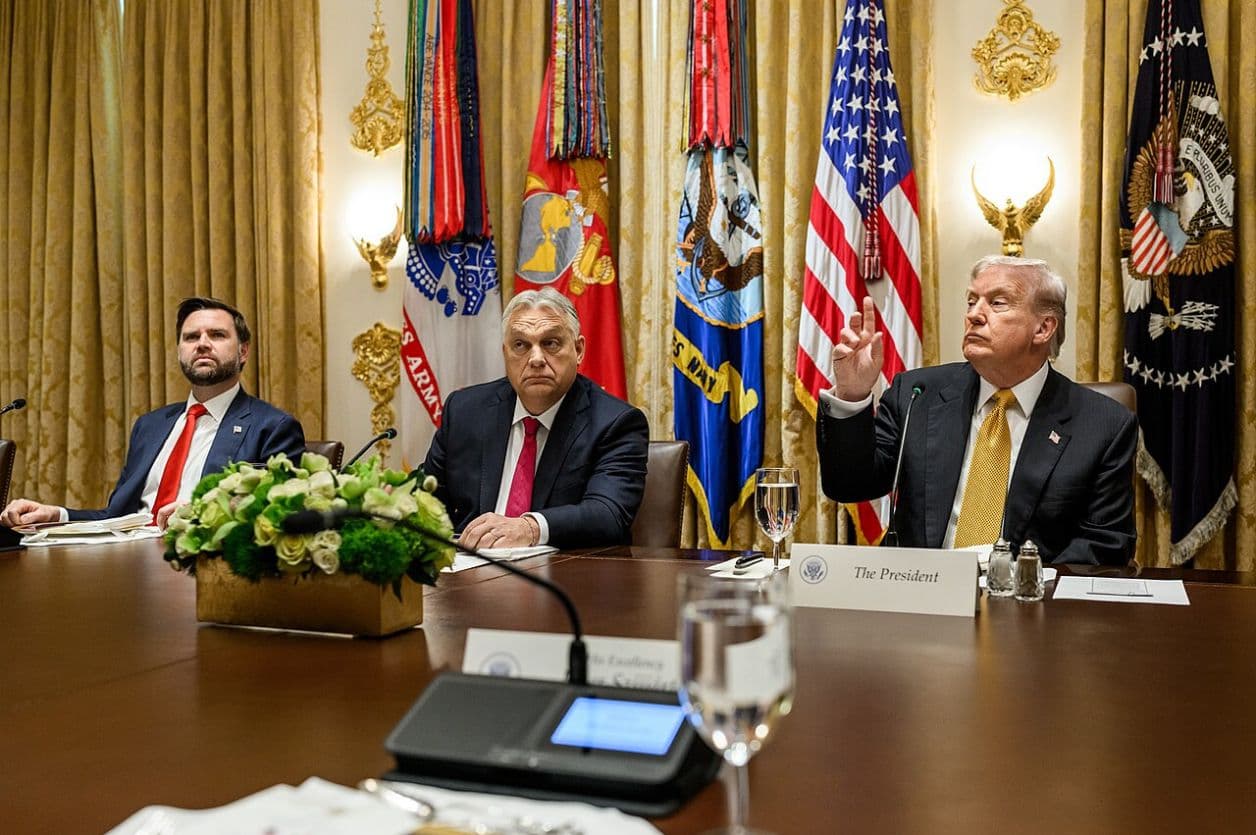
U.S. Vice President JD Vance traveled to Budapest to publicly support Hungarian Prime Minister Viktor Orbán ahead of Hungary’s April 12 parliamentary election, a contest described as Orbán’s most difficult in more than a decade and his toughest challenge in a political career spanning nearly 40 years. Vance’s schedule included an official meeting with Orbán on Tuesday morning, a joint press conference, and participation in a campaign rally in a football stadium. Vance traveled with his wife, Usha Vance, and they were greeted at Budapest airport by Hungarian Foreign Minister Péter Szijjártó.
The visit followed U.S. President Donald Trump’s February endorsement of Orbán and came after U.S. Secretary of State Marco Rubio visited Hungary in February to signal support. Trump also delivered a video message to the Hungarian Conservative Political Action Conference in Budapest last month stating his support for Orbán’s reelection. Hungarian officials framed the visit as evidence of a strengthened bilateral relationship, with Szijjártó stating that discussions would cover migration, global security, and economic and energy cooperation.
Orbán’s governing Fidesz party faced a challenge from Péter Magyar, a former Fidesz insider who broke with the party two years ago and founded the center-right Tisza party. Multiple polling descriptions indicated Orbán trailing, including ranges placing Tisza ahead by 8 to 12 points in some polls and up to 20 points in others, while a strongly pro-government polling agency was described as placing Fidesz narrowly ahead. Orbán sought to use high-profile U.S. political backing to influence undecided voters by reinforcing his international standing during a period described as turbulent.
Energy security featured prominently in the political context surrounding the election and U.S.-Hungary ties. Orbán traveled to Washington in October to secure an exemption for Hungary from U.S. sanctions on Russian oil firms Rosneft and Lukoil, and Trump later characterized the exemption as a personal deal tied to Orbán’s political position. Orbán also committed in Washington to purchase more U.S. liquefied natural gas and to pursue U.S. nuclear technology and fuel.
Hungary’s dependence on Russian energy supplies was described as acute, including reliance on Russian oil via the Druzhba pipeline and Russian gas via the TurkStream pipeline. No oil had reached Hungary through the Druzhba pipeline since the end of January, and Orbán blamed Ukraine for not restoring flows after a Russian attack on oil infrastructure in western Ukraine on January 27. Hungary responded by releasing fuel reserves and importing non-Russian oil through an alternative pipeline from Croatia.
A separate security incident emerged on Sunday when Serbia announced explosives had been found and neutralized near the TurkStream gas pipeline close to the Hungarian border. Orbán and pro-government media labeled the incident a terror attack on Hungary’s energy supply, while former Hungarian intelligence sources and opposition leader Péter Magyar accused Orbán of staging the incident with Serbian President Aleksandar Vučić to improve reelection prospects, an allegation presented without independent verification in the provided material.
Orbán’s campaign messaging emphasized hostility toward Ukraine and President Volodymyr Zelenskyy. Additional political pressure came from leaked transcripts of private telephone conversations between Szijjártó and senior Russian officials over several years, described as suggesting that Szijjártó kept Russia informed about confidential EU summit discussions and lobbied to remove Russian officials from sanctions lists. Szijjártó defended the calls as normal diplomacy.
Why it Matters
A sitting U.S. vice president campaigning alongside a European Union head of government days before a national election signals a sharper fusion of U.S. domestic politics with alliance management. This approach reduces the distance between partisan alignment and state-to-state relations, making bilateral cooperation more contingent on electoral outcomes. The reported linkage between a sanctions exemption and the continuation of a specific leader’s tenure reinforces that perception. It also increases the likelihood that future European partners interpret U.S. commitments as more personalized and less institutional.
Hungary’s election has outsized alliance implications because it sits at the intersection of EU cohesion, NATO posture, and Russia policy. Orbán’s long-running disputes with Brussels, combined with his positioning on Ukraine, create a structural vulnerability for collective European decision-making. Even if the election remains primarily domestically driven, the visible external endorsement elevates it into a proxy contest over Europe’s political direction. The presence of other far-right leaders in campaign messaging, alongside U.S. engagement, suggests a transnational political network that can amplify polarization inside the EU and complicate consensus on sanctions, military assistance, and rule-of-law conditionality.
Energy security is the most immediate strategic pressure point connecting domestic politics to geopolitics in this case. Hungary’s reliance on Russian oil and gas, combined with disruptions on both the Druzhba and TurkStream routes, turns infrastructure reliability into an election issue and a national security narrative. The Druzhba stoppage since late January, the need to release fuel reserves, and the shift to alternative imports via Croatia illustrate how quickly supply shocks can force policy improvisation. In that environment, promises of expanded U.S. LNG purchases and nuclear cooperation become politically salient tools, not just economic decisions. They also create leverage for Washington, since energy diversification pathways can be framed as rewards for alignment.
The TurkStream explosives incident highlights how pipeline security incidents can be weaponized politically, regardless of ultimate attribution. Competing narratives, including claims of terrorism versus allegations of staging, demonstrate how critical infrastructure events can become instruments of domestic legitimacy and regional signaling. This dynamic matters for deterrence and escalation management because ambiguous incidents near cross-border energy corridors can trigger retaliatory rhetoric, security deployments, or diplomatic crises even when facts remain contested. It also underscores the intelligence dimension: allegations involving former intelligence sources and claims of orchestration point to the political power of covert-action narratives in shaping voter perceptions.
The leaked transcripts involving the foreign minister and Russian officials raise a separate but related risk: perceived compromise of EU internal deliberations. If a member state’s senior officials are seen as channeling confidential EU summit discussions to Moscow or lobbying on sanctions at Russia’s request, trust inside EU institutions erodes. That erosion can translate into tighter information compartmentalization, reduced willingness to share sensitive planning, and greater friction in coordinating sanctions enforcement. It also provides Russia with potential opportunities to exploit divisions, whether through selective disclosures, influence operations, or diplomatic triangulation.
Finally, the election’s framing as a contest between an entrenched incumbent and a former insider leading a new center-right vehicle suggests that even a change in leadership might not produce a wholesale shift on issues like immigration. That nuance matters for forecasting alliance outcomes. The most consequential variable may be governance style, corruption allegations, and the ability to unlock suspended EU funds, rather than a dramatic ideological reversal. In practical terms, the vote could determine whether Hungary remains a persistent veto player on Russia-related policy and Ukraine support, or whether it becomes more transactional and cooperative to restore funding and stabilize its economic and energy position.
Stay Informed. Stay Ahead.