U.S. and Syria Move Toward Diplomatic Cooperation as Regional Dynamics Change
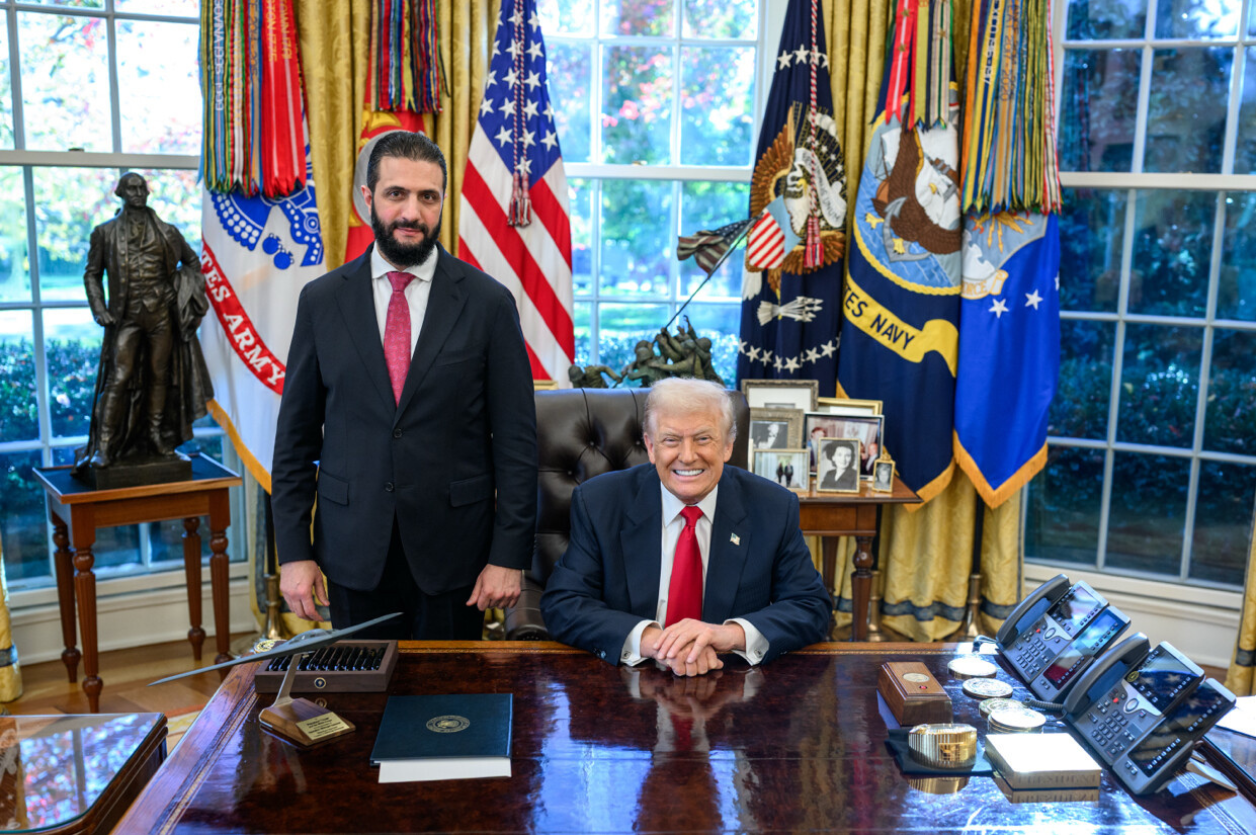
Photo credit: The White House
Intelligence Summary
On November 10, 2025, Syrian President Ahmed al‑Sharaa made a historic visit to Washington, becoming the first Syrian head of state to meet a U.S. president at the White House since Syria’s independence in 1946. The visit marked a dramatic shift in U.S. policy toward Damascus less than a year after al‑Sharaa, a former jihadist commander and ex‑leader of Hayat Tahrir al‑Sham, overthrew Bashar al‑Assad in December 2024.
During the closed‑door White House meeting, President Donald Trump and al‑Sharaa discussed bilateral relations and issues of common interest. Trump publicly praised al‑Sharaa as a strong leader capable of stabilizing Syria, emphasizing that the U.S. would support Syria’s reconstruction.The U.S. Treasury Department simultaneously announced a 180‑day suspension of the Caesar Act sanctions, extending an earlier waiver first issued in June 2025. The Treasury statement described the move as supporting Syria’s reconstruction and counterterrorism efforts, and acknowledged that permanent repeal would require congressional approval.
Al‑Sharaa sought full removal of sanctions to enable Syria’s reintegration into the global financial system and attract reconstruction investment estimated by the World Bank at $216 billion. There are currently two competing proposals being discussed in Congress, one by Senator Jeanne Shaheen for unconditional repeal, and another by Senator Lindsey Graham for conditional review.
The meeting also produced the formal addition of Syria as the 90th member of the U.S.‑led Global Coalition to Defeat ISIL (ISIS). Syrian Information Minister Hamza al‑Mustafa confirmed that Damascus signed a political cooperation declaration with the coalition, emphasizing counterterrorism and regional stability. Syrian security forces have reportedly conducted 61 raids across Aleppo, Idlib, Hama, Homs, and Damascus, arresting 71 suspects and seizing explosives in preemptive operations against ISIL cells. Two ISIL assassination plots targeting al‑Sharaa were also reportedly foiled in recent months.
The U.S. administration also authorized Syria to reopen its embassy in Washington to coordinate on security and economic issues. U.S. Secretary of State Marco Rubio met with Syrian Foreign Minister Asaad al‑Shibani and Turkish Foreign Minister Hakan Fidan to advance a plan integrating the Kurdish‑led Syrian Democratic Forces into the Syrian Army.
Trump’s envoy Jared Kushner met Israeli Prime Minister Benjamin Netanyahu in Jerusalem the same day to discuss the Gaza ceasefire and broader regional security arrangements. Reports from multiple outlets indicated that Washington was brokering a potential security pact between Syria and Israel and considering a limited U.S. military presence at the Mezzeh airbase in Damascus. The United Nations and the United Kingdom had lifted sanctions on al‑Sharaa and senior Syrian officials prior to the visit, signaling international acceptance of the new government.
Israel has continued airstrikes on Syrian military sites. Al‑Sharaa has stated intent to pursue a security agreement and detained members of Palestinian Islamic Jihad. Turkey expressed support for the new Syrian leadership as did Saudi Crown Prince Mohammed bin Salman. However, the United Arab Emirates and Iraq remain skeptical. Domestically, al‑Sharaa’s government has faced renewed sectarian unrest, leading to the deaths of more than 2,500 people since Assad’s fall, including violence against Alawite and Druze minorities.
The White House visit concluded with both leaders affirming cooperation between the two nations. Trump described the meeting as the beginning of a new era in U.S.‑Syria relations, while al‑Sharaa characterized Syria as a future geopolitical ally of Washington rather than a security threat.
Why it Matters
The meeting between the leaders of the U.S. and Syria represents one of the most consequential diplomatic reversals in the Middle East since the 1970s. By engaging a former adversary and lifting sanctions, Washington is attempting to reshape the regional balance of power and create a new security architecture centered on counterterrorism while balancing relations with Israel and Iranian influence.
Strategically, Syria’s entry into the U.S.‑led coalition against ISIL transforms it from a potential threat to peace into a partner in regional security. This move aligns with Washington’s three stated priorities: preventing ISIL’s resurgence, reducing Iranian influence, and improving Syria‑Israel relations. The potential integration of the Kurdish‑led Syrian Democratic Forces into the national army under U.S. supervision could stabilize northern Syria and reduce the risk of renewed insurgency, while simultaneously addressing Turkey’s security concerns.
The suspension of Caesar Act sanctions provides Damascus with limited economic breathing space but also serves as leverage for Washington. Since any permanent repeal requires congressional approval, the U.S. retains a degree of influence over Syria's domestic and foreign policy decisions. The potential for American investment and reconstruction contracts introduces an economic dimension to the geopolitical realignment, linking Syria’s recovery to Western capital rather than Iranian or Russian support.
The proposed U.S. presence at Mezzeh airbase and discussions of a Syria‑Israel security pact indicate a shift toward direct US involvement in post‑conflict stabilization. Such a presence would serve as both a deterrent to Iranian proxies and a signal to Moscow that Washington intends to reassert influence in the Levant. However, it also risks friction with Israel, whose continued air operations in Syria contradict U.S. efforts to stabilize the new government.
Regionally, the realignment could fracture existing alliances. Iran and Hezbollah stand to lose a critical logistical corridor, while Turkey and Saudi Arabia may gain strategic depth through cooperation with a U.S.‑aligned Damascus. The move also challenges Russia’s long‑standing military foothold in Syria, particularly if U.S. forces establish a permanent base near Damascus.
Domestically, al‑Sharaa’s consolidation of power amid sectarian violence raises questions about the durability of the new regime. U.S. cooperation with a former jihadist leader carries reputational and security risks, especially if human rights abuses continue. The muted White House reception and absence of a joint press conference suggest Washington’s awareness of these sensitivities.
In a broader regional context, the ongoing Gaza negotiations, Israel’s assertive military posture, and the U.S. government’s focus on counterterrorism, frames the renewed engagement as part of a larger strategy to stabilize the Middle East under American leadership. Yet, success depends on balancing competing interests: Israeli security demands, congressional skepticism, and the need to prevent Syria’s relapse into conflict.
If sustained, the U.S.‑Syria alignment could mark the end of Iran’s strategic corridor from Tehran to Beirut and redefine regional geopolitics. Conversely, failure to manage sectarian tensions or Israeli opposition could exacerbate the instability in an already fragile region. The visit symbolizes both opportunity and risk, presenting as a test of whether pragmatic engagement can replace decades of confrontation in one of the world’s most volatile regions.
Key Actors
- United States
- Syrian Arab Republic
- Israel
- Turkey
- Iran
- Russia
- United Nations