U.S. Expands Caribbean Military Presence Amid Rising Tensions with Venezuela
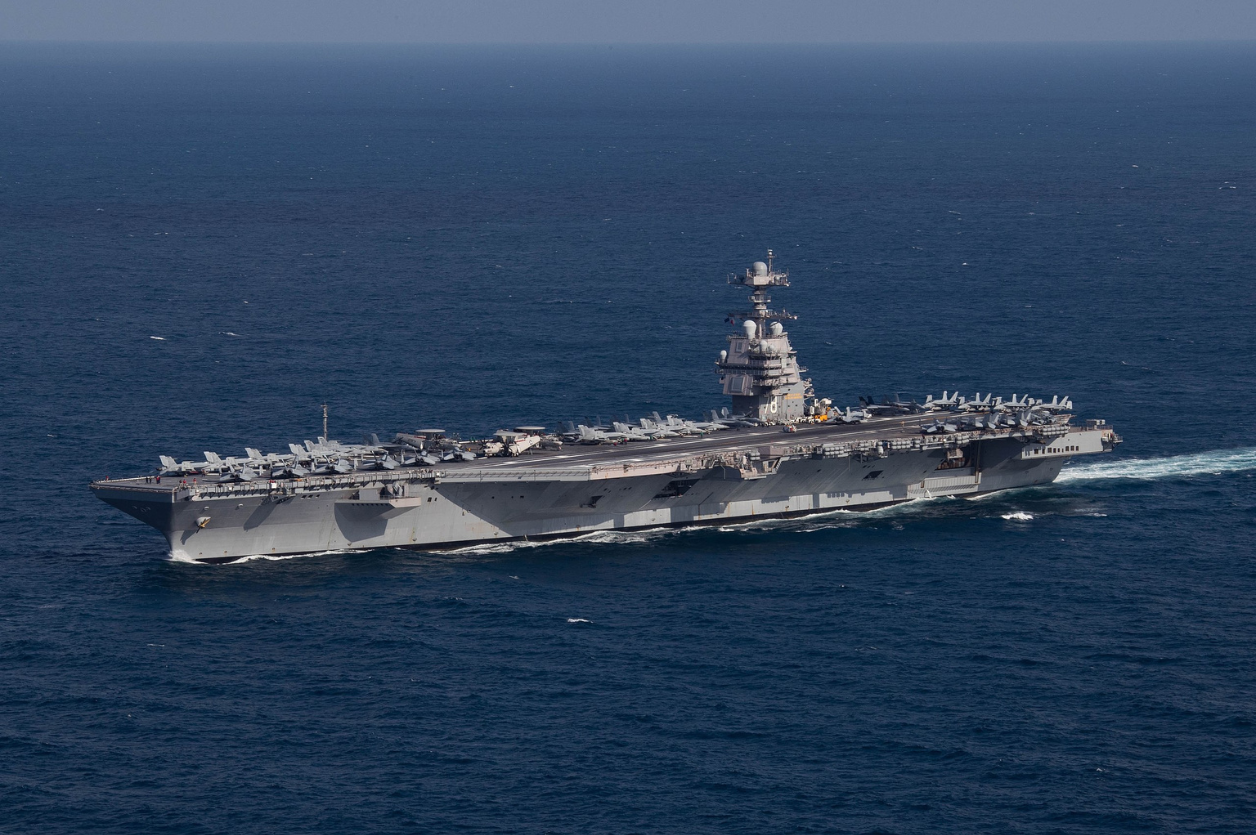
Photo credit: The U.S. Navy
Intelligence Summary
As of mid-November 2025, the United States has significantly expanded its military presence in the Caribbean under “Operation Southern Spear”. The campaign is officially described as a counter-narcotics mission, but has been interpreted by some as a show of force directed at Venezuela. The deployment centered on the USS Gerald R. Ford, the world’s largest aircraft carrier, accompanied by guided-missile destroyers, support vessels, and tactical aircraft. The strike group joined nearly a dozen U.S. Navy ships and approximately 12,000 sailors and Marines already operating in the region. Rear Admiral Paul Lanzilotta, commanding the carrier group, emphasized that the mission aimed to protect U.S. security and prosperity against narco-terrorism in the Western Hemisphere.
The U.S. has also continued its series of strikes on small boats in the Caribbean and eastern Pacific, which the Pentagon claims were engaged in drug trafficking. The most recent strike, announced on November 16, targeted a vessel in the eastern Pacific and killed three individuals. U.S. Southern Command released video footage of the attack but provided no evidence that the boats were carrying narcotics. As a result, the U.S. continues to face intense criticism both domestically and abroad.
On November 16, U.S. Marines from the 22nd Marine Expeditionary Unit began joint exercises with the Trinidad and Tobago Defence Force. The exercises are expected to continue through November 21, taking place in Trinidad and Tobago, a mere seven miles from Venezuela’s coast at its closest point. Trinidadian Foreign Minister Sean Sobers said the drills were intended to combat violent crime and drug trafficking, while Venezuelan officials denounced them as acts of aggression. U.S. Secretary of the Army Dan Driscoll confirmed that American troops were also training in Panama and that the U.S. was reactivating its jungle warfare school there.
President Donald Trump and senior officials, including Secretary of War Pete Hegseth and Secretary of State Marco Rubio, publicly linked the military buildup to alleged Venezuelan involvement in narcotics trafficking. On November 16, Rubio announced that the State Department would designate the “Cartel de los Soles,” which Washington claims is led by President Nicolás Maduro and senior Venezuelan officials, as a Foreign Terrorist Organization effective November 24. The designation would criminalize providing material support to the group and, according to Trump, allow the U.S. military to target its assets and infrastructure.
Despite the tensions, Trump stated that the U.S. “may be having discussions” with Maduro, suggesting a potential diplomatic channel. Yet, when asked about sending U.S. troops into Venezuela for possible ground operations, Trump emphasized that he would “not rule out anything”. Sources have also alleged that Trump had been briefed on options for attacking Venezuela, including special operations to capture or kill Maduro or larger-scale missions to seize airfields and oil infrastructure.
Maduro, who faces U.S. narcoterrorism charges, accused Washington of fabricating a war and has responded by mobilizing Venezuelan troops and civilians for defense. He warned that the U.S. military buildup threatened regional peace and placed the Venezuelan army on high alert. In public statements, Maduro said Venezuela was ready to defend its sovereignty and called for direct talks with the U.S.
Trinidad and Tobago’s government supported the U.S. operations, while fishermen there expressed fear after bodies from U.S. strikes reportedly washed ashore. The U.S. allies expressed concern about the legality of the strikes, and faced pushback from the United Nations human rights chief. Despite these concerns, Senate Republicans voted against legislation that would have restricted Trump’s ability to launch attacks on Venezuela without congressional authorization.
Why it Matters
The U.S. military presence in the Caribbean represents the most significant projection of American naval power in Latin America in decades, demonstrating renewed U.S. strategic dominance in the Western Hemisphere. The deployment of the USS Gerald R. Ford and accompanying strike group demonstrates Washington’s intent to deter adversaries and reestablish potentially coercive leverage over Venezuela’s government. The operation’s framing as a counter-narcotics mission provides a legal and political pretext for sustained military presence. However, the scale and composition of forces in use suggest preparation for broader operations.
The announcement of the designation of the “Cartel de los Soles” as a Foreign Terrorist Organization marks a major shift in U.S. policy. By labeling a foreign government’s leadership as terrorists, Washington effectively opens the door to military targeting under counterterrorism authorities. Some analysts believe this blurs the line between law enforcement and warfare, potentially setting a precedent for military action against state actors under the guise of counterterrorism. The move also increases the risk of miscalculation, as Caracas may interpret it as a prelude to regime change operations.
The simultaneous signals of diplomacy and perceived coercion reflect a deliberate strategy of strategic ambiguity. Trump’s statements about possible talks with Maduro, juxtaposed with his refusal to rule out troop deployment, create uncertainty likely intended to pressure Caracas into concessions. However, this ambiguity also heightens instability, as Venezuelan forces may misread U.S. intentions and respond defensively, increasing the risk of accidental confrontation.
The regional implications are significant. Joint exercises in Trinidad and Tobago and the announcement of renewed U.S. training in Panama indicate a broader reactivation of U.S. security forces across the Caribbean Basin. These activities strengthen U.S. influence in small island states but risk alienating Latin American governments wary of this seemingly renewed trend toward U.S. interventionism. The proximity of U.S. forces to Venezuelan territory further enhances the risk of rapid acceleration if either side miscalculates.
From an energy security perspective, Venezuela’s vast oil reserves remain a strategic factor. Several analyses suggest that U.S. pressure may aim to secure future access to Venezuelan energy resources or to weaken a regime aligned with U.S. rivals. The presence of advanced naval assets capable of blockading or striking coastal infrastructure underscores the potential for energy-related coercion.
The continued U.S. strikes on alleged drug boats have killed over 80 people without judicial process, challenging the established norms of international law and the prohibition on extrajudicial killings. The lack of evidence presented for the narcotics claims undermines the legitimacy of the campaign and could erode U.S. credibility in multilateral forums. Domestically, the Senate’s rejection of oversight legislation further backs executive authority over the use of force, raising constitutional questions about war powers.
For intelligence and defense analysts, the operation illustrates the integration of counter-narcotics, counterterrorism, and deterrence missions under a single operational framework. The continuation of the U.S.-Venezuela confrontation exemplifies the convergence of domestic, regional, and global security and policy, producing volatile military postures. The situation remains fluid, with the potential for either limited diplomatic engagement or rapid escalation into open conflict depending on political decisions in Washington and Caracas.
Key Actors
- United States
- Venezuela
- Trinidad and Tobago
- Panama
- United Nations
Stay Informed. Stay Ahead.