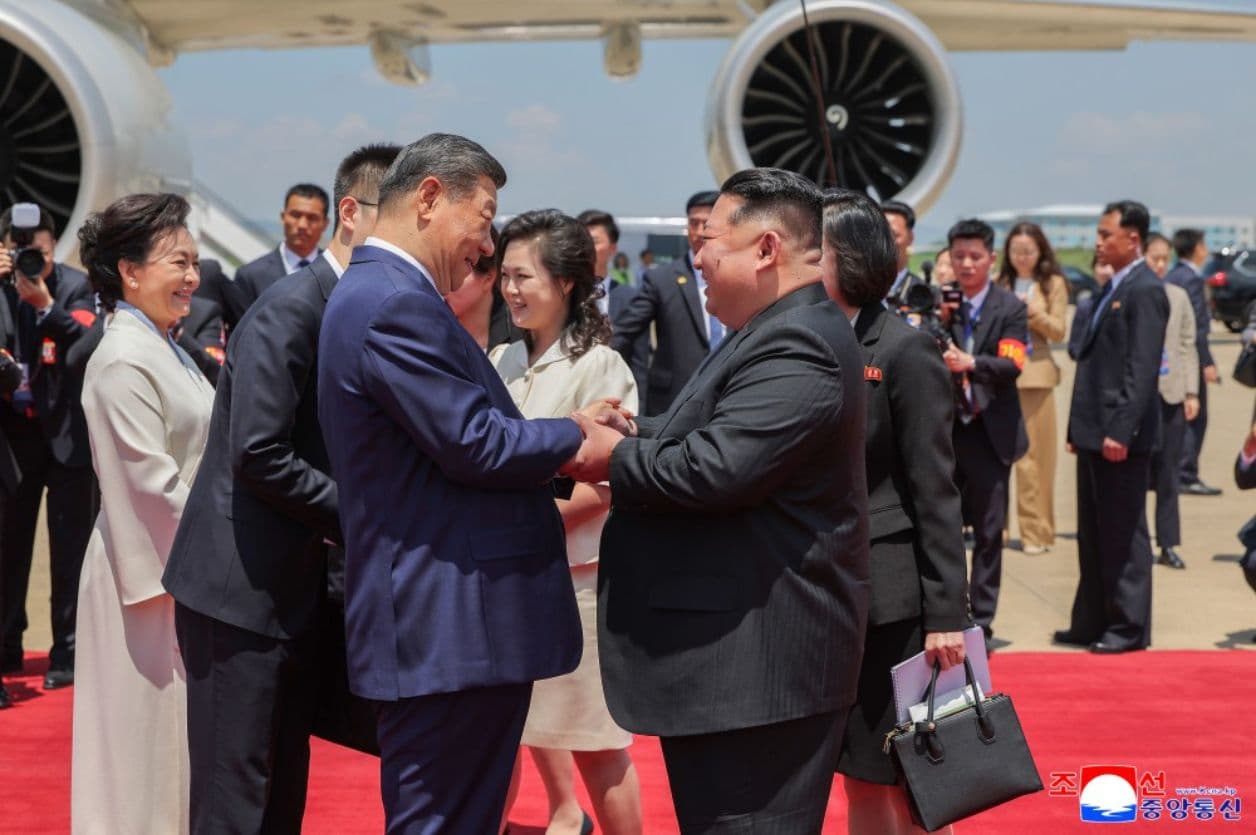
Chinese President Xi Jinping arrived in Pyongyang on June 8, 2026, for his first state visit to North Korea in seven years, marking a significant diplomatic event amid shifting regional alignments. Xi and his wife Peng Liyuan were greeted at Pyongyang International Airport by North Korean leader Kim Jong Un and his wife Ri Sol Ju, with a 21-gun salute, military band, and cheering crowds waving Chinese and North Korean flags. The visit followed Xi’s back-to-back summits in Beijing with U.S. President Donald Trump and Russian President Vladimir Putin, signaling Beijing’s intent to reassert influence over Pyongyang amid intensifying competition with the United States.
During the two-day visit, Xi and Kim held a summit in Pyongyang’s main square, where both leaders emphasized the “unbreakable” nature of their relationship and pledged to deepen cooperation in trade, agriculture, construction, and technology. Xi stated that both countries should strengthen strategic coordination and safeguard sovereignty and security interests, while Kim described the visit as proof of an enduring alliance. The meeting coincided with the 65th anniversary of the 1961 Treaty of Friendship, Cooperation, and Mutual Assistance, the only formal defense treaty China maintains.
Xi’s visit came as North Korea expanded its military and economic cooperation with Russia, including the supply of troops and weapons to support Moscow’s war in Ukraine, reportedly resulting in approximately 2,300 North Korean casualties. In exchange, Pyongyang has received oil and military assistance from Russia. Western analysts noted that Beijing’s decision to visit Pyongyang a month before the treaty anniversary reflected anxiety over North Korea’s growing alignment with Moscow.
China remains North Korea’s primary economic partner, accounting for up to 95 percent of its trade and 85 percent of its exports. Chinese exports to North Korea reached approximately $2.3 billion in 2025, the highest level in six years, and passenger train services between Beijing and Pyongyang resumed after a six-year hiatus. Xi is expected to offer Kim economic aid packages, including rice and fertilizer shipments, the resumption of Chinese group tourism, and joint economic projects.
North Korea’s economy reportedly grew by about 3 percent annually over the past two years, aided by increased Chinese trade and tourism. Kim is seeking to leverage this relationship to gain legitimacy and international recognition, potentially through participation in multilateral organizations such as the Shanghai Cooperation Organization and BRICS.
The visit also occurred amid heightened military developments. A day before Xi’s arrival, North Korea announced plans for a 10,000-ton naval destroyer, reinforcing its status as a nuclear-armed state. Kim’s sister, Kim Yo Jong, reiterated that the nuclear weapons program was a “line of no retreat,” signaling Pyongyang’s unwillingness to denuclearize despite U.S. pressure. South Korean President Lee Jae Myung stated that North Korea now produces enough fissile material annually for 10 to 20 nuclear bombs and is nearing completion of intercontinental ballistic missile technology.
Beijing’s approach to denuclearization remains cautious. While China and the U.S. reaffirmed a shared goal of denuclearization during the Xi-Trump summit, Beijing’s official statements only referred to “discussions” on the issue. Some Western analysts speculate that China avoids pressing Pyongyang publicly on nuclear disarmament to prevent driving it further into Russia’s orbit.
Xi’s visit was also intended to demonstrate China’s leadership in Northeast Asia and to project itself as a stabilizing power amid U.S. alliances with Japan, South Korea, and the Philippines. News reports suggested that Xi’s early visit and the lavish reception were designed to showcase China’s regional influence and to counter perceptions of declining U.S. commitment to the Indo-Pacific.