Yerevan Summits Highlight Europe’s Security Pivot
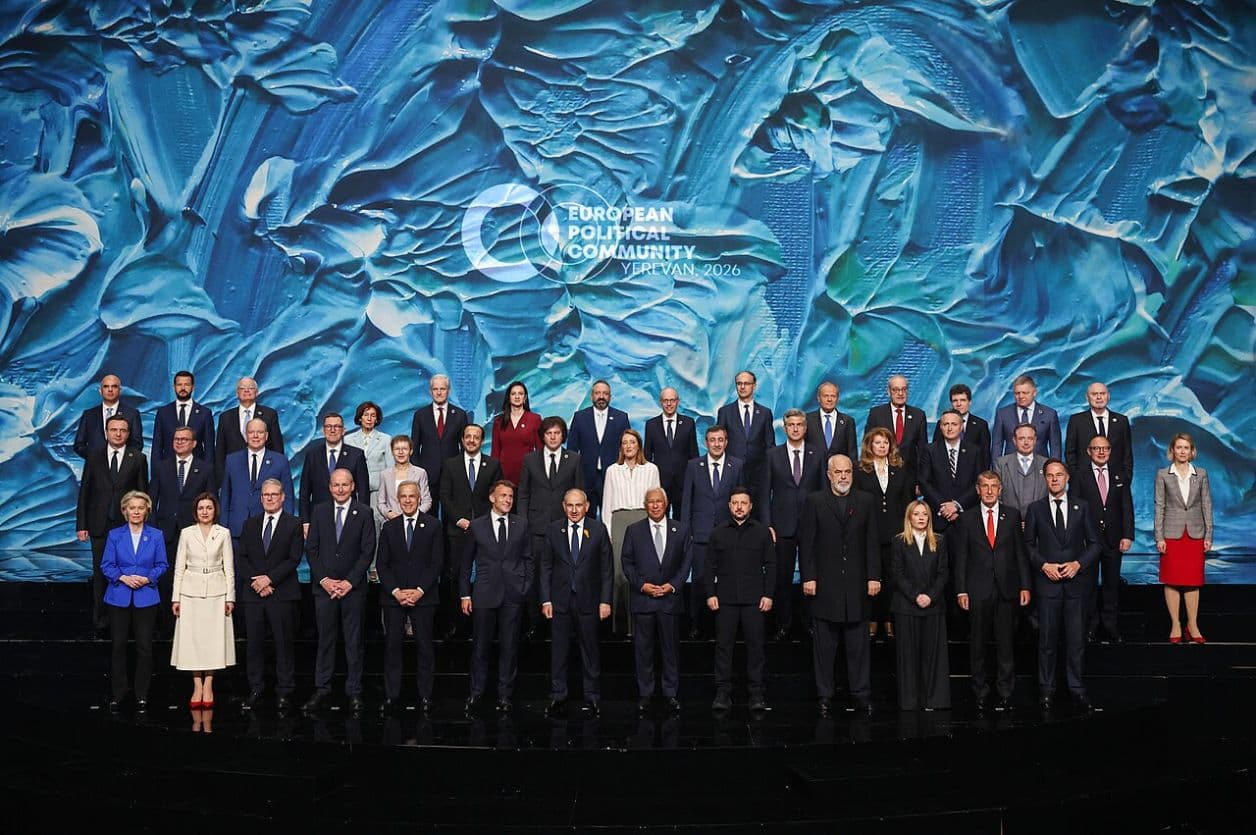
Photo credit: Lauren Hurley / No 10 Downing Street
Intelligence Summary
European leaders gathered in Yerevan for two high-level meetings that underscored both Europe’s defense recalibration and Armenia’s widening engagement with European institutions. More than 30 European leaders and Canada’s prime minister participated in a European Political Community summit in Yerevan on Monday. A first-ever bilateral EU–Armenia summit followed on Tuesday, attended by European Commission President Ursula von der Leyen and European Council President António Costa.
The meetings took place amid uncertainty over United States policy toward European security and NATO force posture. NATO Secretary-General Mark Rutte stated on Monday that European leaders had absorbed Washington’s message on defense after United States President Donald Trump announced plans to withdraw 5,000 soldiers from Germany. The Pentagon announced the troop withdrawal from Germany on Friday, and NATO spokesperson Allison Hart said NATO officials were working with the United States to understand details of the decision on force posture in Germany.
European leaders in Yerevan linked the defense push to a larger effort to strengthen Europe’s role inside NATO. European Union High Representative Kaja Kallas described the timing of the troop withdrawal announcement as a surprise and argued for strengthening the European pillar in NATO while noting that American troops in Europe also serve American interests. French President Emmanuel Macron described Europeans as taking their destiny into their own hands through increased defense and security spending and common solutions. European Commission President Ursula von der Leyen said Europe needed to step up military capabilities to defend and protect itself.
The Iran war and its economic spillovers also shaped European positioning. German Chancellor Friedrich Merz compared the war to prior military quagmires and said it was costing Europe significant money while directly affecting economic output. Spain refused to allow the United States to launch attacks on Iran from Spanish airspace or bases, and Prime Minister Pedro Sánchez condemned the war as unjustified and outside international law. Trump called Spain terrible and threatened to end all trade ties. Rutte said more European nations were pre-positioning assets such as minehunters and minesweepers close to the Gulf for a next phase in the war, without providing details.
Armenia’s hosting role carried heightened symbolism because it remains embedded in Russian-led structures and relies heavily on Russian energy. Armenia is a member of the Eurasian Economic Union, and Russia maintains a military base on Armenian territory. Armenia buys Russian gas at a preferential rate, and Vladimir Putin highlighted on April 1 during Prime Minister Nikol Pashinyan’s Moscow visit that Russia sells gas to Armenia for $177.50 per 1,000 cubic metres compared with $600 in Europe.
Armenia’s shift accelerated after Azerbaijan’s 2023 operation to complete its takeover of Nagorno-Karabakh, which expelled more than 100,000 ethnic Armenians, while Russia’s peacekeepers stood aside and the Russia-led Collective Security Treaty Organisation did not respond to earlier incursions into Armenian territory. Armenia’s foreign relations committee chair Sargis Khandanyan said Armenia concluded its existing security architecture was not working. The EU had brokered a border recognition deal and deployed a civilian monitoring mission on Armenia’s border with Azerbaijan, which Khandanyan said shifted public perceptions and increased demand for closer EU relations. In March 2025, Armenia’s parliament passed a law to launch the process of joining the EU.
The peace process remained fragile and carried diplomatic costs with Azerbaijan. Azerbaijan’s parliament voted last week to suspend ties with the European Parliament after a resolution calling for the right of return for Nagorno-Karabakh Armenians who fled in 2023 and for the release of Armenian prisoners held by Baku. Armenia and Azerbaijan also announced the Trump Route for International Peace and Prosperity, described as a connectivity corridor running along Armenia’s border with Iran to link the region to European markets.
Moscow signaled irritation and applied pressure measures alongside information and cyber activity concerns. Putin told Pashinyan that EU membership ambitions were incompatible with Eurasian Economic Union membership. Russia banned imports of Armenian mineral water days before the EPC summit. Artur Papyan of CyberHUB-AM described patterns in which pro-EU statements or Brussels visits were followed by disruptions such as Armenian trucks being stopped at the Georgian-Russian border and hacker threats against government websites. The EU approved a new civilian mission for Armenia for the next two years to counter Russian disinformation, cyberattacks, and illicit financial flows ahead of Armenia’s parliamentary elections in June, modeled on a similar deployment to Moldova before the 2025 elections. Papyan said his team documented a mass WhatsApp attack in January that compromised an estimated several hundred thousand accounts and described a separate operation using a fake Signal account impersonating EU Ambassador Vassilis Maragos, with traced IP addresses pointing to Zelenograd near Moscow. Council of Europe Secretary General Alain Berset said Armenia’s democratic institutions had progressed but faced pressure, and he highlighted foreign interference, disinformation, and online political polarization as key concerns ahead of the June elections. European engagement included discussion of civilian missions and visa liberalization over the next two years, while no timeline was presented for EU membership, defense commitments, or replacement of Russian gas. The Yerevan summits were also framed as focusing on security, trade, and the war in Ukraine, signaling Armenia’s deepening ties with the EU and raising questions about its long-standing alignment with Russia.
Why it Matters
The Yerevan summits illustrate a dual realignment dynamic that matters for European security architecture and for post-Soviet geopolitical ordering. Europe’s defense debate is no longer confined to incremental burden-sharing inside NATO. It is increasingly shaped by explicit uncertainty about US force posture and political conditionality. The announced withdrawal of 5,000 US soldiers from Germany functions as a concrete stress test. It forces European capitals to translate rhetoric about strategic responsibility into deployable capabilities, readiness, and sustained budgets.
This shift is occurring while European leaders face simultaneous external shocks. The Iran war has created economic and legal-political fractures inside Europe, visible in Spain’s refusal to support US strike operations from its territory and in German warnings about economic costs. These divergences matter because they can complicate alliance cohesion at the exact moment Europe is trying to strengthen the European pillar in NATO. The result is a more complex deterrence environment: Europe seeks greater autonomy, but it still depends on US enablers and must manage internal disagreement over Middle East policy and international law.
Armenia’s role as host is strategically significant because it signals that European engagement is moving deeper into regions historically treated as Russia’s privileged security space. Armenia remains structurally tied to Russia through energy dependence, Eurasian Economic Union membership, and the presence of a Russian military base. Yet Armenia is also openly advancing an EU accession process and hosting unprecedented European gatherings. This combination creates a high-risk balancing act. It increases Armenia’s diplomatic leverage with Europe, but it also raises the probability of coercive responses from Moscow that fall below the threshold of overt military action.
Various insiders highlight why hybrid pressure is central to this contest. Trade restrictions such as the ban on Armenian mineral water, logistical disruptions at borders, and cyber-enabled influence operations provide scalable tools for punishment and signaling. The described WhatsApp compromise affecting several hundred thousand accounts and the impersonation of the EU ambassador via a fake Signal account demonstrate a targeting logic focused on decision-makers, civil society intermediaries, and information trust chains. These methods can degrade governance capacity during sensitive political periods, especially ahead of parliamentary elections. They also impose defensive costs on a small state with limited cyber resilience.
European responses, centered on civilian missions designed to counter disinformation, cyberattacks, and illicit financial flows, show an emerging model of forward defense that is not purely military. This matters for students of intelligence and geopolitics because it demonstrates how influence and cyber threats are being treated as operational security issues tied to electoral integrity and strategic alignment. It also shows how Europe is attempting to compete in contested spaces without offering hard security guarantees.
The Armenia–Azerbaijan dimension adds another layer. The peace process is described as fragile, and Azerbaijan’s suspension of ties with the European Parliament over return and prisoner issues indicates that European engagement can generate backlash from regional actors. That backlash can constrain Europe’s ability to act as mediator and can create incentives for local players to seek alternative patrons. At the same time, the announced connectivity corridor along Armenia’s border with Iran, framed as linking the region to European markets, suggests that infrastructure and trade routes are being used as geopolitical instruments. Such corridors can diversify economic options and embed political relationships, but they also create new vulnerabilities to disruption and coercion.
Overall, the development matters because it connects three strategic arenas into one picture: NATO burden-sharing under US pressure, Europe’s contested unity over Middle East escalation, and a South Caucasus state attempting to pivot westward while exposed to hybrid retaliation. The convergence in Yerevan demonstrates that European strategic realignment is not only about tanks and budgets. It is also about resilience, political warfare, and the credibility of European engagement beyond its borders.
Stay Informed. Stay Ahead.