COMPASS Framework for Geopolitical Analysis

Navigate Geopolitical Complexity with Precision and Confidence.

Geopolitical risk has become a persistent operational variable for businesses, governments, and investment institutions. Decisions are increasingly shaped by state behavior, alliance dynamics, economic coercion, security competition, and environmental constraints. Yet many organizations continue to rely on fragmented, intuition-driven, or narrative-based assessments that lack methodological consistency and analytical transparency.

The result is uneven decision support, difficulty comparing risk across countries or regions, and limited ability to forecast change with confidence.

The COMPASS™ Framework for Geopolitical Analysis, developed by Dr. Steven Smith, Executive Director of the Institute for Applied Geopolitics, addresses this gap by providing a structured, replicable methodology for evaluating geopolitical actors and their environments. Rather than treating geopolitics as an abstract or purely qualitative discipline, COMPASS operationalizes geopolitical analysis through a navigation-based framework designed to meet professional consulting, policy, and intelligence standards.

Write your awesome label here.

The Strategic Problem

Across business, policy, and intelligence communities, traditional geopolitical analysis often suffers from recurring weaknesses:


  • Inconsistent indicator selection and weighting

  • Overreliance on intuition or narrative framing

  • Limited integration of historical data into forward-looking assessments

  • Difficulty correcting for bias, misinformation, or analytical distortion

  • Lack of standardized risk scoring that enables comparison over time or across countries


These limitations reduce analytical credibility and make it harder to translate geopolitical insight into actionable decision support.

The COMPASS™ Framework

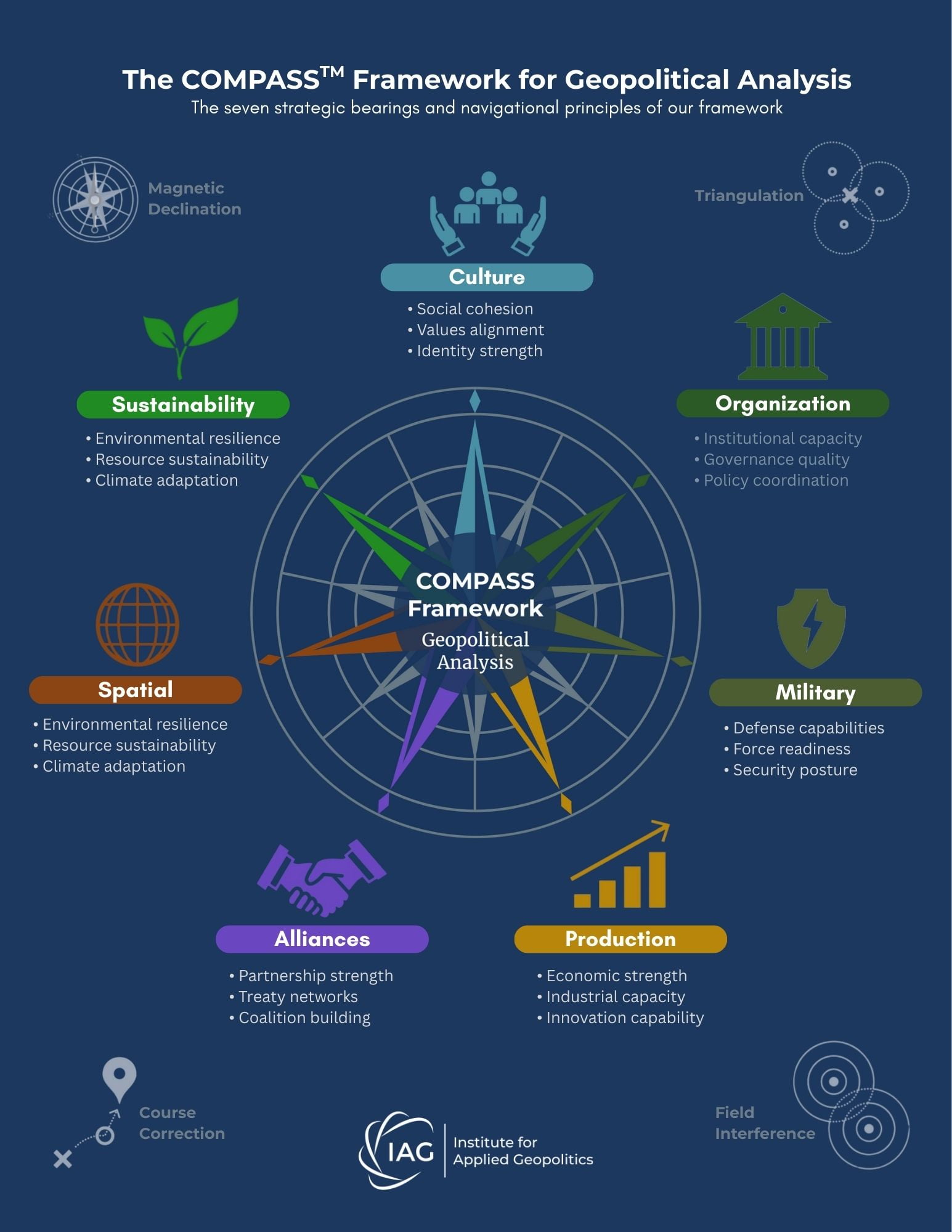
The COMPASS Framework introduces a systematic, two-stage analytical methodology built around seven integrated strategic bearings. Together, these bearings function as navigational reference points for understanding how states and organizations operate within the international system.
The Seven Strategic Bearings:
  • Culture (Magnetic North)

    Social foundations, identity, demographics, values, and cohesion that shape political behavior and influence all other analytical dimensions.

  • Organization (Institutional Bearing)

    Governance structures, institutional effectiveness, legitimacy, administrative capacity, and systemic constraints on power execution.

  • Military (Security Bearing)

    Defense posture, readiness, deterrence, threat environment, and security dynamics shaping strategic risk and stability.

  • Production (Economic Bearing)

    Economic systems, trade networks, industrial capacity, macroeconomic policy, resources, and wealth creation mechanisms.

  • Alliances (External Bearing)

    Diplomatic networks, partnerships, soft power, international positioning, and influence patterns.

  • Spatial (Geographic Bearing)

    Geography, territorial dynamics, infrastructure, chokepoints, and spatial constraints shaping strategic options.

  • Sustainability (Environmental Bearing)

    Environmental resilience, resource management, climate adaptation, and long-term strategic viability.


  • Methodological Rigor

    COMPASS is designed as a professional-grade analytical system, not an ad hoc checklist.


    Two-Stage Methodology


    Part I: Core Analytical Process

    1. Indicator identification and selection

    2. Historical data collection (minimum 10-year horizon)

    3. Pattern and trend analysis

    4. Data visualization and analytical communication

    5. Forecasting and predictive analysis


    Part II: Risk Calculation and Empirical Modeling

    • Individual indicator risk scoring

    • Bearing-level risk aggregation

    • Integration of qualitative assessments

    • Composite risk score calculation (0–100 scale)

    • Scenario-based risk projection


    This structure enables analysts to move from raw data to defensible, transparent, and comparable geopolitical risk assessments.

    Learning Outcomes

    Upon completion of the program, participants will be able to:


    • Conduct systematic geopolitical assessments using a standardized framework

    • Select and justify indicators across seven strategic dimensions

    • Integrate historical data into contemporary and forward-looking analysis

    • Calculate and interpret composite country risk scores

    • Compare geopolitical risk across countries and regions using consistent benchmarks

    • Identify early warning indicators of geopolitical disruption

    • Correct for analytical bias, distortion, and narrative overreach

    • Produce transparent, replicable analysis suitable for professional decision support


    These capabilities are applicable across corporate strategy, policy analysis, investment risk assessment, intelligence analysis, and academic research.

    Course Structure and Delivery

    Format: 8-week program
    Delivery: Online, self-paced learning
    Time Commitment: Approximately 4–6 hours per week
    Level: Foundation, no prerequisites required
    Platform: IAG Learning Management System

    Learning Modules:
    1. Introduction to the COMPASS Framework
    2. The COMPASS Methodology and Navigation Principles
    3. Culture Bearing: Society and Demographics
    4. Organization Bearing: Governance and Institutions
    5. Military Bearing: Security and Defense
    6. Production Bearing: Economic Systems and Development
    7. Alliances Bearing: External Relations and Influence
    8. Spatial Bearing: Geography and Infrastructure
    9. Sustainability Bearing: Environment and Long-Term Viability
    10. Integration and Capstone Application

    The program culminates in a capstone project, where participants complete a full COMPASS analysis of a selected country, integrating all seven bearings into a composite risk assessment.

    Who This Program Is Designed For

    The COMPASS Framework is designed for professionals who require structured, defensible geopolitical analysis, including:

      
    • Business intelligence and competitive intelligence professionals
    • Corporate strategy and management consulting professionals
    • Economists and macroeconomic analysts
    • Policy analysts, government affairs professionals, and think tank researchers
    • Investment professionals and country risk analysts
    • Supply chain and enterprise risk managers
    • Security and intelligence analysts
    • Academic researchers and graduate students
    • International development practitioners


    The program is particularly valuable for those who must:

      
    • Conduct cross-country comparative analysis
    • Support high-stakes strategic decisions
    • Demonstrate analytical rigor and transparency
    • Improve forecasting accuracy and consistency
    • Build organizational analytical capacity

    Building Professional Geopolitical Capability

    The COMPASS™ Framework for Geopolitical Analysis is not designed to deliver headlines or commentary. It is designed to build repeatable analytical capability.


    For professionals operating in environments shaped by geopolitical volatility, the ability to systematically assess risk, identify trends, and support strategic decisions is no longer optional. COMPASS provides the structure, discipline, and methodological clarity required to meet that challenge.


    Enrollment is appropriate for those seeking to move beyond ad hoc geopolitical analysis toward a standardized, professional-grade analytical system.