The COMPASS Framework for Geopolitical Analysis

Gain the skills to analyze global dynamics with precision. The COMPASS Framework teaches a systematic, data-driven approach to evaluating nations, forecasting risks, and making informed strategic decisions.
  • Online, Self-paced

    Format
  • 10+ Hours

    Total video
  • 16 weeks

    Access
    • 10

      Modules
    • 47

      Videos
    • Digital Badge

      Credential

    Navigate Geopolitical Complexity with Precision and Confidence.

    Geopolitical risk has become a persistent operational variable for businesses, governments, and investment institutions. Strategic decisions are increasingly shaped by state behavior, alliance dynamics, economic coercion, security competition, and environmental constraints. Yet many organizations continue to rely on fragmented, intuition-driven, or narrative-based assessments that lack methodological consistency and analytical transparency.

    The result is uneven decision support, difficulty comparing risk across countries or regions, and limited ability to forecast change with confidence.

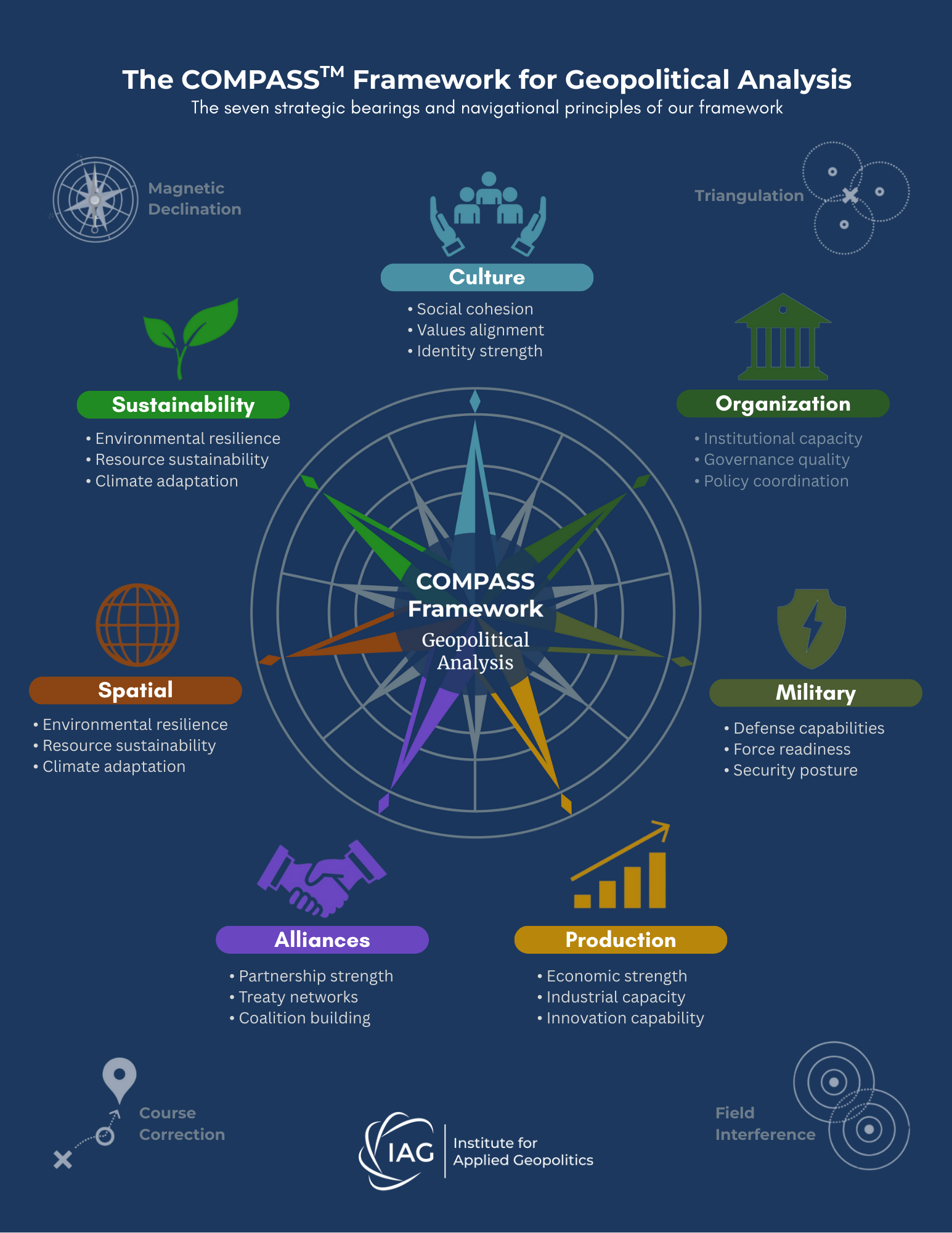
    The COMPASS™ Framework for Geopolitical Analysis, developed by Dr. Steven Smith, Executive Director of the Institute for Applied Geopolitics, addresses this gap by providing a structured, replicable methodology for evaluating geopolitical actors and their strategic environments. Rather than treating geopolitics as an abstract or purely qualitative discipline, COMPASS operationalizes geopolitical analysis through a navigation-based framework designed to meet professional consulting, policy, and intelligence standards.

    Write your awesome label here.

    The Strategic Problem

    Across business, policy, and intelligence communities, traditional geopolitical analysis often suffers from recurring weaknesses:


    • Inconsistent indicator selection and weighting

    • Overreliance on intuition or narrative framing

    • Limited integration of historical data into forward-looking assessments

    • Difficulty correcting for bias, misinformation, or analytical distortion

    • Lack of standardized risk scoring that enables comparison over time or across countries


    These limitations reduce analytical credibility and make it harder to translate geopolitical insight into actionable decision support.

    Methodological Rigor

    COMPASS is designed as a professional-grade analytical system, not an ad hoc checklist.


    Two-Stage Methodology


    Part I: Core Analytical Process

    1. Indicator identification and selection

    2. Historical data collection (minimum 10-year horizon)

    3. Pattern and trend analysis

    4. Data visualization and analytical communication

    5. Forecasting and predictive analysis


    Part II: Risk Calculation and Empirical Modeling

    • Individual indicator risk scoring

    • Bearing-level risk aggregation

    • Integration of qualitative assessments

    • Composite risk score calculation (0–100 scale)

    • Scenario-based risk projection


    This structure enables analysts to move from raw data to defensible, transparent, and comparable geopolitical risk assessments.

    Learning Outcomes

    Upon completion of the program, participants will be able to:


    • Conduct systematic geopolitical assessments using a standardized framework

    • Select and justify indicators across seven strategic dimensions

    • Integrate historical data into contemporary and forward-looking analysis

    • Calculate and interpret composite country risk scores

    • Compare geopolitical risk across countries and regions using consistent benchmarks

    • Identify early warning indicators of geopolitical disruption

    • Correct for analytical bias, distortion, and narrative overreach

    • Produce transparent, replicable analysis suitable for professional decision support


    These capabilities are applicable across corporate strategy, policy analysis, investment risk assessment, intelligence analysis, and academic research.

    Course Lessons