Geopolitics of Energy and Resources

Energy and natural resources have long shaped the balance of power between nations. Today, that relationship is becoming more complex. Oil and natural gas remain central to international affairs, while competition over critical minerals, electricity infrastructure, artificial intelligence, data centers, and the technologies driving the energy transition is reshaping the global geopolitical landscape.

Understanding today’s energy landscape requires more than following headlines. This course provides a structured approach to analyzing how governments, markets, and organizations respond to geopolitical change.
Click to receive course updates and an additional early enrollment discount.
  • Online, Self-paced

    Format
  • 16 weeks

    Access
    • Blockchain-verifiable

      Digital Credential
    • 10

      Modules

    Why This Course Matters

    Energy is no longer just an economic issue. It shapes national security, global trade, industrial policy, technology competition, and international relations. Decisions about where energy is produced, how it is transported, and who controls critical resources increasingly determine strategic advantage.

    National Security

    Energy is a source of strategic leverage and geopolitical power.

    Global Markets

    Supply disruptions reshape economies and trade.

    Critical Resources

    Competition for minerals and infrastructure is accelerating.

    Business Strategy

    Organizations need structured analysis to support strategic decision-making.
    As governments and organizations compete for access to oil, natural gas, critical minerals. electricity infrastructure, and emerging technologies, understanding these dynamics has become essential for professionals across business, government, finance, and security.

    What you'll explore

    The geopolitical dimensions of energy extend well beyond oil and gas markets. Throughout the course, participants examine how energy and natural resources influence international competition, global markets, national security, technology, and long-term strategic decision-making. Contemporary case studies, analytical frameworks, and applied analytical exercises reinforce the concepts introduced throughout the course.

    How do energy and natural resources shape geopolitical competition?

    Examine how states use energy and strategic resources to advance national interests, influence international relationships, and strengthen their geopolitical position.

    How do political decisions influence global energy markets?

    Explore how sanctions, trade policy, resource nationalism, regulation, and diplomatic relationships affect energy production, pricing, investment, and supply chains.

    Why are critical minerals becoming strategic resources?

    Analyze the growing importance of lithium, cobalt, rare earth elements, and other critical minerals in the global competition surrounding advanced manufacturing, clean energy technologies, and artificial intelligence.

    How do geopolitical developments create risk for organizations?

    Develop structured approaches to evaluating geopolitical risk across energy markets, supply chains, infrastructure, and long-term investment decisions.

    How can organizations prepare for an uncertain energy future?

    Apply geopolitical risk assessment and scenario planning techniques to evaluate plausible future developments and support more informed strategic decision-making. 
    As the course progresses, participants apply structured approaches to geopolitical risk assessment, scenario analysis, and communicating findings to decision-makers.
    WHO SHOULD ENROLL

    Built for professionals across sectors and disciplines

    This course is designed for professionals whose work is shaped by developments in global energy, natural resources, international affairs, and geopolitical risk. 

    Business and Corporate Strategy Professionals

    Professionals responsible for long-term planning, market strategy, supply chains, manufacturing, or corporate development who need to understand how geopolitical developments can affect business operations and investment decisions.

    Energy Professionals

    Professionals working across the energy sector who want to strengthen their understanding of the geopolitical forces influencing energy markets, resource competition, infrastructure, and policy.

    Government and Public Sector Professionals

    Policy professionals, government officials, diplomats, military personnel, and public sector leaders seeking a broader understanding of how energy and natural resources influence international affairs and national security.

    Investment and Financial Professionals

    Investors, portfolio managers, economists, and financial professionals who incorporate geopolitical developments into country analysis, market assessments, and long-term investment decisions.

    Intelligence, Risk, and Security Professionals

    Intelligence analysts, geopolitical risk professionals, corporate security teams, and consultants responsible for identifying, assessing, and communicating geopolitical risks that may affect organizations and their stakeholders.

    Consultants and Advisors

    Professionals who advise organizations on strategy, geopolitical risk, public policy, energy, infrastructure, or international business and want a structured framework for evaluating complex global developments.

    Course Experience

    A curriculum designed for real-world application.
    Geopolitics of Energy and Resources is delivered through the Institute for Applied Geopolitics’ online learning platform, allowing participants to progress through the course at their own pace. Each module combines video instruction, contemporary case studies, and applied analytical exercises  that reinforce key concepts and support long-term retention.

    Rather than presenting geopolitical developments as isolated events, the course builds a structured understanding of how energy and natural resources influence international affairs. As participants progress through the curriculum, they develop the analytical approaches needed to evaluate complex issues, communicate findings, and support strategic decision-making.

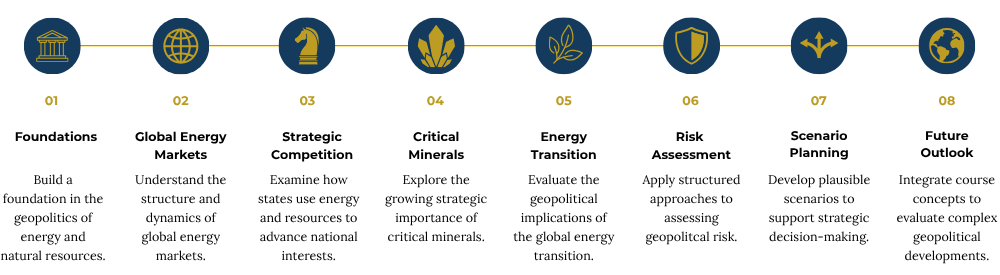
    How the Course Progresses

    The curriculum follows a logical progression from foundational concepts to advanced analysis, with each module building on the knowledge and analytical skills developed in the previous one.

    Meet the Instructor

    Kellee Ann Richards-St Clair

    Faculty Fellow, Institute for Applied Geopolitics
    Kellee Ann Richards-St Clair is an energy and risk professional with nearly two decades of experience in commercial strategy, enterprise risk management, and geopolitical analysis across the United States, the Caribbean, and Latin America. Her work has focused on natural gas and natural gas liquids (NGL) markets, where she has advised senior leadership on geopolitical and regulatory risk, developed commercial strategies, and supported investment decisions where geopolitical risk was a significant consideration.

    She holds a Postgraduate Diploma in Global Business from the University of Oxford’s Saïd Business School, an MBA in Sustainable Energy Management, and professional certifications in governance, risk, and compliance. Her instruction combines extensive industry experience with structured analytical methods, helping participants understand how geopolitical developments influence energy markets and strategic decision-making.

    Earn a Digital Credential

    Upon successful completion of the course, participants receive a blockchain-verifiable digital credential, represented by a shareable digital badge issued through Accredible.

    Your credential provides a secure, verifiable record of your achievement that can be shared with employers, colleagues, and professional networks, including LinkedIn.

    Whether you're demonstrating professional development, documenting specialized expertise, or advancing your career, your credential provides lasting recognition of your accomplishment.

    Stay Informed

    Join the Waitlist

    Be among the first to receive updates when Geopolitics of Energy and Resources opens for enrollment.

    You'll receive information about enrollment dates, course availability, and early registration opportunities.