Strategic Foresight and
Risk Assessment

Develop Structured Approaches to Anticipating Geopolitical Risk

Strategic foresight has become an essential capability for organizations operating in environments shaped by geopolitical uncertainty. Decisions increasingly depend not only on understanding current conditions, but on anticipating how those conditions may evolve.

The Strategic Foresight and Risk Assessment program, led by Dr. Nicholas Kenney, Faculty Fellow at the Institute for Applied Geopolitics and founder of Beacon Geopolitical Intelligence, provides a structured methodology for anticipating geopolitical change through horizon scanning, scenario development, forecasting, and risk assessment.


Drawing on experience across government, military, and executive education environments, the program integrates legal, institutional, and political dynamics into forward-looking analysis. It treats foresight as a disciplined, repeatable process designed to support decision-making under conditions of uncertainty.

Write your awesome label here.

The Foresight Gap

Across business, policy, and intelligence communities, approaches to anticipating geopolitical change often suffer from recurring weaknesses:

 • Overreliance on single-outcome forecasts rather than evaluating multiple plausible futures

 • Weak integration of uncertainty into strategic planning and decision processes

 • Inconsistent identification and prioritization of emerging risks and weak signals

 • Scenario development that lacks clear methodology and analytical rigor


These limitations result in reactive strategies, reduced forecasting accuracy, and insufficient preparation for disruption.

A Structured Approach to Strategic Foresight

The Strategic Foresight and Risk Assessment program introduces a systematic methodology for evaluating future geopolitical conditions and their potential impact on strategic decisions.
Participants will develop the capability to:
  • Identify and Assess Geopolitical Risk
  • Identify emerging trends, weak signals, and structural drivers of change
  • Assess geopolitical risk across categories, time horizons, and levels of uncertainty
  • Evaluate options for integrating AI into geopolitical foresight and forecasting systems and processes.
  • Build and Analyze Scenarios
  • Construct and analyze multiple scenarios based on key variables and their interactions
  • Apply forecasting methodologies with a clear understanding of their strengths and limitations
  • Use scenarios to direct risk assessments and strengthen their utility.
  • Develop Actionable Foresight
  • Design and evaluate risk mitigation and future-proofing strategies
  • Develop structured foresight reports with clear strategic recommendations
  • Build a forecasting and risk assessment process that integrates with AI and foresight to create timely, actionable results
  • Apply Foresight to Decision-Making
  • Define and apply strategic foresight within business, policy, and geopolitical contexts
  • Build indicator systems to monitor change and validate forward-looking assessments
  • Integrate AI-augmented foresight, forecasting, and risk assessment into organizational decision-making processes

Methodological Rigor

Strategic foresight is applied as a structured analytical discipline designed to support decision-making.

  • Horizon scanning and trend identification
  • Scenario construction and comparative analysis
  • Forecasting methodologies and validation techniques
  • Multi-dimensional risk assessment frameworks
  • Iterative feedback and refinement processes


This approach enables participants to move from fragmented analysis to systematic, repeatable foresight practices.

Relationship to Applied Geopolitical Analysis
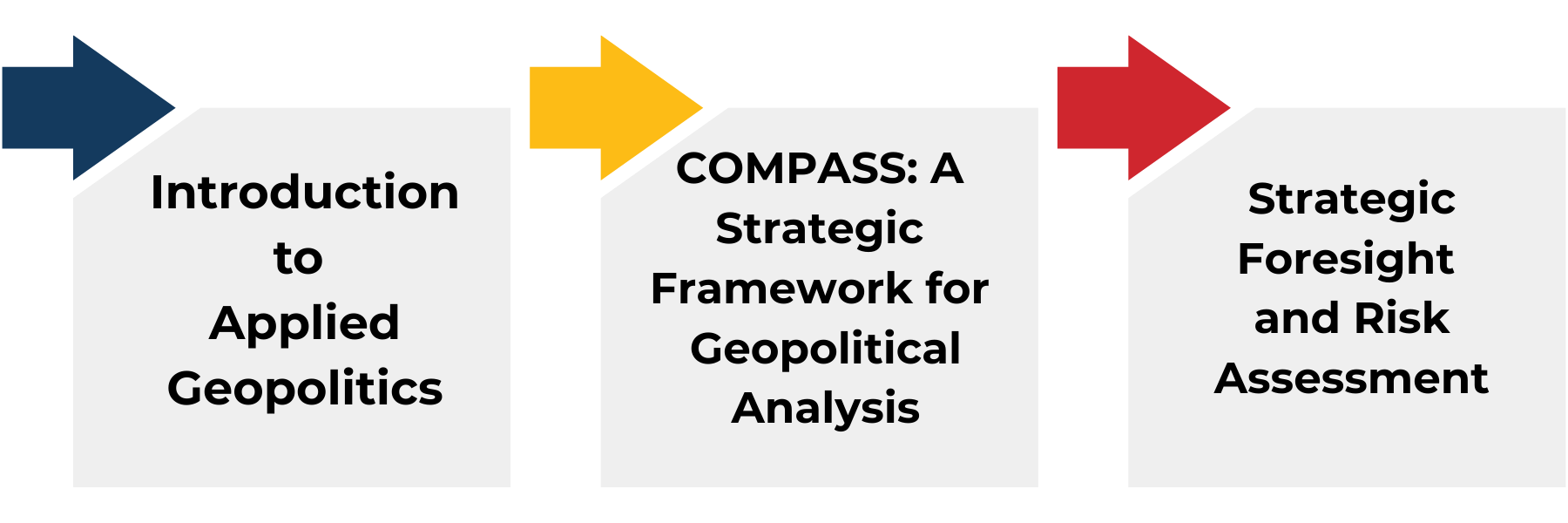
Strategic foresight extends structured geopolitical analysis into the future.

Frameworks such as COMPASS provide a systematic method for understanding current geopolitical environments. Strategic foresight builds on that foundation by introducing forward-looking methodologies that allow analysts to evaluate how those environments may change over time.

Together, these approaches support both situational understanding and anticipatory decision-making.

Course Structure and Delivery

Format: 8-week program
Delivery: Online, self-paced learning
Time Commitment: Approximately 4–6 hours per week
Level: Foundation, no prerequisites required
Platform: IAG Learning Management System

Learning Modules:
  1. What is Strategic Foresight?
  2. Framing the Right Strategic Foresight Question
  3. Horizon Scanning and Trend Analysis
  4. Scenario Planning
  5. Strategic Forecasting
  6. Risk Assessment: Part One
  7. Risk Assessment: Part Two
  8. Risk Mitigation and Future-Proofing
  9. Final Project: Comprehensive Foresight Report
The program culminates in a capstone project, where participants complete a comprehensive foresight report applying the methods taught in the course to a real-world geopolitical challenge.

This Program Is Designed For

The Strategic Foresight and Risk Assessment program is designed for professionals who require structured approaches to forward-looking analysis, including:

  
  • Business intelligence and competitive intelligence professionals
  • Corporate strategy and management consulting professionals
  • Economists and macroeconomic analysts
  • Policy analysts and government affairs professionals
  • Investment professionals and country risk analysts
  • Supply chain and enterprise risk managers
  • Security and intelligence analysts
  • Academic researchers and graduate students
  • International development practitioners

The program is particularly valuable for those who must:

  
  • Anticipate geopolitical developments before they materialize
  • Support high-stakes strategic decisions under uncertainty
  • Improve forecasting accuracy and analytical consistency
  • Integrate long-term uncertainty into planning processes
  • Build organizational capability in foresight and risk assessment

Building Professional Foresight Capability

Strategic foresight is not designed to deliver certainty. It is designed to improve decision-making under conditions of uncertainty.

Organizations that adopt structured foresight practices are better positioned to identify risk, evaluate alternatives, and respond to change with greater clarity and discipline.

This program provides the methodological foundation required to develop that capability.